
If you’ve ever stood in the security line trying to figure out how to pack sunscreen in checked luggage before your flight, you know that moment of complete and utter uncertainty — wondering if your SPF 50 is about to get confiscated or explode all over your carefully folded vacation clothes. It’s one of those things nobody really talks about until you’re mid-panic at the airport, sunscreen in hand.
Here’s the thing: most people overly stress about this. The rules around sunscreen in checked bags are actually more forgiving than most travellers realise, but there’s still a right way to do it if you don’t want your entire suitcase smelling like a coconut-scented disaster.
What TSA Actually Says About Sunscreen in Checked Baggage
The TSA (Transportation Security Administration) classifies sunscreen as a liquid, which puts it under the 3-1-1 rule if you’re carrying it in your carry-on. But in checked luggage? You’ve got a lot more freedom. You can bring sunscreen in checked bags in quantities far beyond 3.4 oz — typically up to 68 oz per item, and no more than 70 oz of aerosol or liquid products total in your checked bag.
According to the FAA’s Hazardous Materials regulations, flammable aerosol sunscreens (the spray kind) are permitted in checked luggage as long as each container doesn’t exceed 18 oz and the total doesn’t go over 70 oz across all toiletry-type aerosols. So your beach-ready spray SPF? Totally fine, just watch the quantities.
For lotion or cream sunscreens, the only real limit is weight — airlines typically have a 50 lb baggage limit, and nobody’s packing 50 pounds of sunscreen. Probably.
The Leak Problem Nobody Warns You About
Here’s what the official rules don’t cover: the messy reality of sunscreen leaking mid-flight. Cabin pressure changes during a flight can cause containers to leak, even ones that were perfectly sealed before you packed them. This is the actual thing you should be worried about — not whether TSA is going to take your SPF.
Lotion sunscreens are the worst offenders. The pressure differential is enough to push product out through the cap if it’s not sealed properly. Spray sunscreens with nozzle locks are a little safer, but they can still drip from the nozzle head if jostled around.
A 2019 travel survey by OnePoll found that nearly 1 in 4 travellers had experienced some kind of toiletry leak in their luggage. Sunscreen, along with shampoos and conditioners, ranked among the top culprits.
How to Actually Pack Sunscreen So It Doesn’t Explode
This is the practical bit you came here for. There’s a handful of techniques that frequent travellers swear by, and most of them are genuinely simple.
Use a sealable plastic bag — but do it right
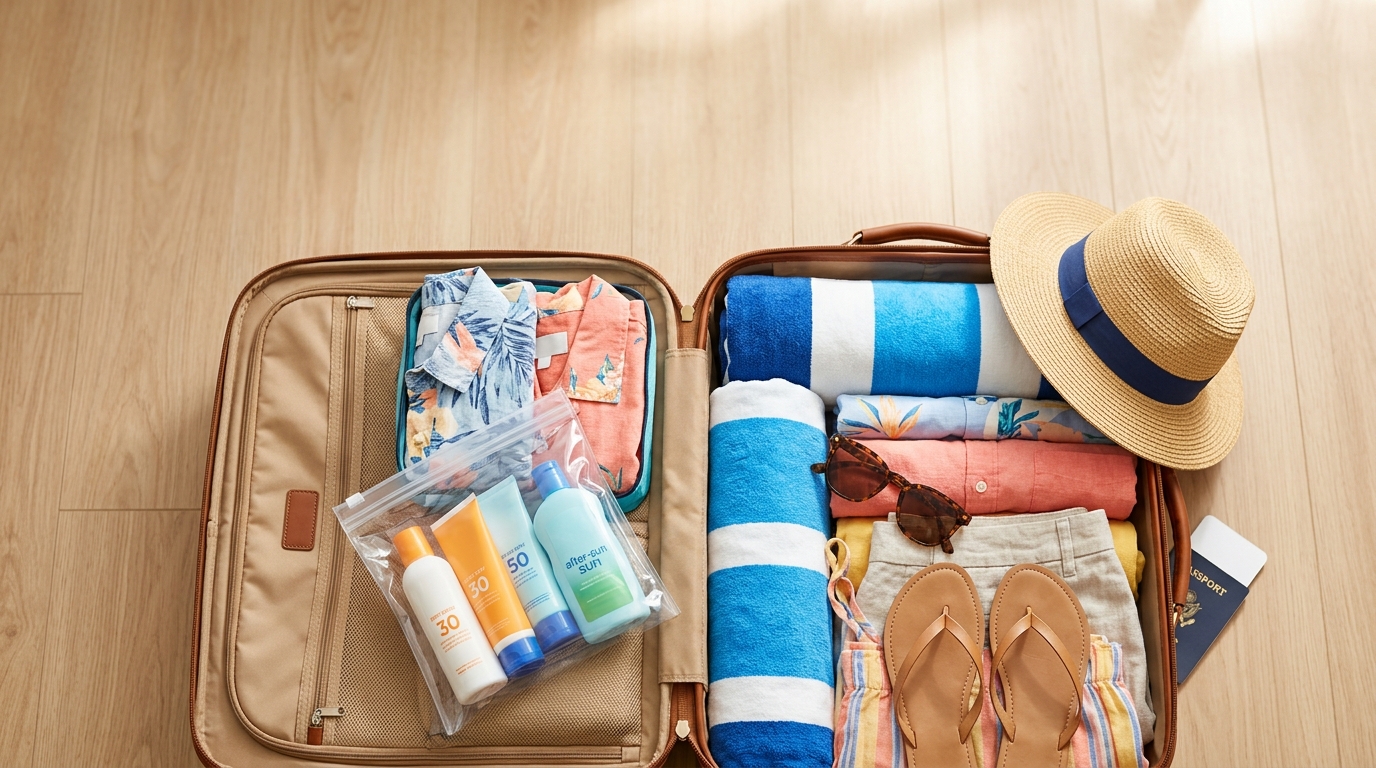
Almost everyone knows the Ziploc bag trick, but most people don’t actually execute it well. Put your sunscreen containers inside a quart-sized or gallon-sized freezer bag (not regular, freezer bags are thicker), squeeze out excess air before sealing, and then double-bag it. Freezer bags are more puncture-resistant and hold up better under pressure changes.
Tape the cap shut
This one sounds overly simple but its extremely effective. Put a strip of packing tape or even just masking tape around the cap of your sunscreen bottle before packing it. For aerosols, make sure the nozzle safety lock is engaged and then tape over it anyway. It adds about three seconds to your packing routine and can save your entire suitcase.
Wrap it in a cloth or clothing layer
Place your bagged sunscreen inside a sock, wrap it in a t-shirt, or tuck it into the center of a rolled-up sweater. This serves two purposes — cushioning in case of any impact, and containment if there is a leak so it doesn’t spread through your whole bag.
Don’t fill containers to the top
If you’re decanting sunscreen into a travel container, leave about 20% of the space empty. Liquid expands slightly under pressure, and giving it room means it’s less likely to force its way out through the seal.
Consider stick or solid sunscreen
Honestly, this is the easiest solution of all. Solid SPF sticks — there are good ones from brands like Supergoop, Raw Elements, and Coola — don’t have the same leak risk because they’re not liquid. They pack like a lip balm, no bag required, no tape needed. If you’re someone who regularly travels and finds liquid sunscreen to be a recurring headache, switching to a stick format for travel might just change your life.
Best Types of Sunscreen for Checked Luggage Travel
Not all sunscreen is created equally from a packing standpoint. Here’s a quick breakdown of which formats work best when they’re going in checked bags:
| Sunscreen Type | Leak Risk | TSA Rules (Checked Bag) | Best Practice |
|---|---|---|---|
| Lotion/Cream | High | No size limit (reasonable) | Double-bag + tape cap |
| Spray/Aerosol | Medium | Max 18 oz per can, 70 oz total | Lock nozzle + bag it |
| Gel | Medium-High | No size limit | Bag it, leave room in container |
| Stick/Solid | Very Low | No restrictions | Pack as-is, maybe a bag anyway |
| Powder SPF | Very Low | No restrictions | Just don’t crush the packaging |
Solid sticks and powder sunscreens are genuinely underrated from a travel perspective. The powder ones — which double as setting powder with SPF — are becoming more popular for exactly this reason.
Packing Sunscreen for International Flights: Extra Considerations
If you’re traveling internationally, the rules can shift a bit depending on your destination country’s customs and the airline you’re flying. Most countries follow IATA (International Air Transport Association) guidelines for liquids in checked bags, which align closely with FAA rules in the US.
However — and this is something a lot of people don’t think about — some countries restrict bringing in certain chemicals for environmental reasons. In places like Hawaii (which has its own state law now), Palau, and several Caribbean destinations, chemical sunscreen containing oxybenzone or octinoxate is actually banned or heavily restricted due to coral reef protection laws. This isn’t a luggage rule, it’s a legal restriction on what sunscreen you can use at the destination.
If you’re heading to any coastal or reef-adjacent destination, double-check the local laws around sunscreen ingredients. Mineral sunscreens with zinc oxide or titanium dioxide are generally the safe, reef-friendly choice and are accepted virtually everywhere.
How Much Sunscreen Should You Actually Bring?
Most people either pack way too much or forget to account for how much they actually go through on a beach holiday. The American Academy of Dermatology recommends about 1 oz of sunscreen per full-body application — roughly a shot glass worth. If you’re reapplying every two hours and spending eight hours outdoors, that’s four applications per day. For a week-long trip, that’s about 28 oz of sunscreen for one person.
A standard 8 oz bottle gets you through about 2 days of full coverage. So for a week, you’re realistically looking at three to four standard bottles, or one large 10–12 oz bottle and some top-up sticks.
Rather than bringing your entire home sunscreen supply, one smart strategy is to bring one full bottle of your preferred formula plus a couple of travel-sized backups, and then buy more at your destination if needed. Beach resorts and pharmacies at tropical destinations almost always stock sunscreen, often at comparable prices to back home.
What Happens if Your Sunscreen Leaks Anyway?
First — don’t panic. A sunscreen leak is annoying, not catastrophic, if you’ve packed smartly. Here’s what to do:
Remove everything from your suitcase and assess what’s affected. Most sunscreens, especially mineral ones, won’t stain fabric permanently if treated quickly. Rinse the affected clothing in cold water immediately (hot water can set the oily residue deeper into fibers).
For your suitcase lining, use a damp cloth to wipe down the interior. A small amount of dish soap or laundry detergent on a cloth helps lift the oily sunscreen residue. Allow it to air dry before repacking.
Aerosol sunscreen leaks are more of a mess than a stain issue — the propellant disperses and leaves a greasy film. Same treatment: damp cloth, mild soap, air dry.
A Few Things Frequent Flyers Actually Do
People who travel a lot have developed their own systems. Here are a few that actually work well in practice:
Packing sunscreen upright is something most people skip, but it genuinely reduces the chance of the cap area being under constant product pressure during the flight. If your checked bag is packed so your sunscreen sits vertically with the cap up, you’re already ahead.
Buying a dedicated travel toiletry bag with a waterproof inner lining is worth the investment if you travel more than a couple of times a year. These are specifically designed so that if something leaks, it stays contained. Brands like Muji, Baggallini, and Eagle Creek make good options.
Some travellers also vacuum-seal their sunscreen inside a small vacuum bag — the kind you use for clothing compression. This eliminates virtually all of the pressure-related leak risk by removing air from the equation entirely, though it does mean you can’t access the sunscreen easily once packed.
Packing Sunscreen in Checked Luggage: The Short Version
If your brain glazed over and you just want the bullet points, here’s what matters:
- Lotion and cream sunscreens have no strict size limit in checked bags, but aerosol sprays max out at 18 oz per can and 70 oz total
- The real risk is leaking from pressure changes, not TSA confiscation
- Double-bag in freezer bags, tape your caps, and pack sunscreen surrounded by soft items
- Solid SPF sticks are the easiest travel sunscreen and basically eliminate the leak problem
- For international travel, check if your destination restricts chemical sunscreen ingredients (oxybenzone, octinoxate)
- Estimate 1 oz per full-body application and plan your quantity accordingly
Packing sunscreen doesn’t have to be this big complicated ordeal. It’s really just about knowing the rules, anticipating the actual risk (leaks, not confiscation), and taking five extra minutes to pack it smart. Once you’ve got a system, you’ll never stress about it again — which means more mental energy for actually enjoying the sun you packed all that SPF for.