
So you’ve been using micellar water to remove sunscreen and honestly wondering if it’s actually doing anything — yeah, that’s a really valid concern and you’re not alone in that. A lot of people reach for their micellar water at the end of the day thinking they’ve done a thorough cleanse, only to realise their skin still feels a little… off. Maybe slightly greasy, or you’re breaking out more than usual, and you can’t quite figure out why.
The truth is kind of complicated, and it depends heavily on the type of sunscreen you’re wearing. Let’s get into it properly.
What Micellar Water Actually Does (And How It Works)
Micellar water is made up of tiny surfactant molecules called micelles suspended in soft water. These micelles have a hydrophilic (water-loving) outer layer and a lipophilic (oil-loving) core, which basically means they can attract and lift away oil-based impurities, light makeup, and dirt from the skin’s surface without you having to rinse.
The appeal is obvious. No rinsing, no scrubbing, just swipe and go. French pharmacies have been selling it for decades, and it became a mainstream staple partly because it’s so gentle. Dermatologists often recommend it for sensitive or reactive skin types precisely because it doesn’t disrupt the skin barrier the way some foaming cleansers can.
But gentle doesn’t necessarily mean thorough. And this is where sunscreen gets… tricky.
Chemical vs Physical Sunscreen — Why It Matters Here
Before you can answer whether micellar water removes sunscreen properly, you have to think about what kind of sunscreen you’re actually using.
Chemical (organic) sunscreens contain UV-absorbing ingredients like avobenzone, octinoxate, oxybenzone, or homosalate. These sit within the upper layers of the skin rather than on top of it, which means they’re more deeply absorbed and therefore harder to remove with a light swipe of micellar water.
Physical (mineral) sunscreens contain zinc oxide or titanium dioxide. These sit on top of the skin and form a physical barrier. They’re often thicker in texture and can leave that white cast some people hate. Interestingly, because they sit on the surface, they might be slightly easier to lift away — but they’re also often formulated with heavier emollients to help them stay put.
Hybrid sunscreens combine both, and these are increasingly common, especially in Asian skincare formulas.
A 2021 study published in the Journal of Cosmetic Dermatology examined how effectively different cleansing methods removed SPF products, and it found that single-step cleansing — including with micellar water — left significant SPF residue on the skin in most cases. That’s not nothing.
Can Micellar Water Remove Sunscreen? The Honest Answer
It can remove some of it. Probably not all of it, and definitely not consistently.
Micellar water works reasonably well on lighter, water-resistant sunscreens with a more fluid texture. If you’re using a very light Korean sunscreen that feels almost like water itself, a thorough wipe with a micellar water-soaked cotton pad will do a decent job. But if you’re using a sport sunscreen or a waterproof, long-wear formula — the kind that’s designed to survive swimming and sweating — micellar water is genuinely not enough on its own.
This isn’t just opinion. Dermatologists including Dr. Mona Gohara have noted publicly that most micellar waters aren’t formulated to break down the film-forming agents in modern sunscreens. These agents are specifically designed to be resistant to water and light rubbing. Micellar water, by design, is gentle — and gentleness has its limits.
If you’ve ever done the “white tissue test” after using micellar water — pressing a dry white tissue to your face after you think it’s clean — and seen colour or residue transfer, that’s the evidence right there.
The Double Cleanse Method And Why It’s Genuinely Useful
The double cleanse method originated in Japanese and Korean skincare culture and has been widely adopted by dermatologists and facialists worldwide. The basic premise is:
Step 1: Use an oil-based cleanser, cleansing balm, or oil cleanser to break down sunscreen, makeup, and sebum.
Step 2: Follow with a gentle water-based cleanser to remove any remaining residue.
This two-step process is consistently recommended by skin experts as the most effective way to ensure sunscreen is fully removed without damaging the skin barrier.
Cleansing oils and balms work on a like-dissolves-like principle — oil dissolves oil-soluble ingredients such as the filters and waxes in sunscreens. They’re significantly more effective at this than micellar water, which doesn’t have the same solubilising power.
Some popular options used widely:
- Cleansing balms with mineral oil or jojoba oil base
- Cleansing oils with lightweight emulsifying formulas that rinse clean
- Cream cleansers with high emollient content
The second cleanse then removes the oily residue from step one, leaving skin genuinely clean without stripping it.
When Micellar Water Is Actually Enough
There are genuinely situations where micellar water alone is fine, and its worth being honest about that rather than just saying “always double cleanse” without nuance.
If you applied a very thin layer of a light, non-waterproof sunscreen and spent most of your day indoors — like you put on SPF in the morning and went straight to an office — then the amount of residue on your skin by evening is relatively minimal. A thorough wipe with a good quality micellar water (particularly ones formulated with stronger surfactant systems, like Bioderma Sensibio H2O or La Roche-Posay’s Micellar Water Ultra) would likely remove that adequately.
Key factors that influence this:
| Situation | Micellar Water Alone: Adequate? |
|---|---|
| Light SPF, spent day indoors | Probably yes |
| Waterproof SPF, outdoor activity | No — double cleanse needed |
| Sweat-resistant sport SPF | No |
| Reapplied SPF multiple times | No |
| Tinted SPF or SPF with makeup | Almost certainly no |
It’s also worth noting that not all micellar waters are equal. Some are basically just soft water with a tiny bit of surfactant — these are unlikely to remove much beyond superficial dust and light makeup. Others are specifically formulated with stronger cleansing ability, and these perform considerably better on heavier products.
What Happens If You Don’t Remove Sunscreen Properly
This is the part that actually matters, skin-wise. Leaving sunscreen residue on your face overnight can cause a few different problems depending on your skin type.
For oily or acne-prone skin, unremoved sunscreen can mix with sebum and dead skin cells and block pores. Chemical filters in particular can be comedogenic for some people, and this partly depends on your individual skin chemistry. If you’ve noticed more breakouts since starting a new sunscreen, incomplete removal could absolutely be a contributing factor.
For dry or sensitive skin, the issue is slightly different. Some people with these skin types are actually more tolerant — a thin layer of residue might even have an incidental moisturising effect overnight. But the preservatives, fragrance, and film-forming agents in most sunscreens aren’t something your skin is designed to sit with for eight hours. Irritation and sensitivity can develop over time.
There’s also the issue of active skincare ingredients not being able to penetrate properly. If you apply a retinol or an AHA serum at night over sunscreen residue, you’re essentially wasting it — it can’t reach the skin cells it’s meant to work on. This is probably the most overlooked consequence of lazy sunscreen removal.
Does It Make A Difference Which Micellar Water You Use
Genuinely, yes. The formulation matters quite a lot, and this is something that doesn’t get discussed enough.
Micellar waters with a higher concentration of surfactants, or those that specifically include an oily or lipid phase, will outperform basic gentle versions when it comes to sunscreen removal. Garnier’s Micellar Cleansing Water with Rose is marketed as gentle and is lovely for light daily use, but it’s not the same as Bioderma’s more clinically formulated versions in terms of actual cleansing power.
Some micellar waters now incorporate biphasic technology — a combination of a water phase and an oil phase that you shake together before use — and these perform significantly better on heavier products including waterproof SPF. These are a better bet if you want to stick to a single cleansing step.
That said, even these have their ceiling, especially for high-SPF waterproof formulas designed for outdoor sport or swimming.
A Note on Technique
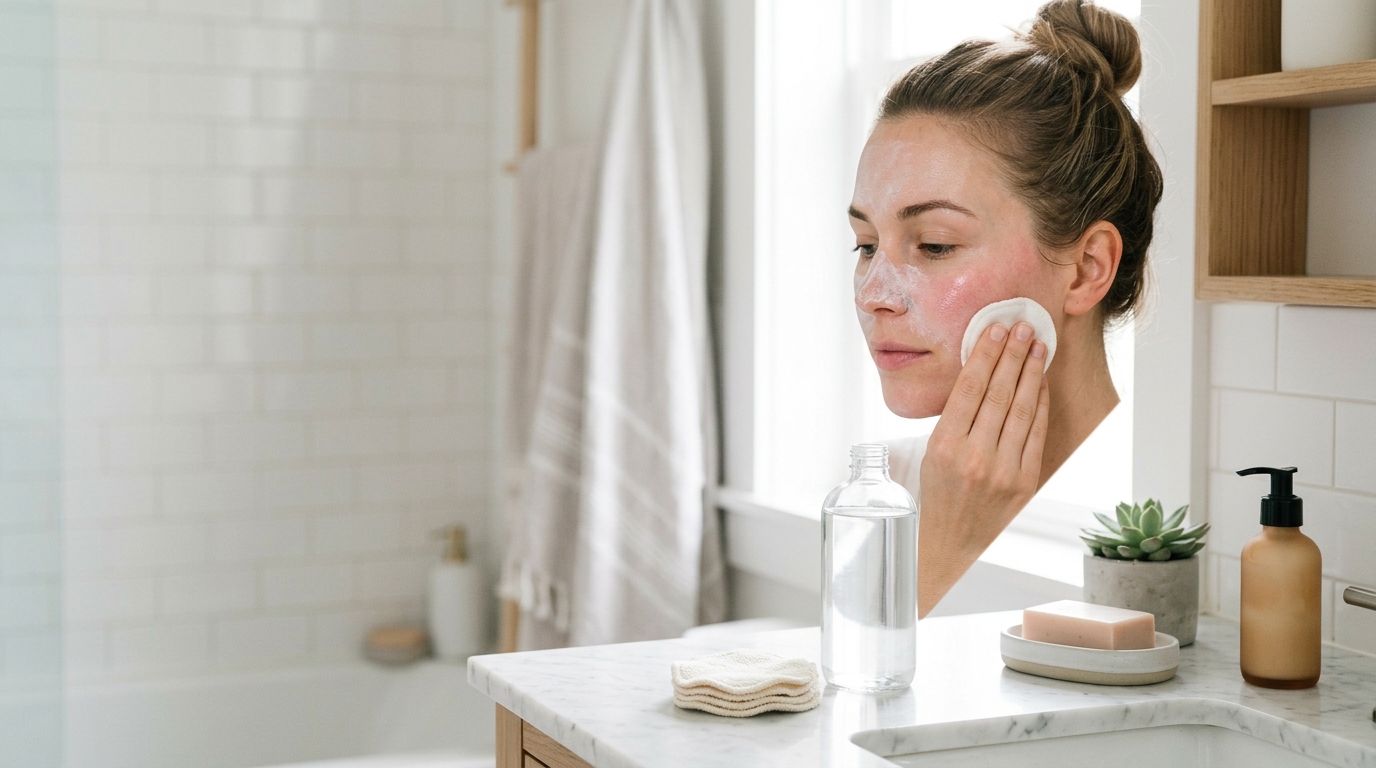
How you apply micellar water matters too, and people almost never talk about this. Rapid, aggressive wiping actually removes less product than holding a soaked cotton pad gently against the skin for 20-30 seconds first, then wiping. The dwelling time allows the micelles to actually bind to the sunscreen before you try to remove it.
Using a cotton pad rather than a cloth also helps because the cotton fibres provide gentle mechanical exfoliation that assists in lifting residue. Reusable cotton rounds work just as well and are more sustainable — just make sure you’re washing them properly between uses because they harbour bacteria otherwise, and that would kind of defeat the whole point.
The Practical Takeaway
If you’re using a light, non-waterproof sunscreen on a day spent mostly indoors, micellar water is probably doing its job reasonably well. But for most real-world sunscreen use — high SPF, waterproof formulas, outdoor days, reapplication throughout the day — it genuinely isn’t sufficient on its own.
The double cleanse method remains the gold standard recommendation from dermatologists for thorough sunscreen removal, and the evidence for this is pretty consistent. An oil-based first cleanse followed by a water-based second cleanse takes maybe an extra 60 seconds and makes a real difference to your skin clarity, your active ingredient absorption, and your long-term skin health.
Micellar water is a brilliant product for what its designed to do — gentle everyday cleansing and light makeup removal. It just wasn’t built to tackle the specific chemistry of modern sunscreen formulas, and expecting it to do that job fully is setting yourself up for skin issues you might not immediately connect to your cleansing routine.