

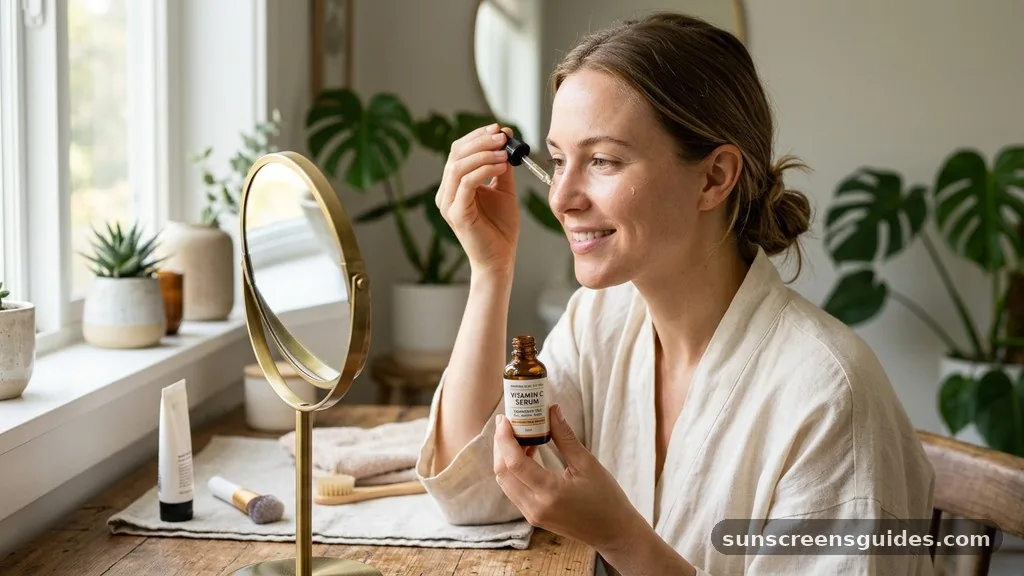
Deciding whether you should use vitamin c serum day or night often depends on your specific skin goals and how your complexion reacts to potent active ingredients. While many enthusiasts default to a morning application to leverage its protective benefits, others find that nighttime use fits better into their personal ritual. Understanding the chemistry behind this powerhouse helps you determine the optimal timing for your unique needs.
By balancing the product’s function as an environmental shield against its ability to aid overnight repair, you can craft a routine that maximizes visible improvements. This article breaks down the science so you can confidently schedule your glow-boosting applications.
The Case for Morning Application

Most dermatologists recommend applying vitamin C in the morning because it provides critical antioxidant protection against external stressors. Throughout the day, your skin faces constant exposure to pollution and infrared radiation, which can trigger the creation of free radicals. These unstable molecules contribute significantly to photoaging, breaking down structural proteins and dulling your natural radiance.
When you apply a high-quality L-ascorbic acid serum before stepping outside, you create a reservoir of protection. Think of it as a secondary line of defense that works alongside your broad-spectrum sunscreen.
While your SPF blocks incoming rays, the serum neutralizes the free radicals that might bypass your sunscreen. This synergy is particularly effective at preventing the cumulative UV damage that leads to long-term issues like fine lines and uneven texture.
Why Nighttime Use Might Be Superior
While morning is standard, some users prefer nocturnal application to avoid the potential instability of the formula during the day. Vitamin C, especially in its pure L-ascorbic acid form, can be sensitive to light and oxidation. If you work in an environment where your face is constantly exposed to direct sunlight or if you use other incompatible active ingredients in the morning, moving the serum to your evening routine makes sense.
Night is when your skin enters its primary recovery phase. Using a serum during this window allows the topical application to work without the interference of environmental aggressors.
Furthermore, for those with sensitive skin, nighttime use reduces the risk of photosensitivity. It allows the formula to penetrate deeply and support collagen synthesis while your body is at rest, providing a calm environment for the ingredients to do their work.
Addressing Sensitivity and Potency
A common concern involves how different forms of the ingredient interact with your skin barrier. If you find that a daytime application causes redness or stinging, the concentration or the pH level of the product might be too high for your current tolerance.
Balancing Strength and Tolerance
- Start with a lower concentration, such as 5% or 10%, to gauge your skin’s initial reaction.
- Ensure your skincare layering is correct by applying the serum on dry, clean skin before heavier creams.
- Avoid mixing your serum with retinoids or AHAs in the same sitting, as this can trigger irritation.
- Monitor your skin for signs of a compromised barrier, such as excessive dryness or tight, uncomfortable sensations.
If you experience irritation, switching to a more stable derivative like sodium ascorbyl phosphate or magnesium ascorbyl phosphate can allow for more flexible timing. These derivatives are often less acidic than L-ascorbic acid, making them gentler for both morning and evening use.
Comparison of Timing Benefits
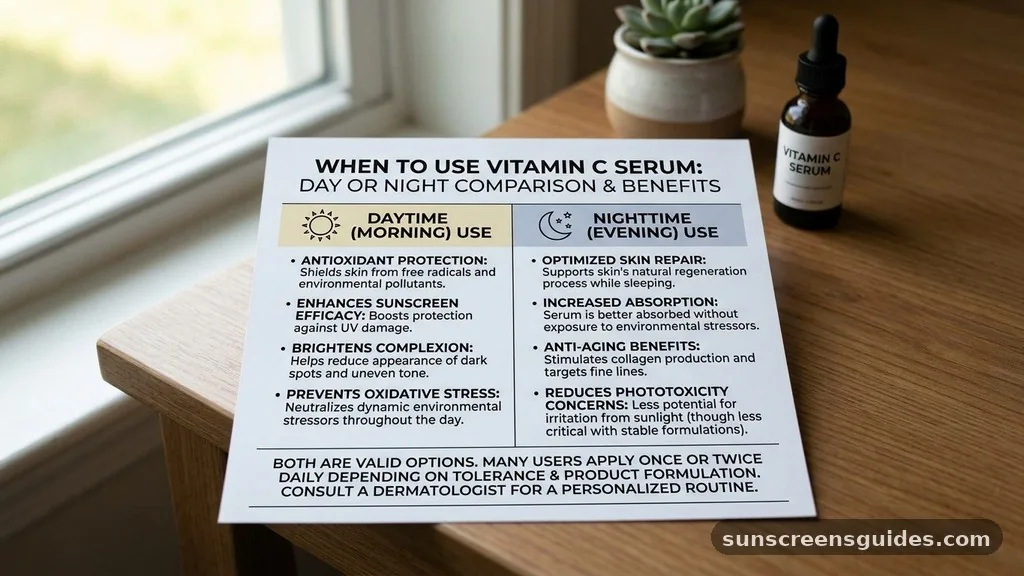
Choosing the right time depends on what you want to achieve. The following table illustrates how timing influences the primary function of your serum.
| Timing | Primary Benefit | Target Goal |
|---|---|---|
| Morning | Environmental Defense | Neutralizing free radicals and UV protection |
| Evening | Repair and Brightening | Addressing hyperpigmentation and collagen support |
| Both | Maximum Saturation | Aggressive treatment for dark spots |
Managing Shelf Life and Oxidation
The efficacy of your serum is heavily tied to its shelf life and how it is stored. Because the ingredient is notoriously unstable, it can lose potency quickly if exposed to air, heat, or light. You will notice a change in the product’s color—if it turns from clear or pale yellow to a dark orange or brown, it has likely oxidized.
Once oxidation occurs, the product not only loses its antioxidant protection but can also become irritating to the skin. To preserve your investment, store your bottle in a cool, dark place, such as a drawer or a refrigerated skincare cabinet.
Always tighten the cap immediately after each use to minimize air exposure. Even if you haven’t finished the bottle, replace it within three to six months to ensure you are applying an active, functional product rather than an inert liquid.
Common Topical Gaps
Many users struggle with the confusion between skin brightening and exfoliation. People often assume that because a serum makes the skin look “glowy,” it must be an exfoliant. However, these products are primarily focused on neutralizing oxidative stress and inhibiting melanin production, which helps fade hyperpigmentation.
Another gap in knowledge is the layering order. Many people apply their serum after their moisturizer, which is incorrect. Because serums have a smaller molecular weight, they must touch the skin first to be absorbed effectively.
If you apply a thick, occlusive cream first, the serum will sit on the surface, unable to reach the deeper layers where it can stimulate production. Always cleanse, apply your serum, wait sixty seconds for it to dry, and then follow with moisturizer.
Conclusion
Ultimately, the choice of when to use vitamin c serum day or night comes down to your personal lifestyle and skin needs. Most users benefit most from a morning application to leverage its protective qualities against daily pollutants and radiation. However, if your skin is particularly reactive or your morning routine is already crowded with other actives, incorporating the serum into your evening ritual is a perfectly valid alternative.
Consistency remains far more important than the specific time of day you choose. By prioritizing quality, storage, and correct layering, you ensure your skin receives the full benefits of this essential nutrient. Experiment with your schedule to see what yields the best results for your complexion, and don’t hesitate to adjust based on how your skin feels.
Frequently Asked Questions
Can I apply vitamin C serum twice a day?
Yes, you can use it twice daily, though it may increase the risk of irritation for sensitive skin.
Does vitamin C make my skin more sun-sensitive?
No, it actually acts as a secondary shield, though it does not replace the need for daily sunscreen.
Should I apply serum before or after moisturizer?
Always apply your serum to clean, dry skin before your moisturizer to ensure proper absorption and deep efficacy.
How do I know if my serum has oxidized?
If the liquid turns dark orange or brown, the product has oxidized and should be discarded immediately.
Can I use vitamin C with retinol?
It is generally best to separate them, using vitamin C in the morning and retinol at night.
Does it help with acne scarring?
Yes, it promotes collagen synthesis and inhibits melanin, which helps fade dark spots and persistent acne scars.
How long until I see results?
Most people see visible improvements in brightness and tone after consistent use for six to eight weeks.



