

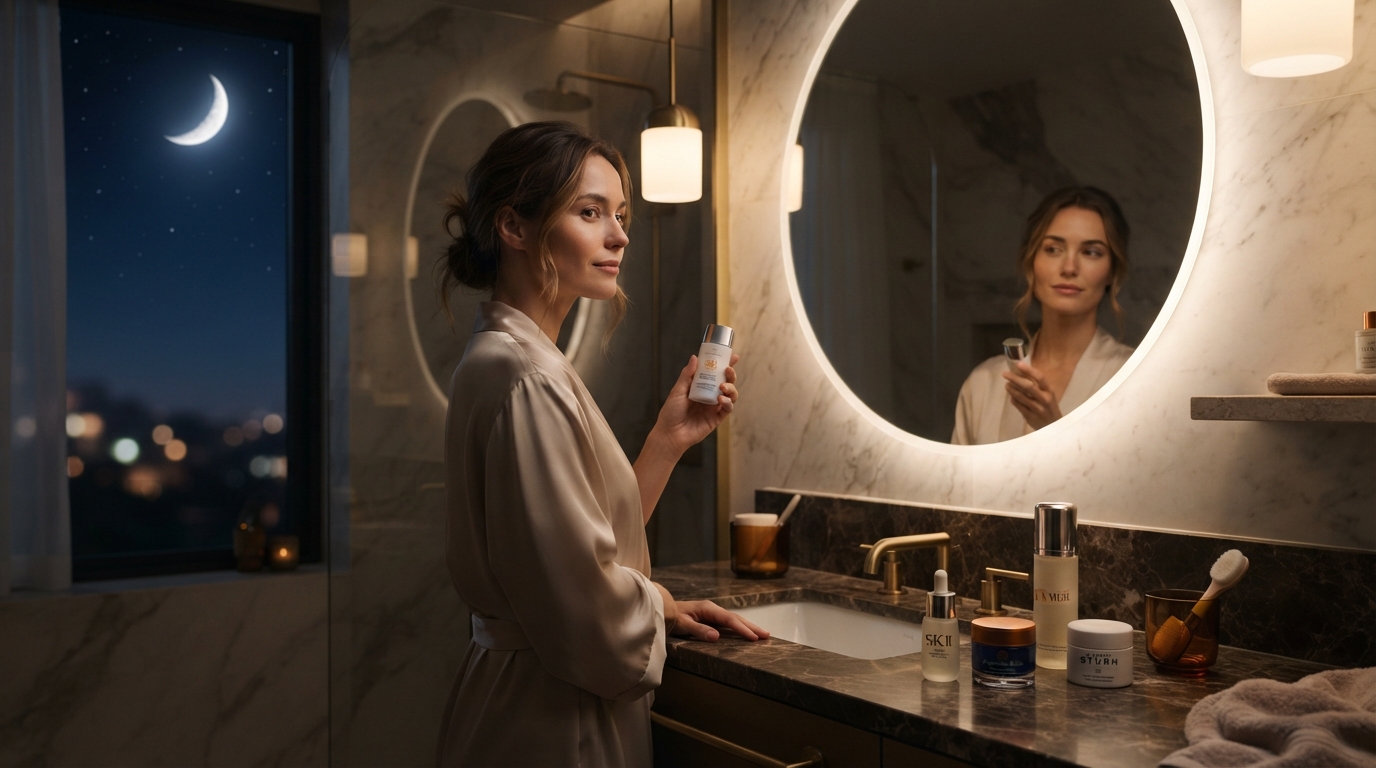
You were probably standing in front of the bathroom mirror wondering, should I put sunscreen on at night, because your evening skincare routine already has five bottles and somehow another idea sneaked into your head. It happens more often than people admit. One skincare video says never skip sunscreen. Another says protect your skin at all times. Then somebody casually mentions blue light from screens and suddenly you start looking at your sunscreen tube before bed. Kinda confusing, honestly. The good news is that the answer is much simpler than the internet sometimes makes it seem.
The short version is this: for most people, wearing sunscreen at night is unnecessary. Sunscreen is designed to protect your skin from ultraviolet (UV) radiation, and at night the sun isn’t exposing your skin to UV rays. Instead of adding sunscreen to your nighttime routine, you’re usually much better off focusing on cleansing, moisturizing, hydration, and ingredients that help your skin repair itself while you sleep.
Still, there are a few interesting exceptions, a handful of myths worth clearing up, and some science that explains why this question keeps coming back. Let’s dig into it.
Should You Put Sunscreen on at Night?
For nearly everyone, the answer is no.
Sunscreen is formulated to block, absorb, or scatter ultraviolet radiation from sunlight. Once the sun goes down, that specific job no longer exists. Applying sunscreen before sleeping doesn’t suddenly create extra protection or improve your skin overnight. In fact, it may simply leave unnecessary ingredients sitting on your face for hours.
Your skin has different priorities during the day and at night.
| Daytime Routine | Nighttime Routine |
|---|---|
| UV protection | Skin repair |
| Antioxidants | Moisturizers |
| Sunscreen | Retinoids (if appropriate) |
| Lightweight hydration | Barrier repair ingredients |
Think of sunscreen like an umbrella. Carrying one while you’re sleeping indoors isn’t harmful most of the time, but it isn’t helping either. Thats probably the easiest way to picture it.
Why Sunscreen Exists in the First Place
Understanding sunscreen’s purpose makes the answer pretty obvious.
Ultraviolet radiation reaches Earth’s surface mainly as:
- UVA rays
- UVB rays
Both contribute to skin damage in different ways.
UVA rays penetrate deeper into the skin and are largely responsible for premature aging, wrinkles, and long-term collagen breakdown. UVB rays mainly affect the skin’s surface and are the primary cause of sunburn.
According to the American Academy of Dermatology (AAD), regular sunscreen use helps reduce the risk of skin cancer and slows visible signs of aging caused by UV exposure.
Notice something important here?
Every benefit comes back to UV exposure. Without UV rays, sunscreen has no meaningful target.
What Happens to Your Skin at Night?
Nighttime is when your skin naturally shifts into repair mode.
Research suggests several biological processes become more active while you sleep:
- Increased cell turnover
- Enhanced skin barrier recovery
- Greater water loss from the skin
- Increased production of certain repair proteins
Because of these nighttime changes, skincare experts usually recommend products that nourish rather than shield.
Common nighttime ingredients include:
- Ceramides
- Hyaluronic acid
- Niacinamide
- Retinol
- Peptides
- Glycerin
These ingredients support recovery instead of protecting against sunlight. It sounds kinda backwards at first, but your skin’s needs really do change after sunset.
Can Sunscreen Damage Your Skin Overnight?
Usually not.
Most modern sunscreens are tested for skin safety and won’t suddenly become harmful because it’s nighttime.
However, wearing sunscreen overnight may create small issues for some people.
Possible drawbacks include:
- Extra oiliness
- Clogged pores
- Acne breakouts
- Sticky feeling
- Product buildup
- Reduced effectiveness of other nighttime treatments
People with oily or acne-prone skin might notice these problems more often than others. If your sunscreen contains silicones or heavier emollients, leaving it on unnecessarily may increase congestion over time.
Is It Bad If You Accidentally Sleep With Sunscreen On?
Not really.
If you’ve come home exhausted and fallen asleep before washing your face, don’t panic.
One night probably won’t cause significant damage.
What matters more is making it a habit.
Sleeping with sunscreen occasionally is far different from intentionally applying fresh sunscreen every night.
If you forget once, simply wash your face the next morning and continue your normal routine.
Should I Put Sunscreen on at Night if I’m Near Windows?
This is where things become a little more interesting.
At night, windows aren’t the concern.
During daylight hours, however, UVA rays can pass through ordinary window glass.
If you’re sitting beside a large sunny window during the day—even indoors—daily sunscreen remains a smart choice.
At night there is essentially no sunlight producing meaningful UV exposure through your windows.
Streetlights, porch lights, and indoor lighting simply don’t emit UV radiation at levels requiring sunscreen.
So no, you don’t need sunscreen because your bedroom has a window. That idea gets repeated online quite alot, honestly.
What About Blue Light From Phones?
Blue light has become one of skincare’s biggest debates.
Laboratory studies have shown that extremely high levels of visible blue light can affect skin cells under controlled conditions.
But here’s the important detail.
The amount of blue light coming from your smartphone, tablet, or laptop is dramatically lower than what researchers typically use in experiments.
The Skin Cancer Foundation and many dermatologists agree that everyday electronic devices do not produce enough blue light to justify wearing sunscreen before bed.
If you’re concerned about blue light, antioxidants in skincare may offer more practical support than sunscreen.
Are Mineral and Chemical Sunscreens Different at Night?
Both serve the same purpose.
Mineral sunscreens typically contain:
- Zinc oxide
- Titanium dioxide
Chemical sunscreens often include ingredients like:
- Avobenzone
- Octinoxate
- Octisalate
- Homosalate
Whether mineral or chemical, neither becomes especially beneficial during nighttime because UV radiation isn’t present.
Choosing between them matters during daytime use—not while sleeping.
What Should You Apply Instead of Sunscreen at Night?
A nighttime routine should focus on restoration.
Here’s a simple example.
| Skin Concern | Recommended Night Ingredient |
|---|---|
| Dry skin | Ceramides |
| Fine lines | Retinol |
| Dullness | Niacinamide |
| Dehydration | Hyaluronic acid |
| Weak skin barrier | Panthenol |
| Sensitive skin | Colloidal oatmeal or ceramides |
You don’t need ten products.
A gentle cleanser, moisturizer, and one treatment product often work beautifully.
Sometimes simpler actually wins. Weirdly enough, adding more products can make skin angrier instead of happier.
Does Wearing Sunscreen Overnight Improve Anti-Aging?
No evidence suggests that sleeping with sunscreen slows aging.
What prevents photoaging is wearing sunscreen during UV exposure.
Once nighttime arrives, anti-aging ingredients become much more useful.
Dermatologists often recommend:
- Retinoids
- Vitamin C during daytime
- Peptides
- Moisturizers
- Consistent sleep
- Healthy nutrition
These strategies have much stronger scientific support for maintaining youthful skin.
What Dermatologists Usually Recommend
Most board-certified dermatologists suggest separating daytime and nighttime skincare goals.
During the day:
- Cleanse
- Moisturize if needed
- Apply broad-spectrum SPF 30 or higher
- Reapply every two hours outdoors
At night:
- Remove sunscreen completely
- Wash away pollution and oil
- Apply treatment products
- Finish with moisturizer
This approach supports both protection and repair.
Common Myths About Wearing Sunscreen at Night
Several myths continue floating around social media.
Myth: Sunscreen repairs skin overnight.
False.
Sunscreen prevents UV damage but doesn’t actively repair skin while you sleep.
Myth: Indoor lights require sunscreen.
False.
Normal household lighting doesn’t emit enough UV radiation to justify sunscreen.
Myth: Sleeping with sunscreen gives extra protection tomorrow morning.
False.
Most sunscreen gradually wears away, rubs off on pillows, and becomes less effective long before sunrise.
Myth: More sunscreen means healthier skin.
Not necessarily.
Using products when they’re actually needed is more effective than applying everything all the time.
Scientific Evidence Supporting Daytime Sunscreen Use
Several major studies have shown impressive benefits from regular sunscreen use.
One landmark Australian trial found that participants using sunscreen daily showed significantly less skin aging over several years compared with those using sunscreen less consistently.
Other research has demonstrated reductions in:
- Actinic keratoses
- Squamous cell carcinoma
- Melanoma risk with consistent sun protection
- Hyperpigmentation caused by UV exposure
These benefits all occurred because sunscreen was used during sun exposure, not during sleep.
As dermatologist Dr. Zoe Diana Draelos has noted:
“Sunscreens are designed to protect skin from ultraviolet radiation.”
That simple sentence pretty much answers the whole question.
When Might Someone Wear Sunscreen at Night?
There are only a few unusual situations.
These might include:
- Working overnight outdoors before sunrise
- Traveling across time zones where daylight begins unexpectedly
- Sleeping briefly during daylight after a night shift
In these cases, sunscreen timing should match sun exposure, not the clock itself.
If your “night” actually happens under daylight because of work schedules, sunscreen still makes sense before UV exposure.
Building a Smarter Evening Routine
Instead of reaching for sunscreen, consider this order:
- Remove makeup.
- Wash away sunscreen from the day.
- Apply treatment serum if needed.
- Moisturize thoroughly.
- Let your skin rest overnight.
This routine supports the skin’s natural repair cycle without adding unnecessary layers.
Consistency matters much more than complexity. People often chase perfect skincare routines when a boring routine done every day quietly beats an exciting one done once a week.
Final Thoughts
If you’ve been asking yourself, should I put sunscreen on at night, the evidence points toward a clear answer: in almost every situation, no. Sunscreen is one of the most effective skincare products ever developed, but its effectiveness depends entirely on exposure to ultraviolet radiation. Without sunlight, it has very little purpose.
Instead, allow your nighttime routine to focus on recovery. Clean away the day’s sunscreen, nourish your skin with moisturizing and repairing ingredients, and let your skin perform the remarkable repair work it naturally does while you sleep. Then, when morning arrives, apply a broad-spectrum sunscreen before heading into daylight. That’s when it truly earns its place in your skincare routine.
Should I put sunscreen on at night if I stay indoors?
No. Indoor nighttime environments lack meaningful UV exposure, so sunscreen offers little benefit. Cleanse your skin instead and use moisturizing or repairing skincare products.
Can sleeping with sunscreen clog pores?
Yes, it can for some people. Heavy sunscreen formulas may trap oil and debris overnight, increasing the chance of clogged pores or occasional breakouts.
Should I remove sunscreen before going to bed?
Yes. Washing off sunscreen helps remove dirt, oil, pollution, and product buildup, allowing nighttime skincare ingredients to work more effectively while you sleep.
Does blue light from my phone mean I need sunscreen at night?
Current evidence suggests no. Everyday phones and laptops emit far less blue light than levels used in laboratory studies affecting skin.
What should I apply instead of sunscreen before bed?
Choose a gentle moisturizer and ingredients like ceramides, hyaluronic acid, niacinamide, or retinol, depending on your skin type and personal skincare goals.