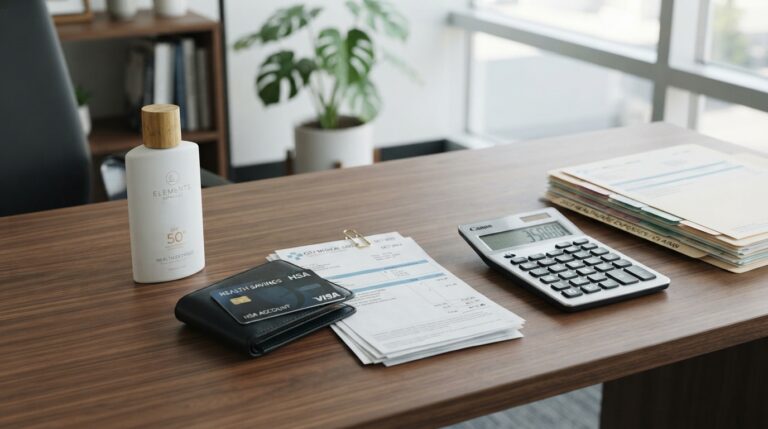

You’ve probably caught yourself wondering, can you buy sunscreen with HSA, especially when you’re standing in a store comparing prices and realizing that skincare somehow gets expensive faster than expected. It’s a fair thing to wonder, honestly. Nobody likes paying out of pocket if they don’t have to, and HSA money already belongs to you anyway. The tricky bit is that sunscreen doesn’t always play by the same rules as other healthcare products, and that’s where people get kinda mixed up.
The good news is that many sunscreens do qualify for HSA purchases, but not every bottle sitting on the shelf will. A few details matter more than most shoppers realize, and understanding those details can help you avoid rejected purchases or unnecessary spending.
What Is an HSA?
A Health Savings Account (HSA) is a tax-advantaged savings account available to people enrolled in a qualified High Deductible Health Plan (HDHP). The money deposited into an HSA can be used for eligible medical expenses without paying federal income tax on those funds.
An HSA offers three major tax benefits:
- Contributions are tax-deductible.
- Earnings grow tax-free.
- Qualified medical withdrawals are tax-free.
That combination makes an HSA one of the most tax-efficient accounts available in the United States. It’s almost like getting rewarded three different times for planning ahead, which is not something taxes usually do.
So, Can You Buy Sunscreen With HSA?
Yes, in many cases you can.
Under current IRS guidelines, sunscreen qualifies as an eligible medical expense when it meets specific requirements. The biggest requirement is the Sun Protection Factor (SPF).
Generally, sunscreen must:
| Requirement | Eligible? |
|---|---|
| SPF 15 or higher | Yes |
| Used to prevent sun damage | Yes |
| Regular cosmetic lotion without sun protection | No |
| Makeup with insignificant SPF | Usually No |
The rule became much clearer after updates following the CARES Act, which expanded eligibility for several over-the-counter healthcare products.
That means a standard SPF 30 sunscreen used to help prevent skin damage from ultraviolet radiation is generally HSA eligible.
Why Does the IRS Consider Sunscreen a Medical Expense?
Years ago, sunscreen wasn’t always viewed as preventive healthcare. Today, medical research tells a different story.
Ultraviolet (UV) radiation contributes to:
- Skin cancer
- Premature aging
- Sunburn
- DNA damage
- Hyperpigmentation
- Immune suppression of skin cells
Dermatologists consistently recommend daily sunscreen use because prevention costs much less than treatment. That kinda flips the whole conversation around. Sunscreen isn’t simply about avoiding a tan anymore.
According to the American Academy of Dermatology, everyone should use a broad-spectrum sunscreen with SPF 30 or higher, even on cloudy days, because up to 80% of UV rays can penetrate clouds.
Understanding the CARES Act Changes
The Coronavirus Aid, Relief, and Economic Security (CARES) Act, passed in 2020, permanently expanded HSA and Flexible Spending Account (FSA) eligibility for several products.
One important addition was sunscreen.
This removed much of the previous confusion surrounding over-the-counter preventive healthcare items.
Today, eligible sunscreen generally no longer requires a prescription when it satisfies IRS requirements.
That simplification saved people a surprising amount of hassle, even if it didn’t get much attention in headlines.
Which Sunscreens Usually Qualify?
Most qualifying products share similar characteristics.
Eligible examples include:
- Broad-spectrum SPF 15+
- SPF 30 lotions
- SPF 50 creams
- Mineral sunscreen
- Zinc oxide sunscreen
- Titanium dioxide sunscreen
- Water-resistant sunscreen
- Sunscreen sticks
- Spray sunscreen
- Baby sunscreen
- Sports sunscreen
As long as the sunscreen primarily protects against UV exposure and meets SPF requirements, it usually qualifies.
Sunscreen Products That May Not Qualify
Some products blur the line between cosmetics and medical protection.
Examples include:
- Cosmetic moisturizer with very low SPF
- Foundation containing SPF mainly for marketing
- Tanning oils
- After-sun lotions
- Self-tanners
- Bronzing creams
- Makeup without meaningful sun protection
These products often serve cosmetic purposes rather than preventive healthcare.
Sometimes the packaging makes everything look equally “healthy,” but the intended purpose matters more than flashy labels.
Mineral vs Chemical Sunscreen
Many shoppers ask whether mineral sunscreen qualifies differently than chemical sunscreen.
Actually, eligibility usually depends on SPF rather than active ingredients.
Mineral Sunscreen
Contains ingredients such as:
- Zinc oxide
- Titanium dioxide
Benefits include:
- Reflects UV rays
- Often recommended for sensitive skin
- Starts working immediately after application
Chemical Sunscreen
Contains ingredients such as:
- Avobenzone
- Octisalate
- Octocrylene
- Homosalate
Benefits include:
- Lightweight texture
- Easier to spread
- Often invisible on darker skin tones
Both types generally qualify if they meet HSA requirements.
How to Buy Sunscreen Using Your HSA
Using your HSA card is usually simple.
The process often looks like this:
- Choose an eligible sunscreen.
- Confirm SPF 15 or higher.
- Pay using your HSA debit card.
- Save your receipt.
- Keep documentation for tax records.
Occasionally a retailer’s payment system may incorrectly reject an eligible item. If that happens, you may still reimburse yourself later by submitting proper documentation through your HSA administrator.
Don’t throw the receipt away too quickly. Future-you might actually thank present-you for once.
What If the Store Declines the Purchase?
Sometimes retailers haven’t updated their inventory coding.
Possible reasons include:
- Incorrect product classification
- Outdated inventory system
- Mixed cosmetic and healthcare category
- HSA card restrictions
If your card declines:
- Pay with another payment method.
- Keep the receipt.
- Submit a reimbursement request.
Most HSA administrators review eligible expenses after purchase.
Can You Buy Sunscreen Online With HSA?
Yes.
Many online retailers clearly label HSA-eligible products before checkout.
Look for phrases such as:
- HSA Eligible
- FSA Eligible
- Qualified Medical Expense
These labels usually make shopping much easier.
Still, it’s worth checking the SPF before clicking “buy.” Tiny details hide in product descriptions more often than you’d expect.
Do You Need a Prescription?
No.
Eligible sunscreen generally does not require a prescription.
This changed after federal legislation expanded over-the-counter coverage.
That means you can purchase qualifying sunscreen directly from stores without scheduling a doctor’s appointment.
Why Daily Sunscreen Matters
Some people only wear sunscreen during beach vacations.
Dermatologists recommend something very different.
Daily sunscreen helps reduce exposure while:
- Driving
- Walking outdoors
- Gardening
- Running errands
- Sitting near windows
- Playing sports
Ultraviolet exposure accumulates over your lifetime.
Tiny amounts each day eventually add together, even when you don’t notice immediate sunburn.
The Cost Benefits of Buying Sunscreen With HSA
Quality sunscreen isn’t cheap.
Average prices often range from:
| Product Type | Average Price |
|---|---|
| Drugstore sunscreen | $10–20 |
| Mineral sunscreen | $20–40 |
| Premium dermatologist brands | $35–60 |
| Family-sized sunscreen | $20–45 |
Using tax-free HSA funds effectively reduces your after-tax cost.
Depending on your tax bracket, that’s similar to getting a meaningful discount without waiting for a store sale.
Common Mistakes People Make
People sometimes assume every skincare product qualifies.
That’s not always true.
Common mistakes include:
- Buying cosmetic moisturizer instead of sunscreen
- Choosing SPF below required levels
- Forgetting receipts
- Assuming all makeup with SPF qualifies
- Confusing HSA with store loyalty programs
- Purchasing tanning products
Reading the label carefully saves both money and frustration.
What Dermatologists Say About Sunscreen
The medical community strongly supports routine sunscreen use.
The American Academy of Dermatology recommends:
“Use a broad-spectrum, water-resistant sunscreen with an SPF of 30 or higher.”
Similarly, the Skin Cancer Foundation recommends daily sunscreen application because UV exposure remains one of the leading preventable causes of skin cancer.
Those recommendations aren’t only for sunny vacations. They apply during regular everyday life too, which surprises people more often than you’d think.
Skin Cancer Statistics Highlight the Importance
Research continues to show why preventive care matters.
Some notable statistics include:
| Statistic | Value |
|---|---|
| Americans diagnosed with skin cancer each year | More than 5 million |
| Melanoma cases diagnosed annually in the U.S. | About 100,000+ |
| UV exposure is the leading preventable risk factor | Yes |
Preventive habits, including sunscreen use, significantly lower cumulative UV damage over time.
Tips for Choosing an HSA-Eligible Sunscreen
When shopping, consider more than just eligibility.
Look for:
- SPF 30 or higher
- Broad-spectrum protection
- Water resistance
- Skin type compatibility
- Fragrance-free formulas if sensitive
- Mineral ingredients if preferred
A sunscreen that qualifies for HSA but feels uncomfortable on your skin probably won’t get used consistently, and that’s sorta defeating the point.
Keeping Records for Tax Purposes
Although sunscreen purchases are generally straightforward, maintaining documentation remains important.
Keep:
- Store receipts
- Digital purchase confirmations
- HSA transaction records
- Product information if requested
The IRS generally recommends retaining records supporting qualified medical expenses in case verification becomes necessary.
Final Thoughts
If you’ve been asking yourself, can you buy sunscreen with HSA, the answer is reassuringly simple in most situations: yes, provided the sunscreen meets the eligibility requirements, particularly an SPF of at least 15 and a genuine purpose of protecting your skin from harmful ultraviolet rays. Understanding these rules lets you make smarter use of your tax-advantaged healthcare dollars while supporting long-term skin health.
Rather than viewing sunscreen as just another cosmetic product, it’s worth thinking of it as preventive healthcare. Daily protection against UV damage reduces the risk of premature aging, painful sunburns, and skin cancer, making sunscreen one of the simplest investments you can make for your future self. And if your HSA can help cover that cost, that’s a pretty nice bonus, even if it feels almost too convenient.
Can you buy sunscreen with HSA at any store?
Yes, if the sunscreen qualifies and the retailer accepts HSA payments. Save your receipt because reimbursement may still be possible if your card is declined.
Does sunscreen need a prescription to be HSA eligible?
No. Most qualifying sunscreens with SPF 15 or higher are eligible without a prescription under current federal rules, making purchases much easier for consumers.
Is SPF 15 enough for HSA eligibility?
Generally, yes. Sunscreen with SPF 15 or higher used primarily for sun protection usually qualifies, although many dermatologists recommend choosing SPF 30 or greater.
Can you use HSA funds for sunscreen bought online?
Yes, you can purchase eligible sunscreen online using HSA funds if the product meets requirements and the retailer supports HSA-eligible healthcare purchases.
Are cosmetic products with SPF covered by an HSA?
Usually not. Products marketed mainly as cosmetics rather than sun protection often don’t qualify, even if they contain a small amount of SPF.