

If you have ever wondered whether applying SPF means you are destined to stay pale forever, you are not alone. Many people worry that can sunscreen prevent tanning effectively enough to ruin their summer glow, while others fear the opposite: that they are accidentally burning despite their best efforts. The reality of skin protection is far more nuanced than a simple “yes” or “no.”
It involves understanding how your body reacts to solar radiation and how specific ingredients manipulate that process. By learning the science behind melanin production, you can better manage your expectations regarding your skin’s color changes and long-term health.
The Biological Mechanics of Tanning

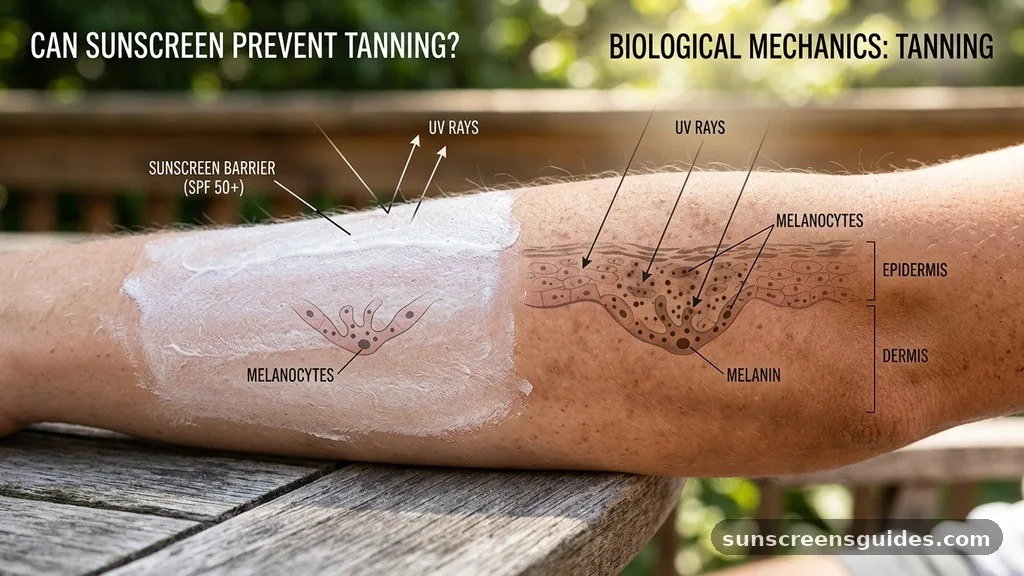
Tanning is essentially your body’s way of sounding an alarm. When your skin is exposed to solar radiation, your melanocytes—specialized cells located in the basal layer of the epidermis—go into overdrive.
They produce more melanin, the pigment responsible for skin color, in a desperate attempt to create a shield against further cellular damage. This process is not a sign of health; it is a defensive reaction to injury.
When we talk about the question of can sunscreen prevent tanning, we are really asking if we can stop this defensive mechanism from triggering. Because tanning is a response to ultraviolet radiation, any product that blocks those rays will, by definition, inhibit the activation of your melanocytes.
If you successfully block every single photon of UV light, your skin will not darken. In practice, however, achieving perfect, 100% blockage is nearly impossible for the average person applying lotion on a beach.
UVA vs. UVB: Understanding the Spectrum
To understand why you might still end up with a tan despite using protection, you have to distinguish between the two types of UV light. UVB rays are primarily responsible for the redness, burning, and immediate DNA damage associated with erythema. UVA rays, on the other hand, penetrate much deeper into the skin. They are the primary drivers of long-term skin changes, including photoaging and the darkening of existing pigment.
Many older or lower-quality sunscreens were designed primarily to stop burning, meaning they focused heavily on UVB protection. If a product lacks broad-spectrum protection, it might prevent you from turning lobster-red while still allowing enough UVA exposure to trigger a tan. This is why you might feel like you are “protected” because you didn’t burn, yet notice your skin color changing by the end of the day.
How SPF Ratings Influence Skin Pigmentation
The SPF rating on a bottle refers specifically to how well a product filters UVB radiation. An SPF 30 product filters out approximately 97% of UVB rays, while SPF 50 filters out about 98%. While that 1% difference seems negligible, it can be the difference between a minor tan and a significant reaction for someone with sensitive skin.
However, SPF does not inherently measure UVA protection. This is why looking for the PA++++ rating or the “Broad Spectrum” label is critical.
If your goal is to stop tanning, you need a formula that addresses both ends of the spectrum. Even with high-SPF products, tanning can still occur if:
- You apply too little product (most people use less than half the recommended amount).
- You fail to reapply every two hours or after swimming.
- You miss spots like the ears, neck, and tops of the feet.
- The product has expired or was stored in extreme heat, degrading the active ingredients.
Chemical Filters vs. Mineral Blockers

The ingredients within your bottle change how the light interacts with your skin. Chemical filters like avobenzone or oxybenzone work by absorbing UV radiation and converting it into heat, which is then released from the skin. Mineral blockers like zinc oxide and titanium dioxide act as physical shields, reflecting and scattering a portion of the incoming light.
For those strictly interested in whether can sunscreen prevent tanning completely, mineral-based formulas often provide a more reliable barrier. Because they sit on top of the skin rather than absorbing into the upper layers, they offer a more uniform layer of defense.
However, they can be cosmetically heavy, leading some to apply them thinly, which defeats the purpose. Chemical sunscreens are often more elegant to wear, making consistent, full-coverage application more likely.
Addressing Common Misconceptions and Topical Gaps
There is a persistent belief that higher SPF values somehow “allow” a tan to develop slowly and safely. This is a dangerous myth. There is no such thing as a “safe tan.”
Any darkening of the skin represents an accumulation of damage. Even if you use a high-SPF product, you are not engaging in “safe tanning”; you are simply slowing the rate at which your skin is being damaged.
Some users also wonder if their skin tone affects how much they tan through sunscreen. While individuals with deeper skin tones have more melanin—providing a natural, albeit limited, base protection—they are still susceptible to hyperpigmentation and long-term damage. The sun does not discriminate, and the biological process of tanning remains a sign of UV-induced stress regardless of your baseline complexion.
| Sunscreen Type | Primary Mechanism | Common Strengths |
|---|---|---|
| Mineral (Zinc/Titanium) | Physical Reflection | Instant protection, gentle on sensitive skin. |
| Chemical | UV Absorption | Lightweight, no white cast, easy to layer. |
| Broad-Spectrum | Dual-Action Filtering | Necessary to stop both UVA and UVB rays. |
Managing Expectations for Daily Protection
If you are trying to minimize tanning, you must treat your dermatological photoprotection as a daily habit rather than a vacation-only event. UV rays are present even on cloudy days and can penetrate through glass windows. If you are consistently exposed to ambient light, you will eventually see shifts in your skin tone if you aren’t diligent.
The most effective way to prevent tanning is to adopt a multi-layered approach. Sunscreen is just one tool.
Wearing protective clothing, such as wide-brimmed hats and UPF-rated shirts, removes the human error factor associated with lotion application. When you combine physical barriers with high-quality, broad-spectrum sunscreen, you are significantly more likely to maintain your natural skin tone.
FAQ: Common Questions on Sunscreen and Tanning
Does sunscreen block you from getting tan?
It significantly reduces the process by blocking UV radiation, but it rarely achieves 100% total prevention.
How can I prevent getting tan effectively?
Use a broad-spectrum SPF 50+, apply a generous amount, and supplement with hats and shade-seeking behavior.
Can I still get tan with SPF 50?
Yes, especially if the application is uneven, thin, or if you fail to reapply every two hours.
Can sunscreen help reduce tanning?
Absolutely, it is the most effective way to minimize the melanin response caused by harmful UV rays.
Does sunscreen prevent tanning on face?
Yes, it helps prevent facial tanning, which is essential for avoiding premature aging and uneven skin tone.
Does sunscreen prevent tanning in Black skin?
It prevents the UV-induced darkening and hyperpigmentation that occurs in deeper skin tones due to sun exposure.
Can you tan with sunscreen SPF 30?
Yes, SPF 30 allows more light transmission than SPF 50, making a tan more likely if exposure continues.
Final Thoughts on Skin Protection
Ultimately, the question of can sunscreen prevent tanning is best answered by looking at the goal of skin health. While you might desire a specific aesthetic, the biological reality is that preventing a tan is synonymous with preventing damage. By utilizing high-quality, broad-spectrum products and maintaining consistent application, you protect your skin’s long-term integrity.
Remember that the best approach to skin care is one that prioritizes prevention over correction. Start by choosing a sunscreen you enjoy wearing, as you are far more likely to reapply a product that feels good on your skin.
Your future self will certainly thank you for the extra attention you give to your skin today. Reach out to a dermatologist if you notice unusual changes, and keep your protection consistent throughout the year.



