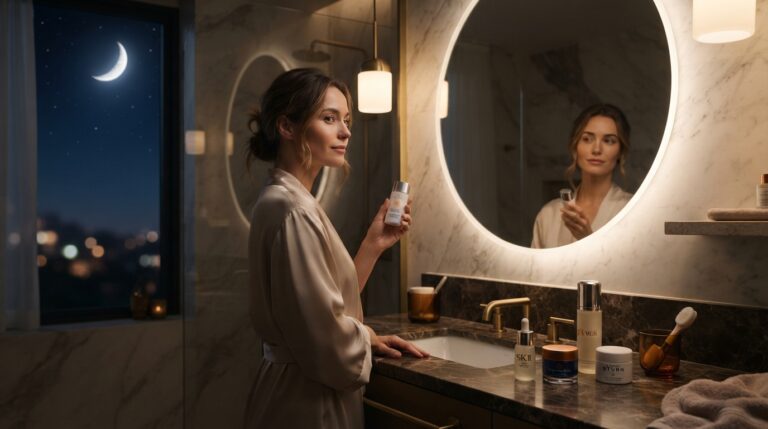

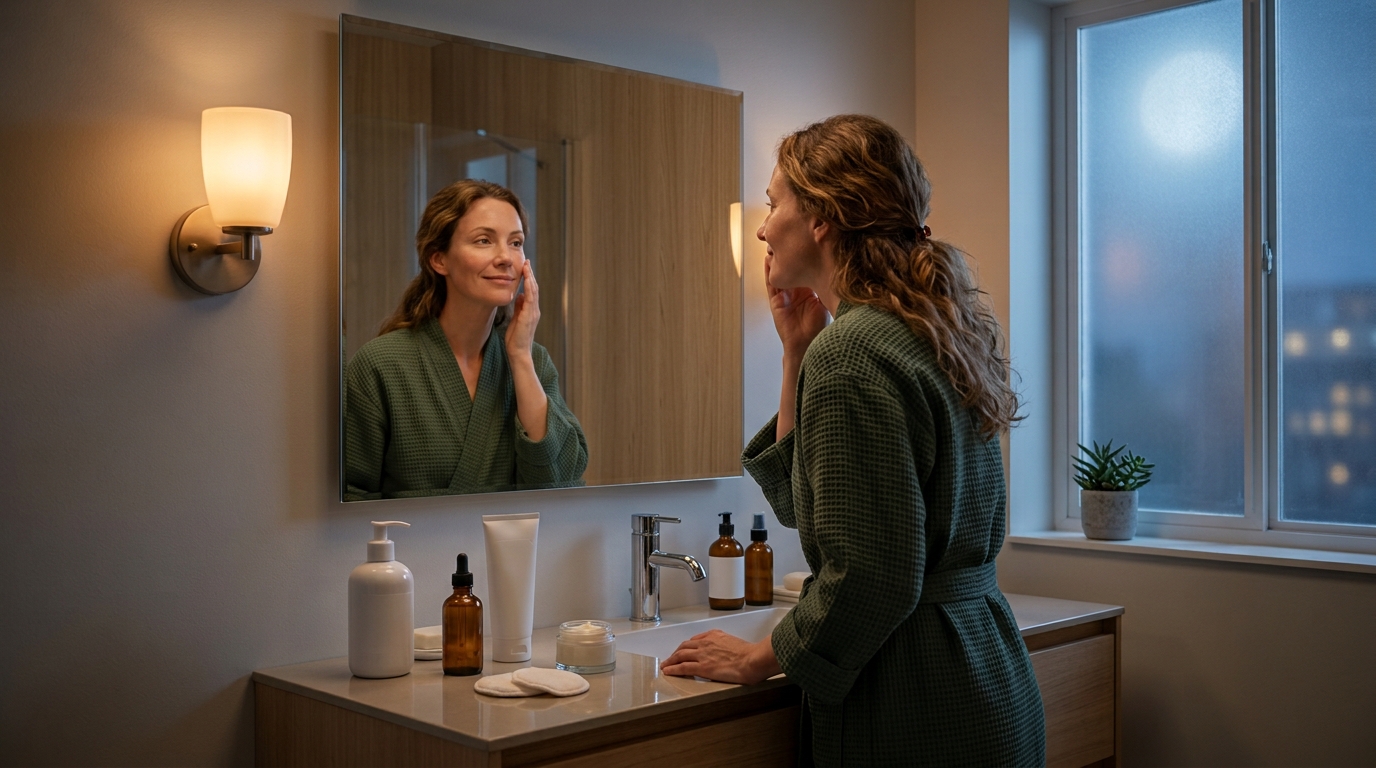
You’re stood in front of your bathroom mirror at 11pm, sunscreen bottle in hand, wondering if you actually need to wear sunscreen at night or if this is just another skincare rule you’ve been following without ever questioning why.
Maybe a friend told you to, maybe you saw it on a fifteen second video, maybe you just got confused somewhere along the way and now you can’t remember what’s true anymore. You’re not the only one, honestly this is one of those skincare questions that trips up even people who’ve been doing a proper routine for years.
Lets get straight into it because the confusion around this topic has genuinely gotten out of hand, with skincare influencers pushing conflicting advice and half truths that sound convincing but aren’t always backed by anything real.
The Short Answer: No, You Don’t Need Sunscreen While You Sleep
Sunscreen works by blocking or absorbing ultraviolet radiation that comes from the sun, and unless you sleep with your curtains wide open under a full moon that somehow emits UV rays (it doesn’t, moonlight is just reflected sunlight at a much much lower intensity), there is no biological reason to apply SPF before bed. Dermatologists have said this pretty consistently for years now.
Dr. Mona Gohara, a dermatologist at Yale School of Medicine, has explained in interviews that sunscreens purpose is entirely tied to UV exposure, and once the sun goes down that purpose kinda disappears with it. That’s not opinion, thats just how the chemistry and physics of these products actually function.
So why does this myth even exist? Good question, and it’s worth actually unpacking rather than just dismissing it.
Where the “Sunscreen at Night” Myth Came From
A few things seem to have mashed together over time to create this confusion, and once you see them laid out it kind of makes sense why so many people got mixed up.
Blue light anxiety. Somewhere around 2018-2019, a wave of concern about blue light from phones and laptops started circulating, and some brands marketed tinted mineral sunscreens as protection against it. People heard “blue light protection” and assumed that meant nighttime use too, forgetting that their phone screen is on regardless of whether it’s day or night, which honestly is a fair mix up to make.
Retinoid confusion. Retinol and other retinoids make skin more sensitive to sun, so dermatologists tell people using retinoids at night to be extra diligent about SPF the next morning. Somewhere in translation this became “wear sunscreen when you use retinol” which some people interpreted as apply it right after the retinol, at night, instead of the following day.
Anti-pollution skincare trend. Around the same period, anti pollution skincare became a whole category, and some sunscreens got marketed with anti pollution claims too. This blurred lines for a lot of people who now think of SPF as an all purpose shield against basically everything, day or night, which just isn’t accurate.
General over caution. A lot of people, once they learn sunscreen is important, sort of overcorrect and start applying it in situations where its not needed, kind of like how someone who just learned about food safety starts refrigerating things that were always fine at room temp.
What Actually Happens to Your Skin at Night
Your skin isn’t idle while your asleep, quite the opposite honestly. Night time is when skin does most of its repair work, and dermatological research backs this up pretty firmly.
| Time of Day | What Skin Is Doing |
|---|---|
| Daytime | Defending against UV rays, pollution, oxidative stress |
| Nighttime | Repairing DNA damage, producing collagen, increasing cell turnover |
A 2013 study published in the journal Chronobiology International found that skin cell regeneration and repair peaks during nighttime hours, roughly between 11pm and 4am, coinciding with the body’s natural circadian rhythm. This is part of why dermatologists recommend using active repair ingredients like retinoids, peptides, and certain acids at night rather than in the morning, because that’s when your skin is primed to actually use them.
Slathering on a UV filter during this window doesn’t help anything, if anything it just sits there clogging pores or, in the case of chemical sunscreens, potentially causing irritation for skin that’s trying to do repair work not defense work.
Chemical vs Mineral Sunscreen: Does It Change Anything at Night?
Not really, no. Whether your sunscreen uses chemical filters like avobenzone and octinoxate, or mineral filters like zinc oxide and titanium dioxide, the entire mechanism relies on UV light hitting the product to trigger its protective function. No UV light means the product simply isn’t doing what it’s designed to do, regardless of which type sits in the bottle.
Some skincare forums argue mineral sunscreen still offers a “physical barrier” benefit at night because it sits on the skin. This is technically true in the loosest sense, zinc oxide does have some anti inflammatory properties, but that’s not why you’d buy sunscreen and it’s a stretch to justify wearing it as a nighttime staple. There are better, purpose built products for barrier repair, like ceramide creams or plain old petrolatum based ointments.
So What Should You Actually Be Doing at Night?
Instead of sunscreen, here’s what dermatologists generally recommend building into an evening routine, and this list tends to hold up across most skin types with small tweaks:
- Double cleanse if you wore makeup or sunscreen during the day, to properly remove residue
- Apply active ingredients like retinoids, AHAs, or BHAs if your skin can tolerate them
- Follow with a moisturizer suited to your skin type, richer creams for dry skin, gel based for oily skin
- Consider a facial oil or occlusive layer if your skin barrier needs extra support
- Skip SPF entirely, it has no job to do once the sun’s gone
One dermatologist, Dr. Whitney Bowe, put it plainly in a piece for a skincare publication, noting that nighttime is essentially “downtime” for the skin barrier where repair ingredients thrive, and that layering unnecessary products, sunscreen included, can interfere with that process rather than help it.
But What About Morning Sunscreen Habits People Get Wrong?
Since we’re already untangling sunscreen myths, worth mentioning that the bigger issue for most people isn’t nighttime use, its inconsistent daytime use. According to the American Academy of Dermatology, most people apply only 25 to 50 percent of the recommended amount of sunscreen, which is roughly a full shot glass for the body and about a nickel sized amount for the face alone. Under applying during the day matters way more for your skin’s long term health than skipping it at night ever would.
Also worth noting, sunscreen needs reapplication every two hours when you’re outdoors, something a lot of people just don’t do, myself included some days if I’m honest, life gets busy and skincare steps slip.
A Quick Myth vs Fact Breakdown
| Myth | Fact |
|---|---|
| Sunscreen protects skin from blue light at night | Blue light exposure at night mainly comes from screens, and standard SPF isn’t formulated to meaningfully block this |
| Moonlight has UV rays that damage skin | Moonlight is reflected sunlight with negligible UV content, not enough to warrant SPF |
| Sunscreen helps with nighttime skin repair | Repair is driven by retinoids, peptides, and the body’s natural regenerative cycle, not SPF |
| Wearing sunscreen 24/7 is “extra safe” | Unnecessary layering can clog pores and interfere with nighttime actives without adding protection |
| Mineral sunscreen offers barrier benefits worth using nightly | Dedicated barrier repair products do this job better and were formulated specifically for it |
When There Might Be an Exception
There’s genuinely very few edge cases where SPF could matter after dark, mostly involving artificial UV sources like tanning beds (which no dermatologist recommends anyway) or certain medical treatments involving UV light therapy, where a doctor would give specific instructions unrelated to general skincare. For basically everyone reading this at home wondering about their nightly routine, none of these apply, and regular sunscreen isn’t formulated for those niche scenarios regardless.
The Bottom Line
Wearing sunscreen at night doesn’t actively harm your skin in most cases, but it doesn’t do anything useful either, and it can take up space in a routine that would benefit more from actives, hydration, or just letting your skin be. The whole “better safe than sorry” instinct makes sense on paper, but skincare works best when products are used for what they’re actually designed to do, and SPF’s entire reason for existing is tied to something that literally isn’t present once the sun sets. Save the sunscreen for the morning, let your night routine focus on repair, and your skin will probably thank you for the extra breathing room.