
Okay so you’re standing in front of your bathroom mirror at 7am holding two bottles, genuinely stuck, wondering does sunscreen go before or after moisturizer, and honestly this exact moment has probably happened to like ninety percent of people who ever tried to build a real skincare routine. You are not overthinking it, not really, because this one small ordering mistake can actually mess with how well your sunscreen even works. I’ve been there too, staring at a bottle like it owes me an explanation.
Here’s the thing nobody tells you upfront — skincare order isnt just some arbitrary ritual influencers made up to sell more product. It actually has a logic behind it, rooted in how your skin absorbs stuff and how sunscreen physically needs to sit on your skin to protect you properly. Get the order wrong and you could be diluting your SPF protection without even realizing, which kind of defeats the whole point of putting it on in the first place.
The Short Answer (For Those in a Hurry)
Sunscreen goes after moisturizer, as the very last step of your skincare routine, right before makeup if you wear any. That’s the general rule dermatologists tend to agree on. But — and there’s always a but isnt there — the full picture gets a little more textured depending on what kind of sunscreen you’re using and what your skin actually needs that day.
Dr. Shereene Idriss, a New York-based dermatologist, has said in interviews that sunscreen should always be the final step of a morning skincare routine because it needs to create an uninterrupted barrier on top of the skin to do its job properly. Makes sense when you think about it, sunscreen is functioning almost like a shield, and shields don’t work too well if you put something over them.
Why the Order Actually Matters
Moisturizer is designed to sink into your skin, to hydrate the deeper layers, and often it contains ingredients like hyaluronic acid or ceramides that are meant to be absorbed rather than sit on the surface. Sunscreen, on the other hand — especially the chemical kind — needs a few minutes of undisturbed contact with your skin to properly bind and activate its UV-filtering properties.
If you put sunscreen on first and moisturizer after, you’re essentially burying your sun protection under a layer of cream, and that cream can dilute the sunscreen or straight up interfere with how evenly it’s spread across your face. Some studies, including one published in the Journal of the American Academy of Dermatology, found that layering products incorrectly can reduce the effective SPF by a noticeable margin, sometimes as much as 20 to 30 percent depending on formulation.
That’s a pretty big deal considering how much people already tend to under-apply sunscreen to begin with (most people apply only 25 to 50 percent of the recommended amount, according to research from the Skin Cancer Foundation).
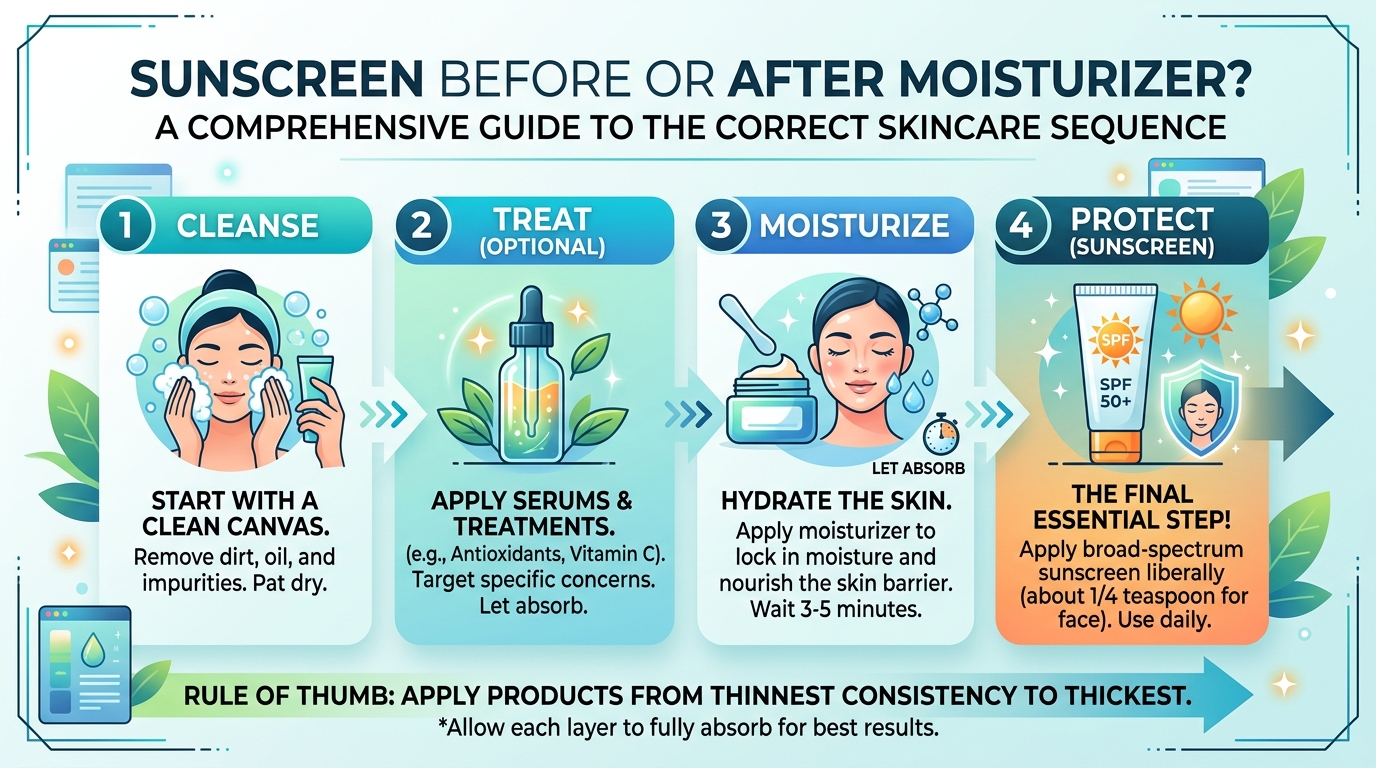
Step-by-Step: The Correct Morning Skincare Order
Below is a fairly standard order that most dermatologists and skincare formulators recommend, though of course individual products or unique skin conditions might shift this slightly.
- Cleanser — start with a clean base, always
- Toner (optional) — if you use one, this comes right after cleansing
- Serum — thinner, active-ingredient-heavy products go before creams
- Eye cream (optional) — if part of your routine
- Moisturizer — locks in hydration and preps the skin
- Sunscreen — always, always last
This “thin to thick” rule is something estheticians repeat constantly, and it genuinely helps products absorb the way they’re supposed to. Sunscreen being last isnt an exception to this rule so much as it is the natural conclusion of it — it’s the thickest, most protective layer, so it sits right on top.
What About Sunscreen-Moisturizer Hybrids?
This is where things get a bit murkier and I’ll be honest, dermatologists dont fully agree here either. A lot of brands now make moisturizers with SPF built in, marketed as a two-in-one solution to save you time in the morning. Convenient, sure, but not always ideal.
The issue is that these hybrid products often dont contain enough SPF-active ingredients to hit the labeled protection number in real-world use, because moisturizer-SPF combos are formulated to spread thin and easy, which works against sunscreen’s need to be applied generously and evenly. Dr. Idriss and several other dermatologists, including those quoted by the American Academy of Dermatology, generally recommend using a dedicated sunscreen rather than relying solely on a moisturizer with SPF, especially if you’re going to be outdoors for extended periods.
If you do use a hybrid product, treat it as your final step still, dont layer a separate moisturizer on top of it.
Chemical vs Physical Sunscreens — Does It Change the Order?
Not really, no. Both chemical (or “organic”) sunscreens and physical (or “mineral”) sunscreens using zinc oxide or titanium dioxide should go on after moisturizer. The difference between the two is more about how they work rather than where they sit in your routine.
| Sunscreen Type | How It Works | Best For |
|---|---|---|
| Chemical | Absorbs UV rays and converts them to heat | Daily wear, lighter texture, easier under makeup |
| Physical/Mineral | Sits on skin and reflects UV rays | Sensitive skin, acne-prone skin, post-procedure skin |
Physical sunscreens especially need to sit undisturbed on the skin’s surface to reflect light properly, so putting anything heavy on top of them (besides makeup) after application can genuinely reduce how well they work.
Common Mistakes People Make With Sunscreen Order
Even people who are pretty diligent about skincare mess this up sometimes, and its worth calling out a few of the more common slip ups so you can avoid em.
- Applying sunscreen before moisturizer thinking it needs to “sink in first”
- Mixing sunscreen and moisturizer together in your palm before applying (this dilutes both products)
- Not waiting long enough between moisturizer and sunscreen application, ideally give it a minute or two
- Skipping sunscreen entirely on cloudy days, which is a whole separate mistake because up to 80 percent of UV rays can penetrate cloud cover according to the World Health Organization
- Using yesterday’s sunscreen application as “good enough” without reapplying
Nighttime Routine — Does Order Matter Then Too?
At night obviously you dont need sunscreen (unless youre nocturnal I suppose), but the same thin-to-thick logic still applies for everything else. Cleanser, treatment serums, then moisturizer as your final sealing step. Some people also use a heavier night cream or facial oil, which should go last since oils are typically the thickest and most occlusive products in a routine.
Does Skin Type Change Anything?
Somewhat, yeah. People with oilier skin might want to use a gel-based moisturizer that absorbs faster, giving the sunscreen a cleaner surface to sit on top of. Drier skin types might need a richer moisturizer, and in that case waiting a bit longer before applying sunscreen helps prevent that pilling or streaky white-cast effect that happens sometimes with mineral sunscreens.
Combination skin, which a lot of people have honestly whether they realize it or not, might benefit from applying a lighter moisturizer only on drier areas (like cheeks) and going straight to sunscreen on oilier zones like the forehead and nose.
A Quick Word on SPF Numbers and Reapplication
Regardless of where sunscreen falls in your routine, the SPF number only means anything if you apply enough of it. Dermatologists generally recommend about a nickel-sized amount for the face alone, and reapplication every two hours if youre outside for extended periods, which — lets be real — almost nobody actually does consistently.
The American Academy of Dermatology has stated plainly that no sunscreen, regardless of SPF level, blocks 100 percent of UV rays, and SPF 30 blocks around 97 percent while SPF 50 blocks about 98 percent, so the jump in protection between higher SPF numbers is smaller than people assume.
Final Thoughts
So to circle back to where we started — does sunscreen go before or after moisturizer, the answer really is after, as the last step before makeup or sun exposure. It’s a small detail in the grand scheme of a skincare routine but it’s the kind of small detail that actually determines whether your sunscreen is doing its job or just sitting there looking pretty on your bathroom shelf.
Skincare doesnt need to be complicated, and honestly getting this one order right is one of those low-effort high-reward changes you can make starting tomorrow morning. Your skin, especially years down the line, will probably thank you for it.