

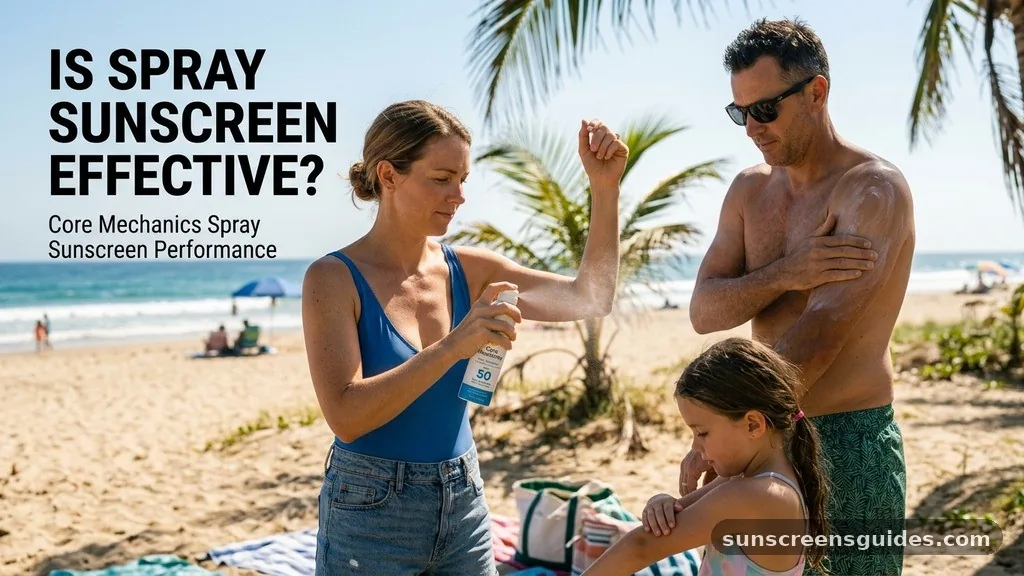
Deciding whether to reach for a bottle of spray or a tube of lotion often comes down to convenience, but knowing if spray sunscreen is effective remains a priority for anyone serious about skin health. While these products offer a quick way to cover large areas of the body, their real-world performance depends heavily on how you handle the canister.
Because they are so easy to use, many people accidentally under-apply the product, which leaves their skin vulnerable to harmful rays. Understanding the balance between ease of use and proper protection is essential for maintaining your skin’s safety throughout the summer months.
The Core Mechanics of Spray Sunscreen Performance

Spray sunscreen is highly effective when used correctly, providing the same level of broad-spectrum protection as traditional lotions. The active ingredients, whether they are chemical filters or physical mineral blockers like zinc oxide or titanium dioxide, work by absorbing or reflecting UV radiation exposure. The efficacy of these products is tied directly to the SPF rating listed on the bottle, assuming you have deposited enough of the product on your skin to meet that standard.
Manufacturers test these products under controlled conditions that simulate a “thick and even” layer of coverage. The issue arises during aerosol application because the mist can be blown away by the wind or fail to settle uniformly on the skin. If you do not create a visible sheen on the skin, you are likely not getting the level of protection promised by the label.
Addressing the Common Risk of Uneven Coverage
The primary reason users struggle with spray formulas is the tendency to create uneven coverage. Unlike creams that you can visibly track as you rub them into your skin, sprays often disappear into the air or settle in inconsistent patterns. This leads to gaps in protection that can result in patchy sunburns.
To ensure you are getting the full benefit of your SPF rating, you must follow a specific process. First, spray the product into your hands before applying it to your face to avoid inhalation risk and to ensure the coverage is thorough.
For the rest of the body, hold the nozzle close to the skin and spray until it glistens. Rubbing the product in after spraying is not just a suggestion; it is a critical step to ensure a continuous film of protection covers every inch of exposed skin.
Comparing Spray and Lotion Formulations
Choosing between a spray and a lotion often feels like a trade-off between convenience and certainty. The following table highlights the key differences that impact how you should use these products in daily life.
| Feature | Spray Sunscreen | Sunscreen Lotion |
|---|---|---|
| Ease of Application | High (Fast for large areas) | Moderate (Requires manual spreading) |
| Coverage Consistency | Variable (Needs rubbing in) | High (Easier to see coverage) |
| Inhalation Risk | Present (Requires caution) | None |
| Travel Convenience | Moderate (Aerosol restrictions) | High (TSA-friendly tubes) |
Regulatory Standards and Photo-stability
The FDA sunscreen regulations require that all sunscreens, including sprays, meet strict standards for safety and performance. These products are tested for photo-stability, meaning the active ingredients must remain effective even after being exposed to sunlight for a designated period. If a product is labeled as water-resistant, it must maintain its SPF rating after a specific duration of time in water, which is a standard that applies equally to sprays and lotions.
The industry has moved toward more rigorous testing to ensure that the chemical and mineral components do not degrade rapidly under the sun. When you buy a reputable brand, you can trust that the formula inside the can is scientifically sound. The responsibility for efficacy shifts from the laboratory to the user once the product is in your hands.
Key Strategies for Proper Application
To maximize the effectiveness of your sunscreen, you should treat your spray canister with the same care you would a bottle of lotion. Adopting a systematic approach prevents the common pitfalls that lead to skin damage.
- Always apply in a wind-free area to ensure the product reaches your skin rather than the surrounding air.
- Use a generous amount; if you don’t see a wet sheen on your skin, you haven’t used enough product.
- Rub the sunscreen in thoroughly to eliminate missed spots and ensure a uniform layer.
- Avoid spraying directly onto your face; spray into your palms first to avoid inhaling the mist.
- Reapply every two hours, or immediately after swimming or heavy sweating, to maintain water resistance.
- Check the expiration date on the can, as older products may lose their stability over time.
Common Topical Gaps Regarding Spray Sunscreen
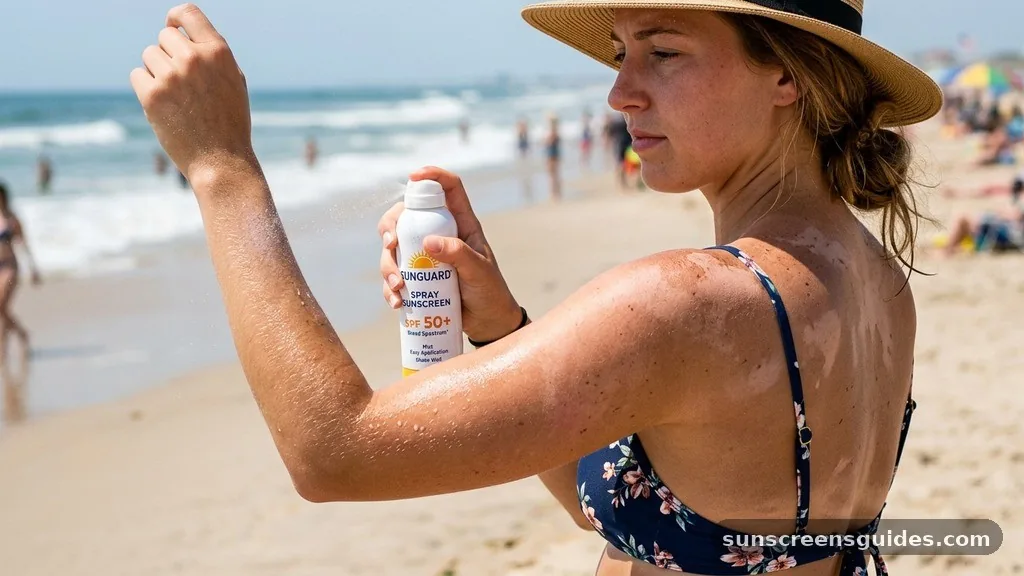
Many people wonder if spray sunscreen is effective for children or those with sensitive skin. The main concern for parents is the inhalation risk associated with the fine mist, which can irritate the lungs if a child breathes it in during application. For younger children, it is safer to spray the product into your own hands and then apply it to their skin manually.
Another common gap in knowledge is the environmental impact of the propellant used in aerosol canisters. While modern sprays have moved away from ozone-depleting chemicals, the aerosol mist can still contribute to air quality issues in enclosed spaces. Always apply sprays outdoors to keep the air around you clean and safe.
Additionally, there is a persistent myth that sprays are “lighter” than lotions. In reality, the protective film left behind is quite similar; the only difference is the carrier fluid used to deliver the active ingredients.
Understanding Inhalation Risks and Safety
The concern regarding inhalation risk is legitimate and should be taken seriously. Because spray sunscreens release microscopic droplets into the air, there is a risk that these particles can enter the respiratory system. The FDA has highlighted this as a point of caution, particularly for those with asthma or other respiratory conditions.
To mitigate this, never use sprays in a small, unventilated bathroom or car. Always stand upwind when applying the product outdoors. If you are using a mineral-based spray containing zinc oxide or titanium dioxide, the particles are generally heavier and less likely to be inhaled than some chemical alternatives, but the rule of thumb remains: spray into your hands first for facial application.
The Role of Application Technique
Your application technique is the single biggest factor determining whether your sunscreen actually works. Many users hold the nozzle too far away from the body, leading to significant product loss through evaporation and wind dispersal. Holding the nozzle roughly four to six inches from the skin allows you to control the density of the application.
It is helpful to think of the spray as a “primer” rather than a finished product. Even if you cover your limbs perfectly with the initial spray, the act of rubbing the product into the skin creates a more robust barrier against UV radiation exposure. This physical act of spreading the lotion also helps you identify areas you might have missed, such as the backs of the knees or the tops of the feet.
When to Choose Lotion Over Spray
While sprays are convenient, there are times when a cream or lotion is objectively better. If you are at the beach on a particularly windy day, the spray will likely end up on the sand instead of your skin. In these conditions, a traditional lotion provides a much more reliable application.
Additionally, for high-intensity activities where you are sweating profusely, some lotions are formulated with superior film-forming agents that hold up better than lighter spray mists. If you have extremely dry skin, many lotion formulations include added moisturizers that can help keep your skin hydrated while you are out in the sun.
The Reality of Water Resistance
It is vital to recognize that no sunscreen is truly “waterproof.” The term water resistance indicates that the product will maintain its effectiveness for a specific amount of time—usually 40 or 80 minutes—while you are in the water. After that period, the protective film begins to break down.
Whether you use a spray or a lotion, you must reapply after swimming or toweling off. Toweling is particularly aggressive at removing sunscreen, as it physically wipes away the protective barrier. Do not assume that because you sprayed on a “water-resistant” product, you are immune to the effects of the sun for the entire day.
Conclusion
Evaluating if spray sunscreen is effective brings us back to the reality that user behavior is as important as the formula itself. While these products are convenient and capable of providing excellent protection, they require a conscious effort to ensure full coverage and safety. By spraying into your hands for facial use, applying the product in a wind-free environment, and rubbing the formula into your skin, you can achieve the same level of safety as traditional lotions.
Always prioritize consistency over speed, and remember that no sunscreen works if it stays in the bottle or gets blown away by the wind. Staying vigilant with your reapplication schedule remains the best way to enjoy the outdoors while keeping your skin healthy and protected.
Frequently Asked Questions
Is spray sunscreen as effective as lotion?
Yes, spray sunscreen is just as effective as lotion, provided you apply enough to cover your skin.
Is it better to use spray or lotion for the face?
It is better to use lotion or to spray the sunscreen into your hands before applying to your face.
What is the biggest mistake when using spray sunscreen?
The biggest mistake is failing to rub the sunscreen in, which leads to gaps and uneven, inadequate coverage.
Does spray sunscreen expire?
Yes, spray sunscreens lose their efficacy over time, so always check the expiration date on the canister label.
Is there an inhalation risk with spray sunscreen?
Yes, inhaling the fine mist can be harmful, so apply it in well-ventilated areas and avoid facial spraying.
Can I use spray sunscreen on kids?
You can, but spray it into your hands first rather than directly onto their skin to prevent inhalation.
Does spray sunscreen provide full coverage?
It provides full coverage only if you apply a visible, thorough layer and manually rub it into the skin.



