

You’ve probably stood in front of your bathroom mirror at least once, sunscreen bottle in hand, thinking “wait, do I actually need this if I’m literally not leaving the house today.” That question, should i wear sunscreen indoors, is way more common than people admit, and honestly it’s not a silly one either. A lot of us assume walls and roofs are basically a force field against the sun, but that’s not quite how it works, and the reality is a bit more layered than a simple yes or no.
Why This Question Even Comes Up
For years the general advice floating around was pretty simple, sunscreen is for beach days and hikes, not for sitting at your desk answering emails. But dermatologists have been pushing back on that idea for a while now, and the science behind it is honestly kind of fascinating once you dig in a little.
Here’s the thing that most people dont realize until someone points it out to them, sunlight isn’t a single type of ray, its a mix of different wavelengths, and each one behaves differently when it hits glass, curtains, or your skin.
UVA vs UVB, The Indoor Difference
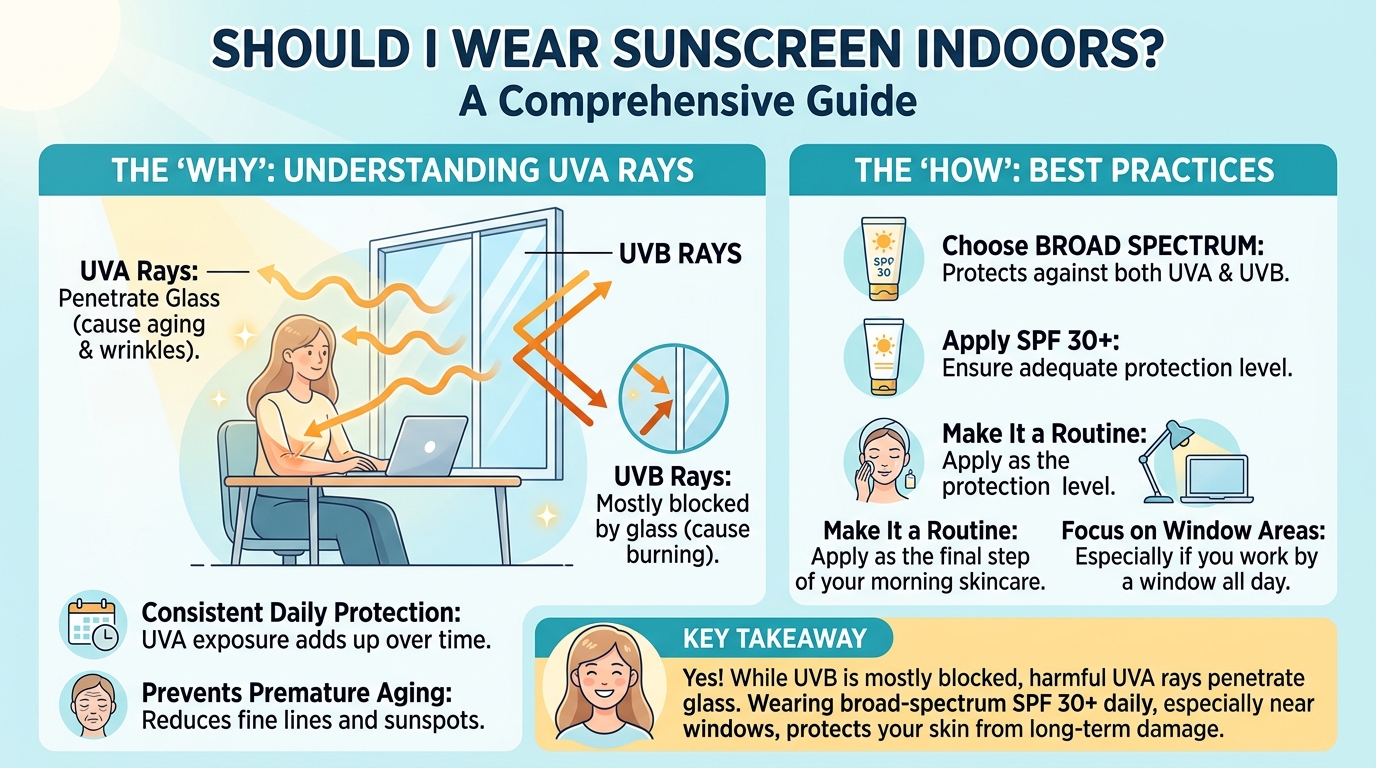
There’s two main types of ultraviolet radiation that matter here, UVA and UVB.
- UVB rays are the ones responsible for sunburn, and most window glass does a decent job blocking them.
- UVA rays, on the other hand, penetrate glass fairly easily, and these are the rays linked more closely to premature skin aging and deeper skin damage.
So when you’re sitting by a sunny window for hours, working from your laptop, your skin might not be burning, but its still getting hit with UVA exposure the whole time. Thats the part that catches people off guard.
The American Academy of Dermatology has pointed out that UVA rays can pass through windows and contribute to skin aging and long term damage even when you’re indoors, which kind of flips the whole “im safe inside” assumption on its head.
Real Numbers Behind Indoor Sun Exposure
Its easy to dismiss this as overblown, but there’s actual data supporting the concern. A study published in JAMA Dermatology looked at UV exposure through windshields while driving and found measurable UVA penetration strong enough to cause visible asymmetry in skin aging between the left and right side of drivers faces, especially truck drivers who spend years behind the wheel.
| Exposure Type | UVB Blocked by Glass | UVA Blocked by Glass |
|---|---|---|
| Standard window glass | Around 95-100% | Only 40-50% |
| Car windshield (laminated) | Nearly 100% | Roughly 90-95% |
| Car side windows (tempered) | Nearly 100% | As low as 20-30% |
That table alone kinda explains why some people who drive a lot develop more sun damage on one side of their face, its not urban legend, its physics and biology working together in a not so fun way.
What About Blue Light From Screens?
Okay so this is where things get a bit murkier and honestly there’s still some debate among researchers. Blue light emitted from phones, laptops, and tablets has been studied for its potential to contribute to pigmentation issues, particularly in people with darker skin tones. The evidence isnt as strong or conclusive as UVA research, but a few dermatology studies have suggested that high energy visible light might worsen melasma and hyperpigmentation over time.
Dr. Shereen Idriss, a well known dermatologist, has mentioned in interviews that while blue light research is still developing, patients dealing with melasma often benefit from broad spectrum sunscreens that offer some protection against visible light too, not just UV rays.
So should you be paranoid about your laptop screen giving you wrinkles? Probably not to an extreme degree, but if you already have pigmentation concerns, it might be worth factoring in.
So, Should You Actually Wear Sunscreen Indoors?
Honestly it depends a lot on your situation, and I know that answer feels like a cop out but hear me out.
You probably need it more if you:
- Sit near a window that gets direct sunlight for several hours a day
- Work from home in a bright room with lots of natural light
- Drive frequently, even for short commutes
- Have a history of melasma, hyperpigmentation, or sun sensitivity
- Are trying to prevent premature aging as a long term skincare goal
You might not need it as urgently if you:
- Work in a windowless office or basement level space
- Rarely get direct sunlight through glass during the day
- Already apply sunscreen before leaving home each morning anyway, which covers you for the transition periods
A skin cancer foundation report noted that up to 90 percent of visible skin aging is caused by sun exposure over a lifetime, and that number includes cumulative indoor exposure through windows, not just beach vacations or outdoor sports. Thats a pretty wild stat when you actually sit with it for a second.
How To Choose Sunscreen For Indoor Use
If you’ve decided indoor sunscreen is worth adding to your routine, not all sunscreens are created equal for this specific purpose.
Look for products labeled “broad spectrum,” since these protect against both UVA and UVB rays, unlike some older formulas that only guarded against burning from UVB.
An SPF of 30 is generally considered sufficient for daily indoor use according to most dermatology guidelines, you dont necessarily need SPF 50 unless you’re also stepping outside frequently throughout the day.
Mineral sunscreens containing zinc oxide or titanium dioxide tend to offer better protection against visible light and blue light compared to purely chemical formulas, which is worth considering if screen exposure is a concern for you specifically.
Common Myths Worth Clearing Up
There’s a handful of myths that keep circulating and honestly they deserve a quick myth busting moment.
Myth one, if its cloudy or you’re indoors you dont need sunscreen at all. Not accurate, clouds block some visible light but UVA still gets through pretty effectively, and windows only block it partially as we covered above.
Myth two, sunscreen is only necessary in summer. UVA rays remain fairly consistent year round, unlike UVB which fluctuates more seasonally, so winter sun through a window is still doing its slow damage even if it doesnt feel as intense.
Myth three, makeup with SPF is enough coverage. Most people dont apply nearly enough makeup to get the labeled SPF protection, research has shown youd need to apply several times the normal amount of foundation to actually hit that SPF number, which almost nobody does in real life.
Practical Tips For Building The Habit
Building a new habit around indoor sunscreen doesnt have to feel like a chore if you approach it the right way.
Keep a small tube near your workspace or desk, so its literally right there when you sit down each morning, out of sight often means out of mind with skincare routines.
Pair the application with something you already do daily, like brushing your teeth or making your morning coffee, habit stacking tends to make new routines stick faster according to behavioral psychology research.
Reapplication matters less indoors than outdoors since you’re not sweating it off or swimming, but a midday touch up especially if you’re near a bright window for hours can still be worthwhile.
Final Thoughts
At the end of the day, the answer to should i wear sunscreen indoors isnt a dramatic yes or a dismissive no, its somewhere in the middle depending on how much natural light your daily environment actually gets. If you spend hours near windows, drive often, or already deal with pigmentation concerns, its probably a smart addition to your routine rather than an unnecessary extra step. And if you’re mostly tucked away from direct sunlight all day, you can probably ease up a little, though a light daily SPF habit rarely hurts anyone in the long run anyway.
Your skin doesnt really care whether the UV rays came from a beach or a bay window, damage accumulates either way, quietly, over years, which is honestly the part that convinced me to just keep the bottle on my desk and stop overthinking it.