
Can I tan with sunscreen? You probably asked yourself that after spending a whole afternoon outside, doing everything “right,” and then somehow ending up with a darker skin tone anyway. It’s a bit confusing, honestly. Maybe you expected the sunscreen to stop everything the sun could possibly do, but your skin had other plans, and now you’re wondering what actually happened.
You’re not alone in that. A lot of people think sunscreen creates some kind of invisible wall that blocks every single ray from reaching the skin. It doesn’t quite work like that. Sunscreen is designed to reduce damage from ultraviolet (UV) radiation, not make you invisible to the sun. That tiny difference changes almost everything about how tanning works.
If you’ve ever wondered whether sunscreen prevents tanning, whether SPF 50 is enough to stop a tan, or whether you can safely get bronzed while protecting your skin, this guide walks through the facts, clears up common myths, and explains what dermatologists actually recommend.
The Short Answer: Can You Tan While Wearing Sunscreen?
Yes, you can still tan while wearing sunscreen.
Even high-SPF sunscreen does not block 100% of UV rays. Some ultraviolet radiation still reaches your skin, especially if:
- You don’t apply enough sunscreen.
- You miss certain areas.
- You forget to reapply every two hours.
- You sweat or swim.
- You’re outdoors for several hours.
That small amount of UV exposure is often enough to stimulate melanin production. Melanin is the pigment your skin produces in response to UV exposure, and it is what creates a tan.
So while sunscreen significantly reduces UV exposure, it doesn’t eliminate it completely.
Why Does Your Skin Tan in the First Place?
A tan isn’t actually a sign of healthy skin. It’s your body’s defense mechanism.
When ultraviolet rays penetrate the skin, they damage DNA inside skin cells. In response, your body increases melanin production. Melanin absorbs some UV radiation and helps reduce additional damage.
In other words, your tan is evidence that your skin has already experienced UV stress.
That’s one of those things people don’t always hear growing up, but it’s worth knowing.
Understanding UVA and UVB Rays
Not all sunlight affects your skin the same way.
| UV Type | Primary Effect | Role in Tanning |
|---|---|---|
| UVA | Penetrates deeper into the skin, contributes to aging and tanning | Major contributor to tanning |
| UVB | Damages the outer skin layers and causes sunburn | Triggers melanin production and burns |
| UVC | Blocked by Earth’s atmosphere | Does not reach the skin naturally |
A broad-spectrum sunscreen protects against both UVA and UVB rays, which is why dermatologists consistently recommend it.
Does SPF Affect How Much You Tan?
Absolutely.
SPF measures how effectively sunscreen protects against UVB radiation.
Here’s a simple comparison.
| SPF | Approximate UVB Blocked |
|---|---|
| SPF 15 | About 93% |
| SPF 30 | About 97% |
| SPF 50 | About 98% |
| SPF 100 | About 99% |
Notice something?
Even SPF 100 doesn’t block every UV ray. That remaining one percent may sound tiny, but over several hours in strong sunlight, it can still contribute to tanning and skin damage.
Why Do Some People Tan Even With SPF 50?
There are several reasons.
Most people don’t apply enough
Research consistently shows that people apply only around one-quarter to one-half of the recommended amount of sunscreen.
Adults generally need about one ounce—roughly enough to fill a shot glass—to cover the entire body.
Using less dramatically reduces the actual SPF protection.
Sunscreen wears off
Even water-resistant formulas lose effectiveness over time.
Activities that reduce protection include:
- Swimming
- Sweating
- Towel drying
- Touching your face
- Friction from clothing
That’s why reapplication matters just as much as the first application.
UV rays are stronger than people expect
Cloudy days don’t completely block UV radiation.
According to the World Health Organization, up to 80% of UV rays can pass through light cloud cover.
So yes, you can absolutely tan on an overcast afternoon.
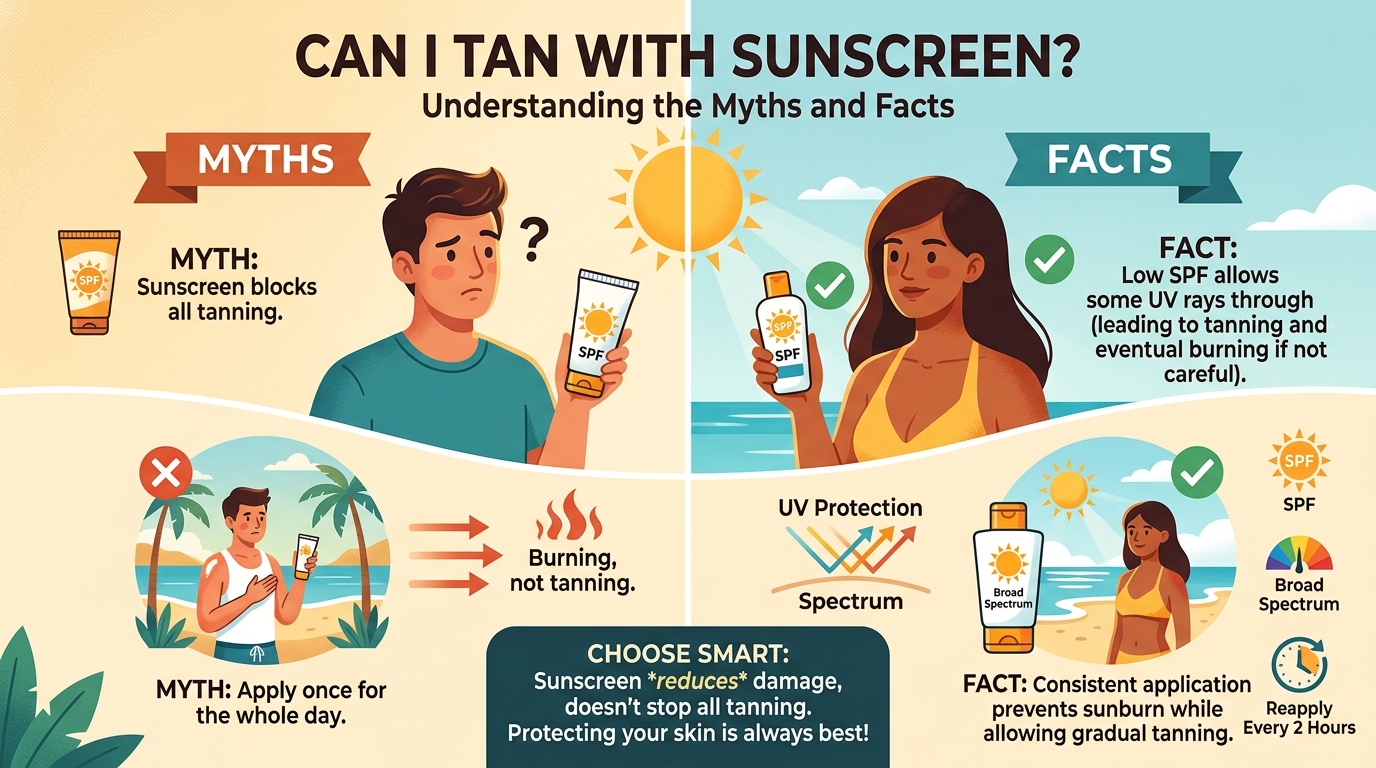
Myth: Sunscreen Prevents All Tanning
This is probably the biggest misconception.
Sunscreen reduces UV exposure—it does not eliminate it.
Think of it like wearing a raincoat in light rain. You’ll stay much drier, but if you’re outside long enough, some moisture eventually gets through.
The same idea applies to UV radiation.
With proper sunscreen use, your tan develops more slowly and is usually less intense than it would be without protection.
Myth: A Base Tan Protects Your Skin
This myth has been around forever.
Some people intentionally tan before vacations because they believe it prevents sunburn.
Scientific evidence says otherwise.
Dermatologists estimate that a base tan provides protection roughly equal to SPF 3 or less.
Considering experts recommend SPF 30 or higher, a base tan offers very little meaningful protection.
It also represents previous skin damage.
Myth: Darker Skin Doesn’t Need Sunscreen
People with darker skin tones naturally have more melanin, which offers some additional UV protection.
However, no skin tone is immune to:
- Sunburn
- Premature aging
- Hyperpigmentation
- Skin cancer
- DNA damage
Skin cancer can actually be more dangerous in people with darker skin because it is sometimes diagnosed later.
Everyone benefits from sunscreen.
Can You Tan Safely?
This question comes up a lot.
The honest answer is that there is no completely safe way to tan from ultraviolet radiation.
Whether the UV exposure comes from:
- Natural sunlight
- Tanning beds
- Sun lamps
the underlying process involves DNA damage.
The American Academy of Dermatology states that tanning is a sign of skin injury, not healthy skin.
If your goal is simply achieving bronzed-looking skin, sunless tanning products provide color without UV exposure.
Does Sunscreen Stop Vitamin D Production?
Many people worry that sunscreen blocks vitamin D completely.
Real-world studies suggest this concern is often overstated.
Because sunscreen is rarely applied perfectly, enough UV exposure usually occurs during everyday life for normal vitamin D production.
Diet and supplements are also reliable vitamin D sources if needed.
If you’re concerned about vitamin D deficiency, it’s better to discuss testing with a healthcare professional than intentionally skipping sunscreen.
Common Mistakes That Make Sunscreen Less Effective
You might be wearing sunscreen but still not getting the protection you expect.
Some of the most common mistakes include:
- Applying sunscreen after going outside instead of before.
- Forgetting ears, neck, hands, feet, and scalp.
- Missing the lips.
- Using expired sunscreen.
- Applying only once all day.
- Assuming makeup with SPF is enough.
- Relying on sunscreen alone without seeking shade.
These little things add up more than people realize.
Choosing the Right Sunscreen
Not every sunscreen feels the same, but the essentials are fairly straightforward.
Look for:
- Broad-spectrum protection
- SPF 30 or higher
- Water-resistant formula if swimming or exercising
- Fragrance-free options if you have sensitive skin
Both mineral and chemical sunscreens are effective when used correctly.
Mineral sunscreens typically contain:
- Zinc oxide
- Titanium dioxide
Chemical sunscreens commonly include ingredients that absorb UV radiation before it damages the skin.
The best sunscreen is usually the one you’ll actually wear every day.
What Dermatologists Recommend
Most skin experts agree on several practical habits.
- Apply sunscreen 15 to 30 minutes before sun exposure.
- Reapply every two hours.
- Reapply immediately after swimming or heavy sweating.
- Wear sunglasses with UV protection.
- Use wide-brimmed hats.
- Seek shade between 10 a.m. and 4 p.m. when UV rays are strongest.
- Wear protective clothing whenever practical.
These habits work together. Sunscreen alone isn’t really meant to do all the heavy lifting.
What Research Says
Several respected health organizations have reached similar conclusions regarding sunscreen and tanning.
The American Academy of Dermatology advises daily use of broad-spectrum SPF 30 or higher sunscreen to reduce skin cancer risk and premature aging.
The World Health Organization identifies excessive UV exposure as the primary environmental cause of skin cancer and recommends limiting direct sun exposure during peak hours.
The U.S. Food and Drug Administration also emphasizes that sunscreen should be combined with additional sun protection measures rather than relied upon by itself.
As dermatologist Dr. Henry W. Lim has noted:
“No sunscreen blocks 100 percent of UV radiation.”
That simple statement explains why tanning can still happen even when sunscreen is used correctly.
Frequently Asked Questions
Can I still get darker while wearing sunscreen?
Yes. Because sunscreen does not block every UV ray, gradual tanning can still occur, especially during extended outdoor exposure.
Will SPF 50 stop me from tanning?
Not entirely. SPF 50 blocks about 98% of UVB rays, but some UV radiation still reaches your skin.
Does sunscreen prevent sunburn better than tanning?
Yes. Proper sunscreen use greatly reduces the likelihood of sunburn, although no sunscreen guarantees complete protection.
Can I intentionally tan while wearing sunscreen?
You can, but it is not considered a safe practice. A tan still reflects UV-induced skin damage, even if sunscreen reduces some of that exposure.
Is tanning with sunscreen safer than tanning without it?
Yes, relatively speaking. Sunscreen lowers your overall UV exposure and reduces the risk of sunburn and long-term skin damage, but it does not eliminate those risks.
Final Thoughts
So, can you tan with sunscreen? Yes, you can, and that’s where much of the confusion begins. Sunscreen isn’t designed to stop every bit of sunlight from touching your skin. Its real purpose is to reduce the amount of harmful ultraviolet radiation that reaches your skin, lowering your risk of sunburn, premature aging, and skin cancer.
If you notice a tan after spending hours outdoors while wearing sunscreen, it doesn’t necessarily mean the product failed. It often means your skin still received enough UV exposure to trigger melanin production. That’s why consistent application, regular reapplication, protective clothing, and seeking shade remain important parts of sun safety.
A healthy skincare routine isn’t about chasing the deepest tan possible. It’s about protecting your skin today so it stays healthier in the years ahead. A little patience with sunscreen may not stop every tan, but it can make a meaningful difference in preserving your skin’s long-term health.