

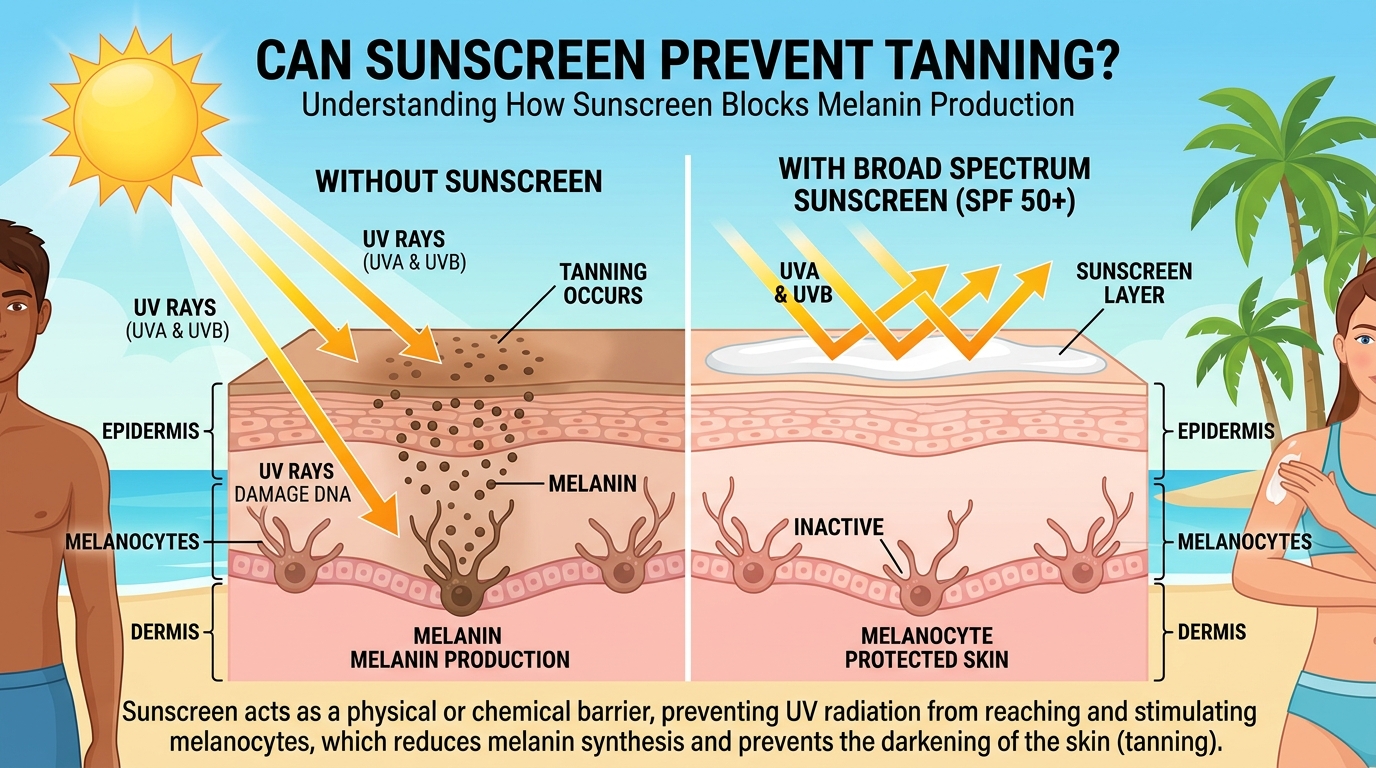
You slather on sunscreen every single morning and yet somehow you still come back from that beach trip looking three shades darker, so naturally you start wondering if sunscreen prevent tanning even actually a real thing or just something the bottle promises you. Its a fair question honestly, and one that a LOT of people quietly google after standing in front of a mirror confused about why their “SPF 50” didnt do what they thought it would.
Here’s the thing nobody tells you upfront, sunscreen was never really built to make you pale forever, it was built to protect your skin cells from getting damaged by ultraviolet radiation. Tanning and sun damage are related but they arent the exact same conversation, and once you get that straight in your head this whole topic makes a lot more sense.
So Does Sunscreen Actually Stop Tanning?
Short answer, sort of, but not completely, and definitely not the way most people assume. Sunscreen reduces the amount of UV rays that reach your skin, it does not build an impenetrable wall around you like some kind of skin force field. Even the best sunscreens on the market let a small percentage of UV rays through, which is exactly why you can still tan, just slower and less intensely.
Dermatologists have pointed out for years that SPF only measures protection against UVB rays, the ones mainly responsible for sunburn, while UVA rays (which penetrate deeper and cause tanning plus long term aging) arent always blocked to the same degree unless the sunscreen is labeled broad spectrum. As the American Academy of Dermatology has explained, a broad spectrum sunscreen is the only kind that shields skin from both UVA and UVB radiation, and that distinction matters more than most shoppers realize when they’re standing in the sunscreen aisle trying to pick between fifteen almost identical bottles.
The UVA and UVB Breakdown (because everyone mixes these up)
| Ray Type | Penetration | Main Effect | Blocked by Regular SPF? |
|---|---|---|---|
| UVB | Surface level | Sunburn, some tanning | Yes, mostly |
| UVA | Deep dermis | Tanning, wrinkles, aging | Only if broad spectrum |
| UVC | Blocked by atmosphere | Not really relevant to us | N/A |
Notice how UVA is the real culprit behind that gradual bronzing everyone chases in summer. This is why someone can wear “sunscreen” religiously and still tan, because plain SPF products werent formulated with UVA blocking as a priority for decades, that only really shifted once broad spectrum labeling became standard practice.
Why People Still Tan Even With Sunscreen On
Lets be real for a second, most people apply way less sunscreen than the bottle recommends. Studies (including one published in the journal Photodermatology, Photoimmunology & Photomedicine) have shown that people typically apply only 25 to 50 percent of the amount used in official SPF testing, which basically means your SPF 30 is functioning more like an SPF 10 or 15 in real life conditions. Kind of a wild gap between the label and reality if you think about it.
There’s also reapplication, which almost nobody actually does properly. Sunscreen breaks down under UV exposure, it rubs off, it sweats off, and once its effectiveness drops your skin is exposed again even though you technically “put sunscreen on this morning.” A few more reasons tanning happens anyway:
- You didnt use enough product (the recommended amount is roughly a shot glass worth for the whole body, which sounds like way more than what most people actually use)
- You skipped reapplying every two hours, especially after swimming or heavy sweating
- Your sunscreen wasnt broad spectrum, so UVA rays snuck through unaffected
- Water and sand reflect UV rays, increasing your total exposure even in shaded spots
- Your skin type naturally tans faster due to higher baseline melanin production
What Sunscreen Actually Does Instead
Okay so if it doesnt fully stop tanning, what is it even doing for you. Quite a lot actually. Sunscreen reduces DNA damage in skin cells, it slows down premature aging, and it dramatically lowers your risk of skin cancers including melanoma, which the Skin Cancer Foundation has repeatedly emphasized as one of the most preventable cancers when sun protection habits are followed consistently.
Think of sunscreen less like a tanning blocker and more like a damage control system. You might still develop some color from the UV rays that do get through, but the underlying skin cells arent taking nearly as much of a beating as they would completely unprotected. Thats the actual value proposition here, cancer risk reduction and anti aging benefits, not a guarantee of staying porcelain white through July and August.
A Quick Reality Check On SPF Numbers
People assume SPF 100 blocks basically everything and SPF 30 is “barely doing anything” but the math doesnt work like that at all.
- SPF 15 blocks around 93 percent of UVB rays
- SPF 30 blocks around 97 percent of UVB rays
- SPF 50 blocks around 98 percent of UVB rays
- SPF 100 blocks around 99 percent of UVB rays
See how small the jump actually is past SPF 30? Going from 30 to 100 gains you maybe 2 percent more protection, its not the massive leap the marketing implies, though higher SPF does buy you more of a buffer if application is uneven (which, again, its almost always uneven).
Can You Prevent Tanning Completely?
Honestly, not with sunscreen alone, no. If total tan prevention is genuinely your goal you’d need to combine sunscreen with physical barriers, think wide brim hats, UPF rated clothing, sunglasses, and just straight up avoiding peak sun hours between 10am and 4pm when UV index is at its highest. A dermatologist quoted in a Harvard Health publication once put it plainly, sunscreen is one layer of protection among several, and relying on it exclusively will always leave gaps.
Shade helps too, though people underestimate how much reflected UV still reaches you under an umbrella at the beach, since sand reflects up to 25 percent of UV radiation back at your skin. So even sitting under a beach umbrella sipping your drink, you’re still catching rays bouncing off the sand around you, which explains why beach tans happen even for people who swear they “stayed in the shade the whole time.”
Practical Tips For Minimizing Tanning While Still Enjoying The Sun
- Choose a broad spectrum sunscreen with SPF 30 or higher, this is non negotiable if UVA protection matters to you
- Apply generously, about two milligrams per square centimeter of skin, which in practical terms means more than you think
- Reapply every two hours, more often if you’re swimming, sweating, or toweling off
- Wear protective clothing when possible, especially for extended outdoor time
- Avoid direct sun during peak hours if tanning prevention is a priority for you
- Consider antioxidant serums like vitamin C underneath sunscreen for an added layer of defense against UV induced free radical damage
Final Thoughts
So, does sunscreen prevent tanning? Partially yes, mostly by reducing the intensity and speed of it, but it wont stop the process entirely unless paired with other protective habits and applied correctly and consistently. The real win with sunscreen isnt a permanently untanned complexion, its the long term protection against sun damage, premature wrinkles, and skin cancer risk that actually matters for your skin’s health over decades, not just over one summer.
Next time you’re standing in the sunscreen aisle wondering why last year’s beach vacation left you tanned despite “wearing sunscreen the whole time,” remember its probably less about the product failing you and more about application amount, reapplication timing, and whether you actually grabbed broad spectrum in the first place. Small details, but they change everything.