
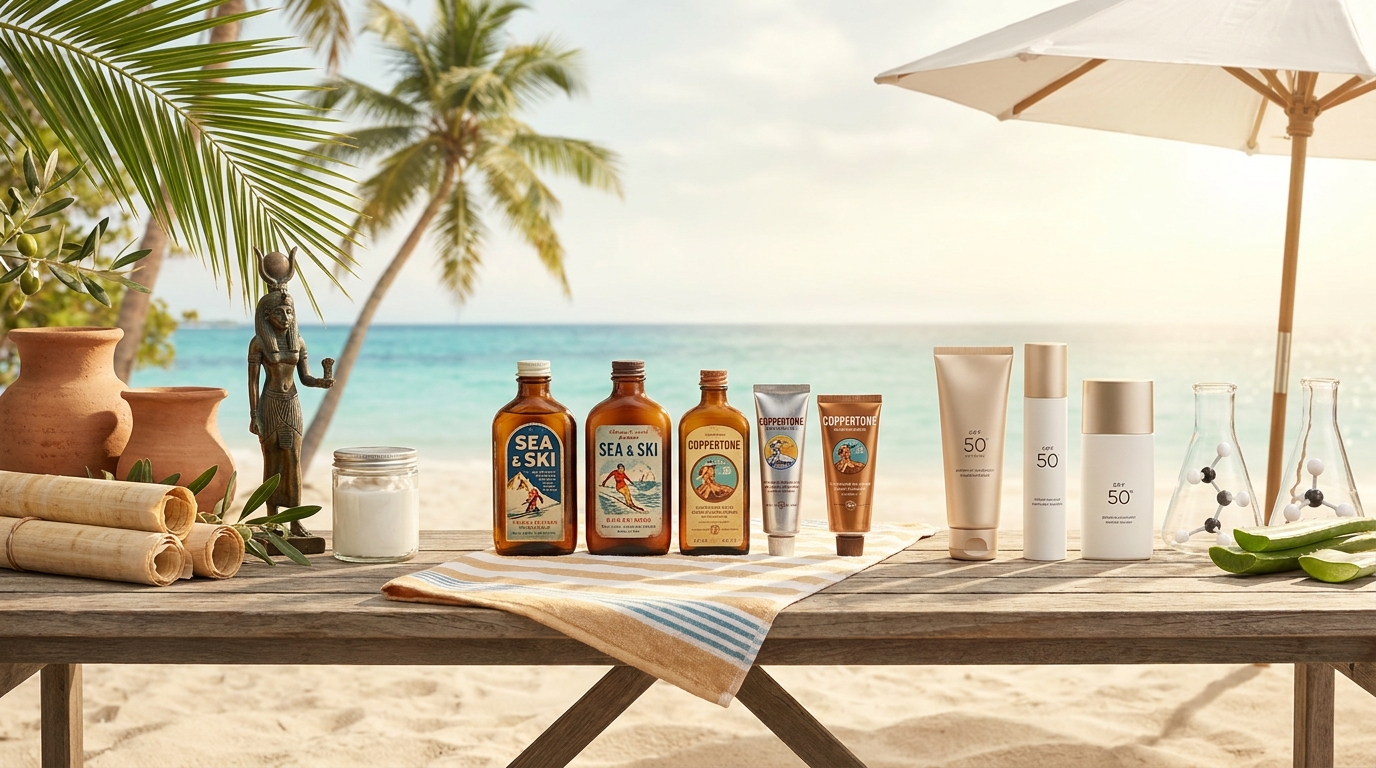
You probably started wondering about the invention of sunscreen a journey through time after catching yourself rubbing sunscreen on your arms without really thinking about who first came up with the idea. Funny thing is, most of us trust that little bottle almost blindly, yet hardly ever stop and ask where it all began. It’s kinda strange when you think about it. Something that quietly sits in beach bags, hiking backpacks, and bathroom shelves has a story packed with war, science, ancient beauty rituals, accidents, and people who simply got tired of getting badly sunburned.
Long before sunscreen came in colorful bottles promising SPF 30, SPF 50, or broad-spectrum protection, people across different civilizations were already trying to outsmart the sun. They didn’t call it ultraviolet radiation, and they certainly weren’t discussing UVA or UVB rays, but they noticed the effects. Skin darkened, blistered, aged faster, and sometimes became painfully damaged after spending too much time outdoors. That observation alone pushed countless generations toward creating natural barriers against sunlight.
Ancient Civilizations Were Already Fighting the Sun
The history behind the invention of sunscreen stretches back thousands of years, far beyond modern laboratories. Ancient societies developed their own methods using whatever nature offered nearby. Their solutions weren’t scientifically perfect, though they showed surprising understanding of protection.
In Ancient Egypt, beauty and skin care were closely connected. Historical records describe the use of ingredients such as:
| Ancient Ingredient | Purpose |
|---|---|
| Rice bran extract | Helped absorb sunlight naturally |
| Jasmine | Believed to repair sun-damaged skin |
| Lupine plants | Used to brighten skin appearance |
| Olive oil | Moisturized while providing slight protection |
Egyptian nobility often preferred lighter complexions because they symbolized status rather than outdoor labor. So protecting skin wasn’t just cosmetic—it carried social meaning too, which feels oddly familiar even today.
Meanwhile, Ancient Greeks and Romans relied on olive oil for skin care. While pure olive oil offers only a very low SPF—estimated at around SPF 2 to 8 depending on composition—it still acted as a physical layer against drying and sun exposure. Not ideal by today’s standards, but they weren’t exactly shopping for dermatologist-approved lotions.
Asian cultures developed different approaches. Historical documents suggest people in China used herbal mixtures while Japanese traditions sometimes favored white rice powder as both cosmetic makeup and a partial sun shield. None of these methods blocked UV radiation effectively by modern measurements, but they reflected growing awareness that prolonged sunlight changed skin in noticeable ways.
As the old saying often attributed to physicians reminds us:
“Prevention is better than cure.”
Oddly enough, humans seemed to understand that idea centuries before they understood why.
Before Modern Science, Clothing Was the Best Sunscreen
For most of human history, fabric actually protected people better than creams.
Loose robes across deserts, wide straw hats in farming communities, parasols carried through European cities, and long sleeves worn by travelers all served one main purpose besides fashion—they kept direct sunlight off the skin.
Sometimes the simplest inventions last the longest.
Even today, dermatologists recommend protective clothing as one of the most reliable forms of sun protection alongside sunscreen.
Some traditional strategies included:
- Wide-brimmed hats
- Linen garments
- Umbrellas and parasols
- Face veils
- Staying indoors during midday
Without realizing it, people had developed behavioral sunscreen long before chemical sunscreen existed.
The Scientific Discovery That Changed Everything
The nineteenth century completely changed how scientists viewed sunlight.
In 1801, German physicist Johann Wilhelm Ritter discovered ultraviolet radiation while experimenting beyond the violet end of the visible spectrum. His work revealed that sunlight included invisible rays carrying more energy than previously understood.
That discovery didn’t immediately create sunscreen, though it planted the first scientific seed.
Later research gradually linked ultraviolet radiation to skin damage, premature aging, and eventually skin cancer. Scientists realized sunlight wasn’t simply warmth and brightness. It carried invisible components capable of affecting living tissue.
During the late nineteenth and early twentieth centuries, physicians started documenting conditions caused by excessive sun exposure.
Knowledge slowly caught up with observation.
The Real Birth of Modern Sunscreen
When discussing the invention of sunscreen, one name almost always appears first: Franz Greiter.
Greiter, a Swiss chemist and mountain climber, reportedly suffered severe sunburn while climbing Piz Buin in 1938. That painful experience inspired him to develop a better protective cream.
A few years later, he introduced one of the world’s first commercially successful sunscreens.
Interestingly, the brand was eventually named after the same mountain where he experienced the burn.
Greiter’s work became even more influential in 1962 when he introduced the Sun Protection Factor (SPF) rating system.
Without SPF, comparing sunscreens today would honestly be a bit of a mess.
World War II Unexpectedly Accelerated Sunscreen Development
History sometimes moves in strange directions.
During World War II, soldiers stationed throughout the Pacific faced relentless tropical sunlight. Severe sunburn became a practical military problem rather than merely an uncomfortable inconvenience.
American pharmacist Benjamin Green created a thick, red petroleum-based substance called “Red Vet Pet.”
It wasn’t elegant.
It wasn’t pleasant.
Apparently it felt sticky and greasy enough that few people would’ve chosen it for cosmetic reasons.
Still, it helped protect soldiers from severe sunburn during extended outdoor missions.
Later, cosmetic improvements transformed Green’s formula into products connected with what eventually became the Coppertone brand.
War, surprisingly enough, pushed sunscreen technology forward faster than fashion ever could.
Sunscreen Became a Household Essential
After the 1950s, beach vacations exploded in popularity.
Suddenly people weren’t avoiding the sun.
They were chasing it.
Tanning became fashionable throughout Europe, North America, and Australia, creating enormous demand for products allowing longer outdoor activities.
Manufacturers rapidly expanded sunscreen formulas.
Some milestones included:
| Decade | Development |
|---|---|
| 1950s | Commercial sunscreen sales increased rapidly |
| 1960s | SPF rating introduced |
| 1970s | Better UVB protection developed |
| 1980s | Water-resistant products improved |
| 1990s | UVA protection gained greater attention |
| 2000s | Broad-spectrum standards strengthened |
| 2010s onward | Mineral and reef-conscious formulas became increasingly popular |
Consumer expectations kept growing.
People wanted products that didn’t smell strange, didn’t leave white streaks, resisted sweat, and worked for different skin tones.
That’s asking alot from one bottle, honestly.
Understanding Mineral and Chemical Sunscreens
Today’s sunscreen formulas generally fall into two categories.
Mineral Sunscreens
Mineral sunscreens usually contain:
- Zinc oxide
- Titanium dioxide
These ingredients primarily reflect, scatter, and also absorb portions of ultraviolet radiation before it penetrates deeply into skin.
Many dermatologists recommend mineral formulas for sensitive skin because irritation rates tend to be lower.
Chemical Sunscreens
Chemical sunscreens may include ingredients such as:
- Avobenzone
- Octinoxate
- Octisalate
- Homosalate
- Octocrylene
Instead of sitting mostly on the surface, these filters absorb UV energy and convert much of it into heat.
Both categories undergo safety testing under regulatory standards, though ingredient regulations differ between countries.
Sunscreen and Skin Cancer Prevention
One reason the invention of sunscreen became so significant lies in modern public health.
According to the World Health Organization:
- Around 2 to 3 million non-melanoma skin cancers occur globally each year.
- Approximately 132,000 melanoma skin cancers are diagnosed annually worldwide.
Meanwhile, organizations including the American Academy of Dermatology consistently recommend combining sunscreen with hats, protective clothing, sunglasses, and shade rather than relying on sunscreen alone.
Research published in long-term Australian studies has also shown regular sunscreen use can significantly reduce squamous cell carcinoma risk while helping slow visible signs of skin aging.
No sunscreen blocks 100% of ultraviolet rays.
That’s probably the biggest misconception still floating around.
Common Myths That Refuse to Disappear
Even after decades of research, myths continue hanging around like stubborn summer flies.
Myth: Higher SPF means you never need to reapply.
Reality: Reapplication every two hours remains recommended during prolonged outdoor exposure.
Myth: Dark skin never needs sunscreen.
Reality: While melanin provides some natural protection, all skin tones can experience UV damage.
Myth: Cloudy days eliminate UV exposure.
Reality: Up to roughly 80% of UV radiation can still penetrate cloud cover.
Myth: Sunscreen lasts all day.
Reality: Sweat, swimming, and towel drying gradually remove protection.
Funny how the simplest advice often gets forgotten first.
How Modern Sunscreen Keeps Improving
Researchers continue searching for safer, longer-lasting, and more environmentally responsible formulations.
Current innovations include:
- Nanotechnology improvements
- Better UVA filters
- Reef-conscious ingredient development
- Invisible mineral formulas
- Antioxidant-enriched sunscreens
- Longer-lasting water resistance
- Reduced white cast for darker skin tones
Scientists are also studying ingredients that remain stable under prolonged sunlight without degrading quickly.
Innovation hasn’t stopped just because sunscreen already works.
Why the Story Still Matters
Looking back at the invention of sunscreen almost feels like reading a history of human curiosity itself. Ancient Egyptians mixed plants together hoping for healthier skin. Soldiers experimented out of necessity. Mountain climbers accidentally inspired laboratory breakthroughs. Dermatologists refined the science year after year until sunscreen became something many of us use before even checking the weather.
That journey reminds you that everyday objects often hide extraordinary histories. A small squeeze from a plastic tube carries centuries of observation, experimentation, mistakes, scientific discoveries, and genuine human problem-solving. Next time you apply sunscreen before heading outside, you’re using the result of thousands of years of trial, learning, and surprisingly stubborn determination. That’s not something most people think about while standing at the beach, but maybe they should.
FAQ: Who invented modern sunscreen?
Modern sunscreen is widely credited to Swiss chemist Franz Greiter, whose severe mountain sunburn inspired protective cream development and later introduced the influential SPF rating system.
FAQ: What did ancient people use before sunscreen?
Ancient civilizations used olive oil, rice bran, herbal mixtures, jasmine, mineral powders, hats, umbrellas, and protective clothing to reduce sunlight exposure, though protection remained limited.
FAQ: Why was SPF invented?
SPF was introduced to measure how effectively sunscreen protects against UVB-induced sunburn, helping consumers compare products using a standardized scientific rating system.
FAQ: Does sunscreen completely block UV rays?
No. Even high-SPF sunscreen cannot block all ultraviolet radiation. Proper protection also includes shade, protective clothing, sunglasses, and regular sunscreen reapplication throughout the day.
FAQ: Why is the invention of sunscreen important today?
The invention of sunscreen helps reduce sunburn, slows premature skin aging, and lowers certain skin cancer risks, making it an essential part of modern skin protection.