

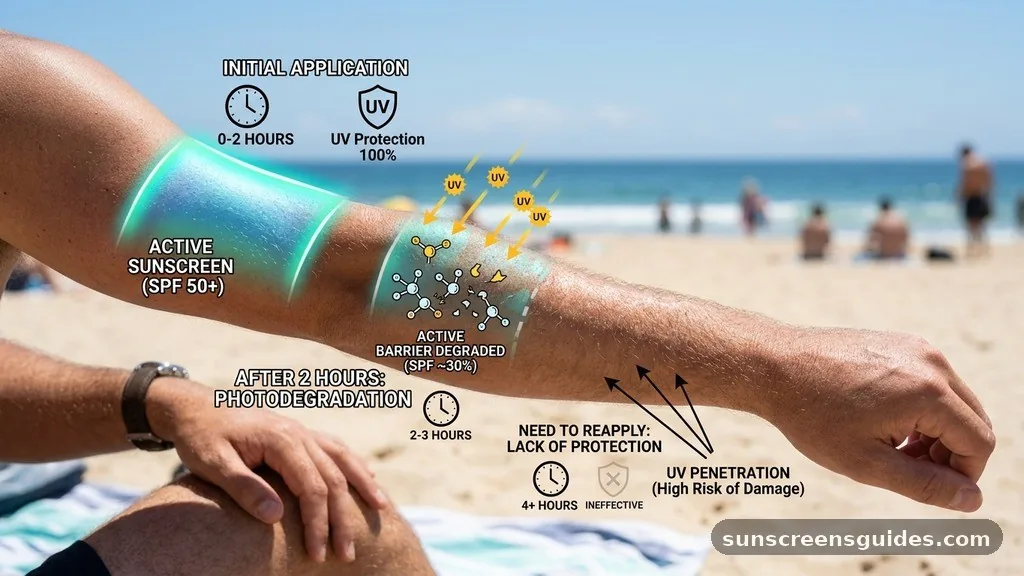
Knowing how long does sunscreen last before reapplying is a fundamental skill for anyone serious about skin health. Many people assume that putting on a generous layer of SPF in the morning covers them for the entire day, but this is a dangerous misconception.
Because of the way UV filters interact with light and environmental stressors, your initial application loses its effectiveness much faster than you might think. By understanding the science of product degradation, you can better protect your complexion from premature aging and long-term damage.
The Two-Hour Rule and Why It Matters
The standard guidance provided by dermatological associations is to reapply your sunscreen every two hours. This is not an arbitrary number. Most SPF products are designed to provide their labeled protection level under controlled laboratory conditions.
In the real world, factors like friction from clothing, natural oils, and physical activity break down the protective film on your skin. When you wait longer than two hours, you leave your skin vulnerable to cumulative UV radiation exposure.
The Role of Photodegradation
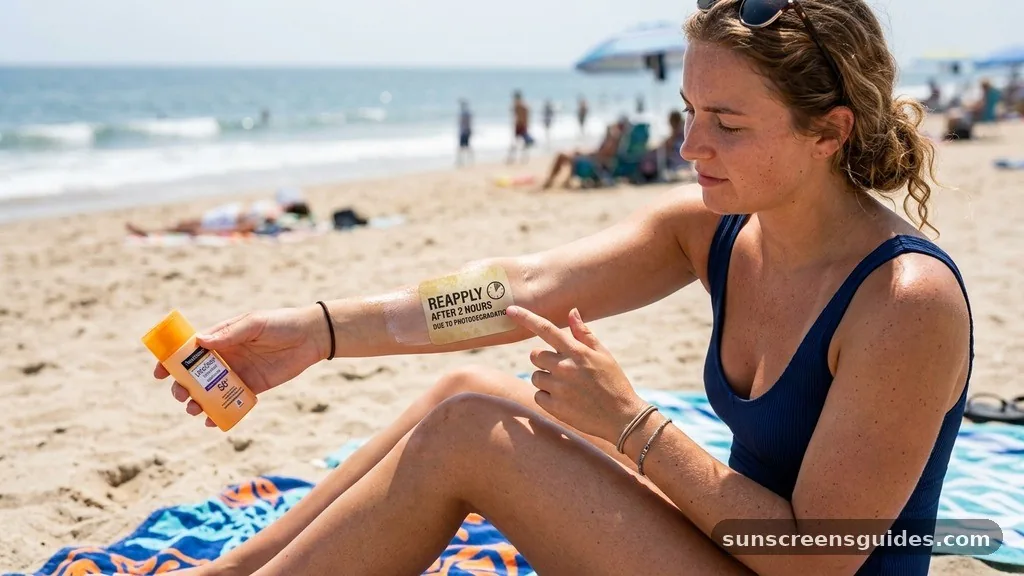
Photodegradation occurs when the active ingredients in your sunscreen—specifically chemical filters—begin to break down upon contact with sunlight. Think of these filters as sacrificial molecules; they absorb or deflect energy until their chemical structure changes and they can no longer do their job. Once these molecules have absorbed their fill of UV rays, they become unstable. This is why even if you aren’t sweating or swimming, your initial application is essentially “used up” after a few hours of consistent sun exposure.
Factors That Accelerate Sunscreen Breakdown
While the two-hour rule is a baseline, certain conditions require you to reapply much sooner. Any activity that disrupts the film of product on your face or body effectively lowers your SPF rating.
* Swimming or heavy perspiration: Even if a product is labeled water-resistant, it is rarely fully waterproof.
* Physical friction: Toweling off, rubbing your face, or wearing tight clothing wipes the product away.
* High-intensity outdoor activity: Direct, midday sun exposure speeds up the chemical breakdown of filters.
* Environmental variables: Wind and sand can act as exfoliants, removing the protective layer of sunscreen from your skin.
Chemical vs. Mineral Sunscreen Considerations
The specific formulation of your product can influence your reapplication strategy, though the two-hour window remains the safest bet. Chemical sunscreens generally work by absorbing UV rays and converting them into heat, which can lead to faster degradation during intense sun exposure. Mineral sunscreens, which use ingredients like zinc oxide or titanium dioxide, act more like a physical shield by reflecting or scattering radiation.
Stability and Skin Interaction
Mineral sunscreens are often praised for their photo-stability, meaning they don’t break down as quickly as chemical filters when hit by sunlight. However, they are still prone to being rubbed off or moved around by natural facial movements throughout the day. Regardless of whether you prefer a physical or chemical filter, the mechanical act of reapplying is necessary to maintain an even, full-coverage layer. If you find that your chosen product feels heavy, opting for a lighter, spray-on or powder-based formula can make the process of frequent reapplication much less of a chore.
Addressing Misconceptions About SPF Ratings
A common myth is that a higher SPF rating, like SPF 50 or SPF 100, grants you more time before you need to reach for the bottle again. This is fundamentally incorrect.
An SPF rating measures the level of protection against UVB rays, not the duration of that protection. Whether you are using SPF 30 or SPF 50, both are subject to the same rate of physical removal and chemical breakdown.
Understanding SPF 30 vs. SPF 50

The difference in protection is marginal at higher levels. SPF 30 blocks approximately 97% of UVB rays, while SPF 50 blocks about 98%. The extra percentage point does not mean you can stay in the sun twice as long or skip a reapplication. You should treat both products with the same level of care regarding timing.
| Factor | Sunscreen Behavior |
|---|---|
| SPF 30 | Blocks 97% of UVB; requires reapplication every 2 hours. |
| SPF 50 | Blocks 98% of UVB; requires reapplication every 2 hours. |
| Water-Resistant | Maintains efficacy for 40-80 minutes in water before needing reapplication. |
| Broad-Spectrum | Protects against both UVA and UVB; needs consistent coverage. |
Managing Sun Protection Indoors and in Daily Life
Many people ignore how long does sunscreen last before reapplying when they spend their day indoors. UVA rays, which are responsible for skin aging, can easily penetrate glass windows in offices, cars, and homes.
If you are sitting near a window, your skin is receiving cumulative UV exposure throughout the day. While you might not need to reapply as aggressively as you would at the beach, a morning application often fades by midday due to natural skin oils.
Practical Tips for Reapplication
Keeping up with reapplication is the biggest hurdle in effective sun protection. If you wear makeup, the idea of slathering on cream sunscreen every two hours feels impossible. Instead, consider using SPF-infused setting sprays or mineral powders. These products are designed to be applied over makeup, allowing you to top up your protection without ruining your look. For those who don’t wear makeup, keeping a travel-sized stick sunscreen in your bag is a convenient way to ensure you never miss a spot.
Identifying and Replacing Expired Products
A frequently overlooked aspect of sun protection is the sunscreen expiration date printed on the bottle. Using expired products is a major gap in most people’s skincare routines.
Over time, the chemical composition of the sunscreen shifts, and the preservatives that keep it stable begin to fail. This not only makes the product less effective at shielding you from UV radiation but can also lead to skin irritation or bacterial growth.
Why Expiration Matters
If you find a bottle in the back of your drawer from two summers ago, it is best to throw it away. Even if it hasn’t reached the printed date, extreme temperature changes—like leaving a bottle in a hot car—can ruin the formula’s integrity. Always check the texture and smell of your sunscreen. If it has separated, changed color, or developed an odd scent, the active ingredients are likely compromised, and you are no longer receiving the advertised broad-spectrum protection.
Addressing Topical Gaps in Sunscreen Maintenance
When discussing how long does sunscreen last before reapplying, many sources fail to address the nuance of skin type and climate. If you have oily skin, your natural sebum production acts as a solvent, breaking down the sunscreen film much faster than it would on dry skin. In humid, tropical climates, the constant presence of moisture on the skin can also accelerate the dilution of your sunscreen, meaning you might need to reapply every 60 to 90 minutes rather than waiting the full two hours.
The Importance of Even Distribution
Another often-ignored gap is the amount of product used. Most users apply only 25-50% of the amount required to achieve the SPF rating on the label. If you aren’t applying a full shot-glass amount to your exposed body parts, you are technically under-applying from the very start. Reapplication is your second chance to correct these coverage gaps. By layering your sunscreen, you ensure that any missed areas from your first application receive coverage during the second or third pass.
The Link Between Consistent Reapplication and Skin Health
The ultimate goal of tracking how long does sunscreen last before reapplying is the long-term prevention of skin cancer and photoaging. Skin cancer prevention is a lifelong commitment that relies on the consistency of your habits.
Every time you skip a reapplication, you allow a small amount of DNA-damaging radiation to penetrate your epidermis. Over months and years, these “small” exposures compound into sunspots, fine lines, and increased malignancy risk.
Creating a Lasting Habit
Make sun protection a ritual rather than a chore. Use cues in your environment to remind you: reapply when you eat lunch, or when you leave your office for a meeting. By building these small, manageable habits, you move past the annoyance of the two-hour rule and turn it into a standard part of your day. Your future skin will benefit significantly from the extra effort you put into maintaining that protective barrier.
Why Reapplication Remains Essential
Consistency is the secret to effective sun protection. Because UV radiation is constant and your skin’s surface is dynamic, no single application of sunscreen can provide all-day coverage. By following the two-hour rule, staying mindful of your activities, and using the right tools for your lifestyle, you effectively mitigate the risks associated with UV exposure.
Remember that the best sunscreen is the one you actually use, and the most effective way to use it is to reapply it regularly. Prioritize your skin’s health by making these simple adjustments to your daily routine, and don’t hesitate to reach out if you have concerns about specific product types or sun safety for your unique skin needs.
How long does SPF 50 last before reapplying?
SPF 50 should be reapplied every two hours, as its protective film degrades regardless of the high rating.
Does SPF 30 mean apply every 30 minutes?
No, SPF 30 refers to protection level, not timing. You still need to reapply every two hours.
How often should you actually reapply sunscreen?
You should reapply sunscreen at least every two hours, or immediately after swimming, sweating, or toweling off.
Is sunscreen from 2 years ago still good?
No, expired sunscreen often loses its chemical stability and protective efficacy; it should be replaced for safety.
Can I reapply sunscreen over my makeup?
Yes, using SPF-infused setting sprays or mineral powders allows for effective reapplication without disturbing your makeup base.
Does sunscreen last longer if I stay in the shade?
Shade reduces direct UV intensity, but ambient UV radiation still reaches the skin, requiring consistent reapplication habits.
Should I reapply on cloudy days?
Yes, UV rays penetrate clouds easily, so you must maintain your two-hour reapplication schedule even when overcast.



