

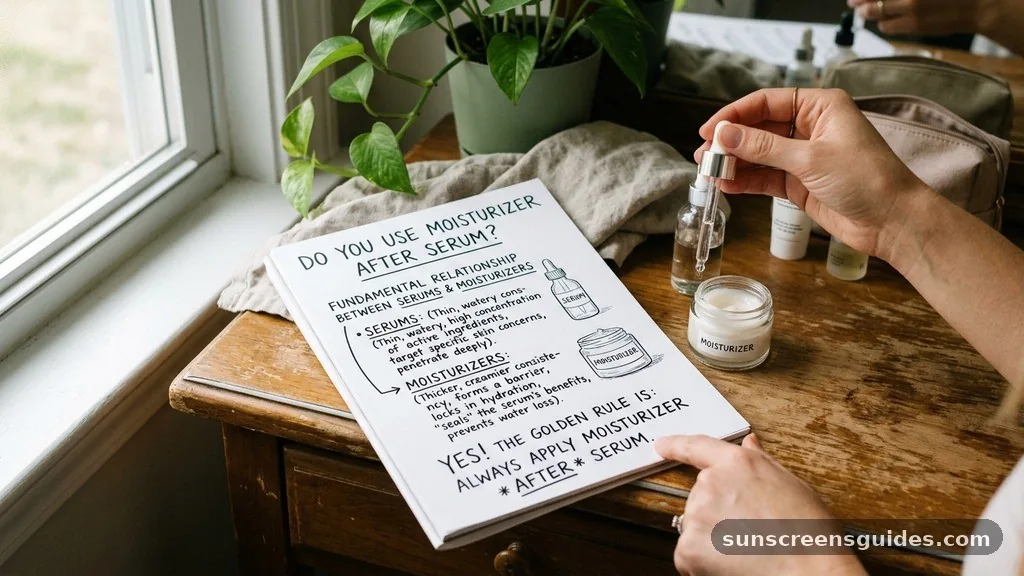
Determining whether you use moisturizer after serum is one of the most common points of confusion in a daily beauty regimen. While serums are designed to deliver potent, concentrated ingredients deep into the skin, they often lack the structural components required to keep that hydration locked in place. Many people skip this step, assuming their skin feels sufficiently hydrated, but this can lead to issues like dryness or irritation later in the day.
Understanding the specific function of each product ensures you get the most out of your investment while protecting your delicate facial surface. Mastering this application sequence is the simplest way to enhance your long-term results.
The Fundamental Relationship Between Serums and Moisturizers
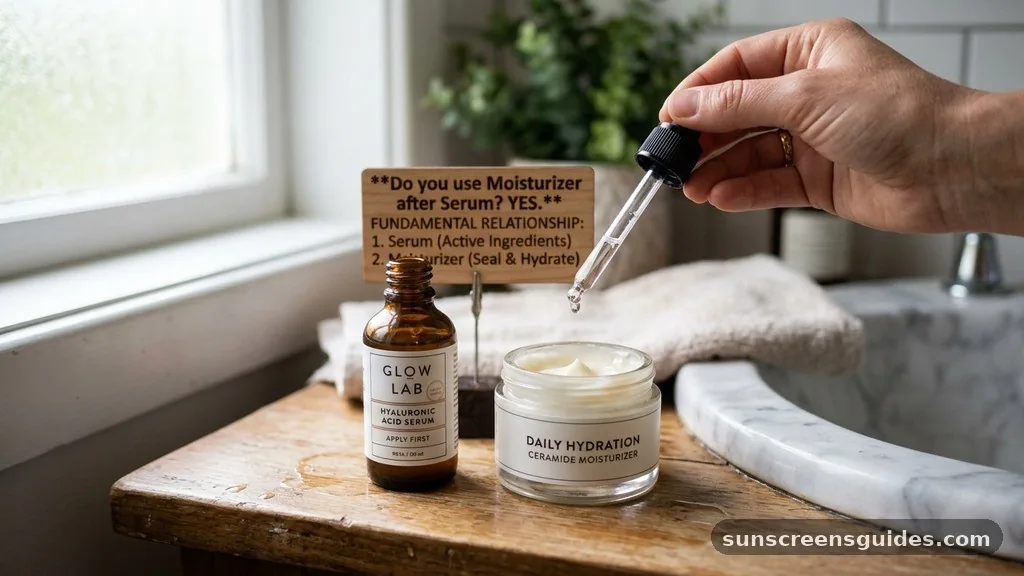
You should almost always apply moisturizer after serum because these products serve entirely different functions in your skincare routine order. A serum is formulated with a smaller molecular structure, allowing it to penetrate the surface quickly to deliver high concentrations of active ingredients like vitamin C or niacinamide.
However, these formulas rarely contain the heavy lipids or waxes needed to form a protective seal. By skipping the final step, you leave your skin vulnerable to transepidermal water loss, where the moisture you just applied evaporates into the surrounding air.
Think of a serum as a treatment layer and a moisturizer as a structural barrier. When you apply a cream or lotion over your serum, you create an occlusive layer that traps the active ingredients and hydration underneath.
This process significantly improves your overall skin barrier function, ensuring that your complexion stays plump and resilient throughout the day. If you have oily skin, you might be tempted to stop at the serum to avoid a greasy feeling, but choosing a light, non-comedogenic emulsion can provide the necessary protection without clogging your pores.
How Ingredient Science Dictates Your Application Order
The science behind product layering relies heavily on the texture and concentration of your chosen formulas. Most dermatologists recommend applying products from the thinnest consistency to the thickest, which naturally places your serum before your heavier creams. Serums often contain humectants like hyaluronic acid, which draw water into the skin, but without a moisturizer to seal that water in, the humectant can actually start pulling moisture out of your deeper skin layers as it evaporates.
| Product Type | Primary Function | Consistency |
|---|---|---|
| Serum | Targeted treatment | Thin, liquid, or gel |
| Moisturizer | Barrier protection | Cream, lotion, or balm |
| Facial Oil | Sealant/Emollient | Heavy, oil-based |
When you incorporate actives like retinol application into your evening routine, the order becomes even more critical. Because retinol can be drying, layering a moisturizer over your serum acts as a buffer, reducing the risk of irritation while still allowing the retinol to work effectively.
This layering technique allows you to enjoy the benefits of potent ingredients without compromising the comfort of your skin. Proper layering ensures that the high-performance serum isn’t wasted and that your skin remains balanced.
Optimizing Absorption Rates for Better Results

Timing your application can significantly impact how well your skin absorbs the products you use. Many experts suggest applying serum to slightly damp skin, as the increased hydration can help the product spread more evenly and penetrate more efficiently.
Once the serum feels tacky—usually after about sixty seconds—it is the perfect time to apply your moisturizer. This short waiting period prevents the products from pilling or mixing together in a way that might dilute their efficacy.
If you are using multiple serums, always apply them from the lowest pH to the highest pH, or from thinnest to thickest. Following this with a moisturizer serves as the final “lock” that stabilizes everything beneath it.
If you rush the process by layering everything at once, the products may not sit correctly on the skin, leading to a sticky residue or poor absorption. By giving each layer a moment to settle, you ensure that your skin barrier function remains intact and that your products are working in harmony rather than competing for space.
Addressing Common Misconceptions About Layering
A frequent gap in knowledge involves the fear that moisturizer will block the benefits of serum. In reality, the opposite is true; your skin is designed to absorb topicals, and a moisturizer provides the necessary environment for those actives to stay stable.
Many people believe that if a serum feels “rich enough,” they don’t need another layer. This is a mistake, as most serums lack the occlusives required to prevent environmental damage or dehydration throughout the day.
- Serums treat specific concerns like dark spots, fine lines, or redness.
- Moisturizers protect the lipid barrier and prevent water loss.
- Active ingredients need a stable base to function without causing sensitivity.
- Applying moisturizer last is a universal rule regardless of skin type.
- Facial oils should generally be used as the final step due to their heavy molecular weight.
Another common question is whether the order changes at night. Generally, the logic remains the same regardless of the time of day.
However, your evening routine is the perfect time to use slightly heavier moisturizers or specialized sleep masks that provide an even stronger barrier, as your skin undergoes natural repair processes while you sleep. By consistently finishing with a moisturizer, you support this nocturnal recovery and wake up with a more hydrated, balanced complexion.
Expert Answers to Common Skincare Questions
Is it ever okay to skip moisturizer after serum?
Generally, no; you should always seal your serum to prevent moisture loss and protect your skin barrier.
Does the order change if I use multiple serums?
Apply multiple serums from thinnest to thickest, then always finish with your moisturizer to seal them in.
Can I mix my serum into my moisturizer?
It is better to layer them, as mixing can disrupt the pH and absorption rates of the active ingredients.
How long should I wait between applying serum and moisturizer?
Waiting about one minute is sufficient for the serum to settle into the skin before applying your cream.
Do I need a moisturizer if I have oily skin?
Yes, use a light, non-comedogenic lotion to keep the skin hydrated without causing excess oil production or breakouts.
Should I use a different moisturizer for morning and night?
Many people prefer lighter lotions for the morning and thicker, nourishing creams for their evening routine.
Can facial oils replace my moisturizer?
Oils are occlusives and should be applied after your moisturizer to seal everything in, not as a replacement.
In summary, the question of do you use moisturizer after serum is answered with a clear directive: always layer your moisturizer over your serum. By following this sequence, you ensure that your treatments are protected and that your skin remains hydrated throughout the day. Start by applying your thinnest formulas first, letting them absorb briefly, and finishing with a moisturizer that suits your specific skin type.
This simple habit preserves your skin barrier and maximizes the effectiveness of every product in your cabinet. Consistency is the key to seeing real results, so make this layering technique a non-negotiable part of your daily routine. If you have been skipping this step, start tonight and notice how much more comfortable and plump your skin feels by morning.



