


The question of whether there is a truth serum has fascinated humanity for decades, appearing frequently in spy novels and cinematic thrillers as a convenient way to extract secrets from unwilling targets. While the term carries a ring of scientific certainty, the actual reality behind these substances is far more nuanced and grounded in the history of pharmacology.
Understanding what people mean when they ask if there is a truth serum requires separating the cultural myth of an “honesty potion” from the clinical application of substances that merely lower a subject’s inhibitions. This article breaks down the pharmacological agents involved, the historical context of their development, and why the concept remains a persistent fixture of popular imagination.
The Pharmacological Reality of Truth Serum
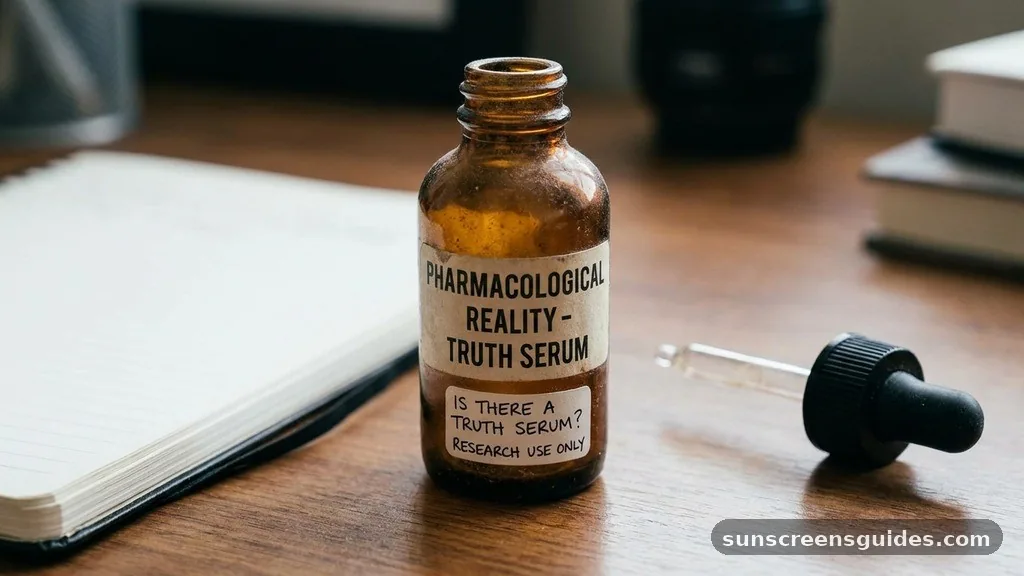
In the strict scientific sense, there is no single substance that can force a human being to speak the absolute truth. The substances historically labeled as truth serum, such as sodium amytal and sodium pentothal, belong to a class of drugs known as barbiturates.
These chemicals act as central nervous system depressants, slowing down brain activity and inducing a state of deep relaxation or mild sedation. When administered in a clinical setting, they can cause drug-induced disinhibition, which might make a person more talkative, less guarded, and more prone to rambling.
However, this increased talkativeness does not equate to accuracy or honesty. Because these drugs cause significant cognitive impairment, they often lead the subject to become highly suggestible, meaning they might agree with whatever premise an interrogator puts forward just to please them or end the session.
The neurological effects create a dreamy, disoriented state where memory becomes unreliable and internal logic breaks down. Consequently, while a person might spill secrets, they are just as likely to invent elaborate fantasies or provide false confessions that sound convincing to the listener.
Historical Experiments and Institutional Use
The search for a reliable chemical agent for interrogation reached its peak during the mid-20th century, most notably through programs like the CIA MKUltra project. During this era, researchers explored various chemicals, including scopolamine and various sedatives, hoping to find a way to dismantle a subject’s resolve. The goal was to bypass the “will to resist” during intelligence operations, but these efforts consistently failed to produce a reliable tool for gathering verified information.
The failure of these programs was largely due to the unpredictable nature of human psychology under chemical influence. While researchers could reliably induce lethargy or confusion, they could not direct the content of the speech that followed.
These programs were eventually abandoned because the data gathered was deemed legally and scientifically useless in a court of law. The legacy of these experiments remains a dark chapter in psychopharmacology, highlighting the dangerous ethical boundaries that were crossed in the pursuit of an impossible technological solution to a complex human behavior problem.
Why Truth Serum Fails in Forensic Settings

When people consider the reality of interrogation, they often wonder why law enforcement agencies don’t utilize these drugs to solve crimes. The primary reason is that the legal and ethical implications of drug-induced testimony make it inadmissible in almost every modern judicial system.
Testimony obtained while a person is under the influence of a sedative is considered coerced or unreliable by default. A person under the influence of a barbiturate cannot provide informed consent, nor can they be cross-examined effectively due to their altered state of mind.
Furthermore, forensic psychology has established that human memory is reconstructive and malleable. Even without chemical intervention, people often misremember events; adding a sedative into the mix creates a cocktail of misinformation that is nearly impossible to untangle.
Unlike polygraph tests, which attempt to measure physiological stress as a proxy for deception, chemical agents interfere with the very cognitive processes required to distinguish between reality and imagination. The following table outlines the main differences between common investigative tools:
| Method | Mechanism | Reliability |
|---|---|---|
| Polygraph | Measures physiological stress | Controversial/Inadmissible |
| Barbiturates | Induces chemical disinhibition | Scientifically unreliable |
| Interrogation | Psychological rapport building | High (when conducted properly) |
Addressing Common Myths and Misconceptions
Many people conflate the idea of a truth serum with hypnotic suggestion or other forms of mind control, assuming that a drug can strip away a person’s personality. This is a profound misunderstanding of how the brain processes information and social pressure.
While a drug might make a person less capable of maintaining a facade, it does not rewrite their core values or replace their internal narrative with a “truth” file. The brain is not a computer drive that can be accessed by injecting a specific compound.
To clarify the nuance of this topic, consider these common misunderstandings:
- The drugs do not make people “truthful”; they make them “unfiltered.”
- There is no antidote or specific dose that guarantees a confession.
- The feeling of being “drugged” often leads to anxiety, which can cause further confusion.
- Different individuals react to the same dosage in vastly different ways based on tolerance.
- Memory retrieval under influence is often fragmented and lacks narrative coherence.
These factors ensure that the pursuit of a chemical truth-teller remains confined to fiction. Science continues to focus on behavioral analysis and cognitive interviewing techniques rather than chemical shortcuts.
Frequently Asked Questions
Is sodium pentothal actually used as a truth serum?
It was historically used to induce disinhibition, but it is not a reliable way to extract truth.
What does a truth serum feel like to the user?
Users typically report a heavy, dreamlike state, significant disorientation, and a decreased ability to filter thoughts.
Why is truth serum considered dangerous for medical use?
These drugs cause respiratory depression and cognitive impairment, which can lead to life-threatening complications if mismanaged.
Can a person fight the effects of a truth serum?
Because the drug affects brain chemistry directly, it is difficult to “fight” the resulting confusion or sedation.
Are there any modern drugs that act like truth serum?
No modern pharmaceutical agent has been proven to reliably elicit accurate, verifiable information from a resistant subject.
Why do movies make truth serum seem effective?
Fiction relies on the trope of a simple solution to complex moral dilemmas to move plot lines forward.
Are confessions under the influence of drugs legal?
No, such confessions are legally inadmissible because they are considered coerced and lack any scientific validity.
The consensus among experts in medicine and law is clear: there is no magic substance that can act as a truth serum. While certain drugs can lower inhibitions and create a talkative state, they simultaneously undermine the reliability of the speaker, making the information gathered largely useless for objective truth-seeking. The persistent myth of such a serum speaks more to our collective desire for a simple solution to human deception than to any tangible breakthrough in chemistry.
Moving forward, justice systems will continue to rely on investigative rigor, forensic evidence, and psychological expertise rather than chemical intervention. If you found this overview helpful, consider exploring how modern memory studies are changing the way investigators approach witness statements and suspect interviews.



