

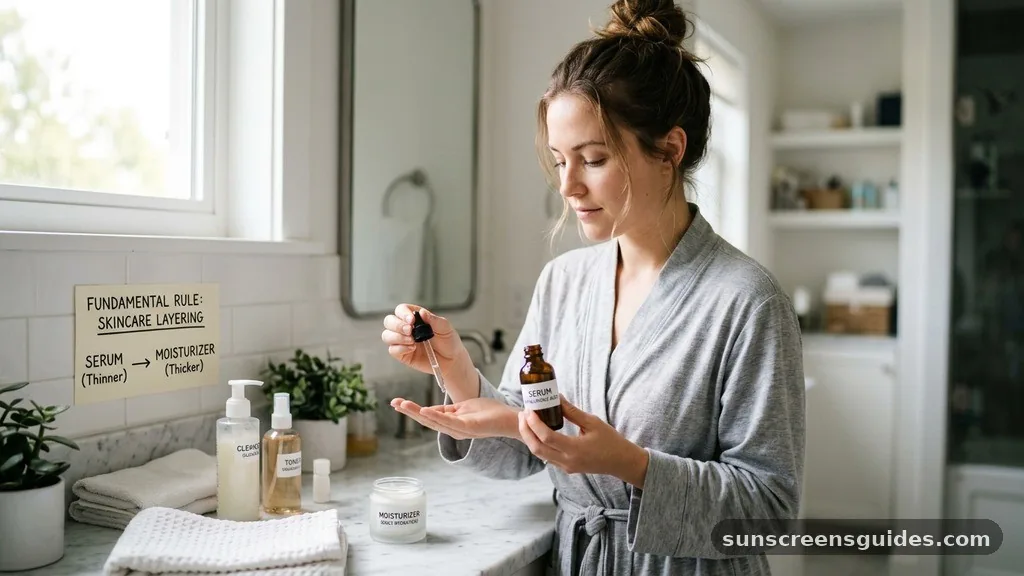
Determining whether you should apply your serum before or after moisturizer is the most common point of confusion in modern beauty regimens. If you have ever stared at your bathroom counter wondering which bottle to reach for first, you aren’t alone. The rule of thumb in professional dermatology is to apply products in order of consistency, moving from the thinnest to the thickest textures.
Since serums contain high concentrations of potent actives and are designed to penetrate deeply, they almost always go on clean, bare skin. Getting this sequence right ensures your skin actually benefits from the expensive ingredients you have invested in rather than letting them sit uselessly on the surface.
The Fundamental Rule of Skincare Layering

When deciding if you should apply a serum before or after moisturizer, the standard professional advice is to prioritize your thinnest products first. Because serums are usually water-based or lightweight gels, they have a lower molecular weight compared to dense, creamy lotions.
If you were to apply a heavy cream first, its thicker consistency would create a barrier that prevents the thinner serum from reaching your pores. By starting with your serum, you allow the active ingredients to bypass the surface layer and interact directly with your skin cells.
Think of your skin as a sponge that needs to be saturated. A lightweight serum acts as the initial soak, delivering concentrated nutrients like hyaluronic acid or brightening agents. Once that has been absorbed for a few seconds, you follow up with a moisturizer to seal everything in.
This layering strategy is not just about preference; it is about respecting the physics of absorption rate and product viscosity. If you find your products pilling or rolling off your face, it is almost certainly a sign that you have applied them in the wrong order or without enough drying time in between.
Understanding Product Textures and Delivery Systems
Not all serums are created equal, which can sometimes complicate the process of layering. A water-based serum will always feel fluid and light, making it the perfect candidate for direct contact with the skin.
However, some newer formulations include oil-based components or thicker suspensions that might feel slightly more viscous. Even then, the goal remains the same: use your most fluid products before your most structured ones.
Why Consistency Dictates Your Routine
Your skincare routine order functions best when you respect the density of your products. A good way to visualize this is to imagine how water behaves compared to a thick wax or butter. The water can flow around and through the layers, but the wax sits on top to create a seal.
- Cleansers and toners prepare the surface by removing debris.
- Serums deliver targeted treatments like peptides, antioxidants, or acids.
- Moisturizers provide an emollient layer to lock in hydration and prevent evaporation.
- Sunscreen or heavy occlusives form the final, non-permeable shield.
By following this sequence, you ensure that the skin barrier remains healthy and protected. If you reverse this order, you essentially waste your serum because the ingredients cannot penetrate the thicker layer of cream.
The Role of Occlusives and Hydration

Many people worry about transepidermal water loss, which is the process where moisture evaporates from your skin throughout the day. This is exactly where your moisturizer plays its most important role. While a serum provides the hydration, a moisturizer acts as an occlusive moisturizer or a heavy-duty emollient that traps that hydration inside.
If you apply your moisturizer first, you are effectively “capping” your skin before the serum has a chance to work. This can lead to a situation where the serum sits on top of the cream, oxidizes, or simply evaporates.
You want the serum to reach the living layers of the epidermis, and you want the moisturizer to protect that work. This symbiotic relationship is the secret to maintaining balanced skin hydration without causing pore clogging or breakouts.
| Product Type | Primary Function | Layering Position |
|---|---|---|
| Cleanser | Removes impurities | First |
| Water-based Serum | Delivers concentrated actives | Second |
| Lightweight Lotion | Provides balanced moisture | Third |
| Occlusive Cream | Seals in hydration | Final |
Addressing Topical Gaps in Layering Knowledge
A common point of confusion arises when using multiple types of serums or specialized treatments. Many users ask: “If I use a vitamin c serum in the morning and a retinol at night, do these change the layering rules?” The answer is consistently no.
Regardless of the specific active, the texture rule remains the dominant factor. You should always apply your most potent treatment immediately after cleansing and toning. If you are using two different serums, apply the thinner one first and wait about thirty to sixty seconds for it to dry before applying the second.
Another gap often found in advice columns is the “damp skin” debate. Many dermatologists suggest applying your serum while your skin is slightly damp from washing, as this can increase the efficacy of humectants like hyaluronic acid. These ingredients work by pulling water molecules into the skin; if the air is dry, they might actually pull moisture out of your skin.
Applying them to damp skin gives them a reservoir of water to work with, which is a significant “pro-tip” that many generic guides overlook. Once the serum is applied to damp skin, you can then proceed with your moisturizer as the final step.
Consistency and Your Skin’s Health
Achieving a healthy complexion is rarely about using the most expensive products, but rather about the skincare layering consistency you maintain. If you are inconsistent with your order, your skin may react unpredictably. You might experience breakouts because a heavy cream was forced into pores that weren’t ready, or you might notice dry, flaky patches because your serum never actually reached the deeper layers of your dermis.
Developing a habit of applying products from thinnest to thickest creates a rhythm that your skin can rely on. Even if you are in a rush, sticking to this sequence ensures that every drop of your product is working as intended. Remember, skincare is a marathon, not a sprint.
The way you layer your products today dictates how your skin will feel and look in the coming weeks and months. Always start with your serum, follow with your moisturizer, and let your skin thank you for the clarity.
Frequently Asked Questions
Does the order change if I use a facial oil?
Yes, facial oils should almost always be applied after your moisturizer, as they are the heaviest products.
Should I wait for my serum to dry before using moisturizer?
Yes, waiting sixty seconds ensures the serum has been absorbed, preventing the products from mixing and pilling.
Can I mix my serum into my moisturizer?
It is generally better to layer them, as mixing can disrupt the formulation and reduce the serum’s absorption.
Does applying serum before moisturizer help with acne?
Yes, it ensures that active treatment ingredients reach the skin directly, which is more effective for managing breakouts.
What happens if I apply moisturizer before serum?
The moisturizer creates a barrier that prevents the serum from penetrating, making the treatment much less effective.
Are there exceptions to the thin-to-thick rule?
Only if your dermatologist specifically prescribes a unique routine for a condition like rosacea or severe eczema.
How do I know if my serum is water-based?
Check the ingredient list; if water (aqua) is the first ingredient, it is almost certainly water-based.
Conclusion
Mastering the order of your daily routine is the simplest way to see better results from your products. Once you commit to the rule of applying your serum before your moisturizer, you allow your targeted treatments to penetrate effectively while your moisturizer provides the necessary seal to prevent evaporation. This straightforward approach protects your skin barrier and maximizes the value of every bottle in your cabinet.
If you have been struggling with products that feel like they aren’t “working” or are causing unwanted texture, try adjusting your layering sequence this week. Consistency in your application order is just as important as the quality of the ingredients themselves.
If you have specific questions about how your unique products interact, feel free to reach out or check the ingredient labels for texture indicators. We are always here to help you refine your approach to better skin health.



