


Navigating the nuances of a daily skincare routine often leaves people wondering if they are applying their products in the most effective sequence. A common point of confusion involves the layering of concentrated treatments versus traditional creams. Determining whether does serum go before moisturizer is essential for maximizing the efficacy of your beauty regimen.
Because serums and moisturizers serve distinct functions, applying them in the wrong order can actually hinder the results you are trying to achieve. Understanding the science behind product absorption and formulation is the key to unlocking a healthier, more radiant complexion. By following a logical application sequence, you ensure every drop of product works exactly as intended for your skin.
The Scientific Logic of Skincare Layering

The fundamental rule of skincare layering is to apply products from the thinnest consistency to the thickest. This principle exists because molecular weight dictates how easily a product penetrates the skin’s surface. Serums are typically formulated with smaller molecules, allowing them to travel deep into the dermis to deliver targeted active ingredients.
If you were to apply a heavy cream first, its thicker, oil-rich texture would create a physical barrier that prevents the lighter serum from reaching its intended destination. Consequently, the serum would sit uselessly on top of the cream, failing to address the underlying concerns it was designed to treat.
When considering if does serum go before moisturizer, it is helpful to think about the primary role of each product. A serum is a delivery system for potent compounds like vitamin c, retinol, or niacinamide. These ingredients need direct contact with clean skin to function optimally.
A moisturizer, on the other hand, acts as a sealant. It is usually an emulsion designed to lock in hydration and prevent evaporation of the water content within your skin. By applying the serum first, you allow the active ingredients to absorb, and then you follow up with a moisturizer to “seal the deal,” creating an effective protective layer over your freshly treated skin.
Why Product Texture Dictates Order
Consistency is the most reliable indicator of where a product belongs in your daily regimen. Most serums are water-based products, which means they have a high absorption rate and are designed to disappear into the skin quickly without leaving a greasy residue.
If you apply a thick, creamy lotion before a watery serum, the lotion’s oils will repel the water-based formula. This disruption makes it nearly impossible for the serum to penetrate, effectively wasting your investment in high-quality treatment products.
Following the rule of “thinnest to thickest” ensures that you don’t compromise the integrity of your skincare routine. You can easily test this by placing a drop of your serum next to your moisturizer on the back of your hand. The serum will likely run or spread quickly, while the moisturizer will hold its shape and sit on the surface.
This simple visual confirms that the serum is designed to be absorbed, while the moisturizer is designed to coat. By respecting the physical properties of these formulas, you maintain the health of your skin barrier and ensure that every product performs its specific job without interference from the next step.
Balancing Humectants and Occlusives
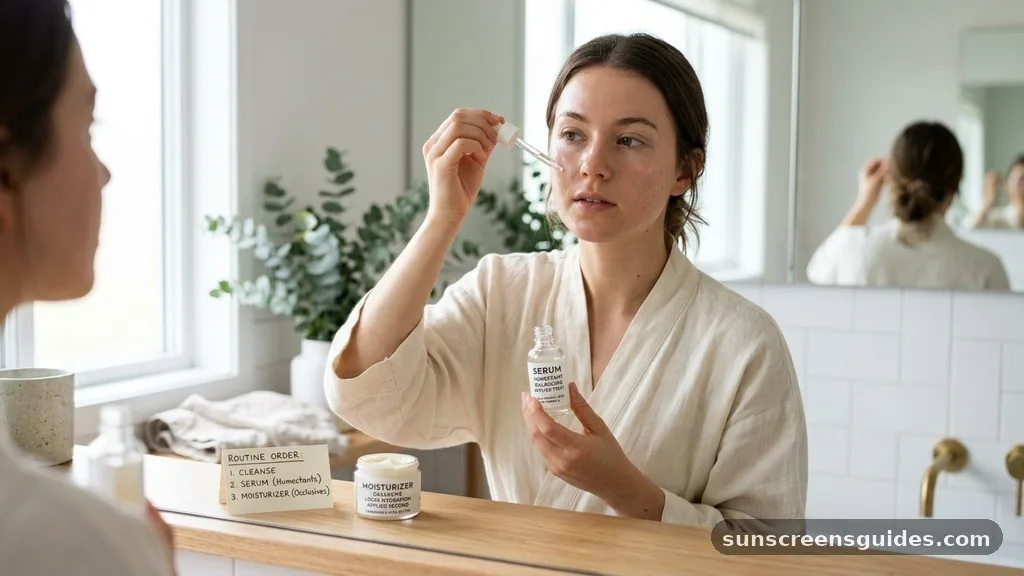
In the world of dermatology, ingredients are often categorized by how they interact with moisture. A humectant, such as hyaluronic acid, works by drawing water into the skin. When you use a serum packed with humectants, you want those ingredients to grab moisture from the air or from your damp skin.
If you apply a heavy occlusive moisturizer—which is designed to sit on top of the skin to block moisture loss—immediately over a humectant serum, you create an ideal environment for hydration. The serum pulls the water in, and the moisturizer prevents it from escaping.
This synergy is vital for maintaining long-term skin health. If you were to flip the order, the occlusive moisturizer would prevent the humectant serum from drawing in any ambient moisture. Furthermore, the occlusive layer might block the serum’s penetration entirely, leading to a situation where your skin feels tight or dry despite your best efforts.
Understanding this relationship helps you troubleshoot why a product might not be working as expected. If you feel like your skin is still parched after a full routine, you might be accidentally blocking your most hydrating treatments by applying them in the wrong sequence.
Creating Your Ideal Skincare Routine Order
Establishing a consistent skincare routine order is the most effective way to see visible improvements in your skin tone and texture. While the basic rule is to move from light to heavy, some people find it helpful to visualize the process as a series of layers. Below is a breakdown of how to structure your daily routine to ensure maximum efficacy.
- Cleanser: Removes dirt and impurities to create a clean canvas.
- Toner: Balances the pH of your skin after washing.
- Serum: Delivers concentrated actives like antioxidants or exfoliants.
- Moisturizer: Seals in the previous layers and provides hydration.
- Sunscreen: Protects the skin from UV damage during the day.
This sequence is designed to optimize each step. For example, applying a vitamin c serum in the morning allows it to provide antioxidant protection before you apply your daytime moisturizer and SPF. Similarly, using a retinol treatment at night ensures that the active molecules can work their magic during your skin’s natural repair cycle, shielded by a nourishing moisturizer.
| Product Category | Primary Function | Application Order |
|---|---|---|
| Serum | Targeted treatment/actives | First (after cleansing) |
| Moisturizer | Hydration/Sealant | Second (after serum) |
| Sunscreen | UV Protection | Last (morning only) |
Addressing Common Routine Misconceptions
Many people wonder if they can skip steps or if all serums are created equal. A common gap in knowledge is the assumption that every serum requires the same amount of time to absorb. While most serums soak in within 30 to 60 seconds, some heavier, oil-based serums might take a bit longer.
If you rush the process, you might end up mixing your products into a pilled mess on your face. Always give each layer a moment to settle before moving on to the next, especially if you are using multiple serums in a single routine.
Another point of confusion is whether you should use both serum and moisturizer at all times. If you have very oily skin, you might feel tempted to use only a serum. However, even oily skin needs a moisturizer to prevent dehydration, which can trigger excess oil production.
Look for lightweight, gel-based moisturizers that provide hydration without feeling heavy. Conversely, if you have dry skin, you might need a richer cream, but the layering logic remains the same.
The serum provides the clinical treatment, and the moisturizer provides the comfort and protection. Never assume that a serum can replace the barrier-building benefits of a well-formulated moisturizer.
Frequently Asked Questions
Does serum go before moisturizer every time?
Yes, you should always apply serum first because its smaller molecules need direct access to your skin.
Can I mix serum and moisturizer together?
Mixing them can dilute the potency of the serum and prevent it from absorbing properly into the skin.
How long should I wait between applying serum and moisturizer?
Wait about 60 seconds for the serum to feel tacky or dry before applying your moisturizer on top.
What happens if I apply moisturizer before serum?
The moisturizer creates a barrier that prevents the serum from penetrating the skin, making the treatment ineffective.
Should the order change at night?
No, the layering rule remains the same at night; always prioritize thin treatments before thicker, occlusive creams.
Can I use multiple serums at once?
Yes, layer them from thinnest to thickest, but avoid combining conflicting actives like retinol and strong exfoliants.
Does the order matter for sunscreen?
Yes, sunscreen should always be the final step in your morning routine to ensure maximum protection against UV.
Final Thoughts on Product Layering
Mastering the correct sequence for your beauty products simplifies your morning and night and ensures you are getting the most out of your skincare investment. By remembering that does serum go before moisturizer is a question answered by the physics of absorption, you can confidently build a routine that actually delivers results. Always start with your thinnest, most potent treatments and follow them up with a protective moisturizer to seal in the goodness.
If you have any specific concerns about your skin type, observing how your face reacts to different textures will guide you toward the perfect regimen. Consistency is the ultimate secret to success, so stick to your order and enjoy the process of caring for your skin. If you found this breakdown helpful, feel free to share it with someone looking to refine their own skincare habits.



