
So you just found a half-squeezed bottle of sunscreen shoved behind the sink and you’re standing there squinting at a date thats half rubbed off, wondering if it’ll still do its job or if your basically about to rub expired goop on your kids before the pool. Yeah, that’s a very normal Tuesday for most of us honestly. Sunscreen isn’t like a candle that just sits there looking pretty on a shelf, it’s a chemistry experiment in a bottle, and chemistry experiments do eventually go sideways.
Most people don’t think twice about expiration dates until their standing in the sun already, bottle in hand, sweat dripping, kids yelling to hurry up. That’s exactly the moment this question hits hardest, and its a fair one to ask because expired sunscreen isn’t just “meh it probably still works a little,” it can genuinely leave you way more exposed then you think.
Does Sunscreen Actually Expire, Or Is That Just a Marketing Thing
Some people online will tell you expiration dates on skincare products are basically a scam to get you buying more bottles, which, fair enough, skepticism is healthy. But in this case the skepticism doesn’t hold up. The FDA requires all sunscreen products to display an expiration date unless stability testing shows the product remains stable for at least three years, and the date must appear clearly, usually with an “EXP” label followed by month and year. That’s not a suggestion, its a regulatory requirement because sunscreen is legally classified as an over the counter drug in the US, not just some cosmetic lotion.
FDA rules require all nonprescription drugs, sunscreen included, to carry an expiration date unless the manufacturer’s stability testing proves the formula stays stable for at least three years, meaning a bottle without a printed date should be treated as expired three years after you bought it. So basically, no date on the bottle doesn’t mean forever-good, it just means the company already proved the three year mark to the FDA and didn’t bother printing anything.
So How Long Is Sunscreen Actually Good For
Here’s the part everyone actually wants to know, cutting past all the regulatory stuff. In general terms:
- Unopened sunscreen, stored somewhere reasonable: about 3 years from manufacture
- Opened sunscreen, used regularly: still roughly 3 years, opening the bottle doesn’t speed anything up on its own
- Sunscreen left in a hot car, beach bag, or windowsill: could degrade way faster, sometimes within a single summer
- Sunscreen with a rubbed-off or missing date: treat it as 3 years from your purchase date, write it on with a sharpie if you have to
Consumer Reports actually tested this directly, which I think is kind of reassuring. According to their sunscreen testing lead Susan Booth, a sunscreen expiring in six months should perform just as well as one with three years left on the clock, as long as it’s been stored properly. They even went back and retested old samples from previous years sitting in their lab and found basically no drop off in how well they worked, so opening the bottle really isn’t the villain here, heat and sunlight are.
What Happens Once It Passes the Expiration Date
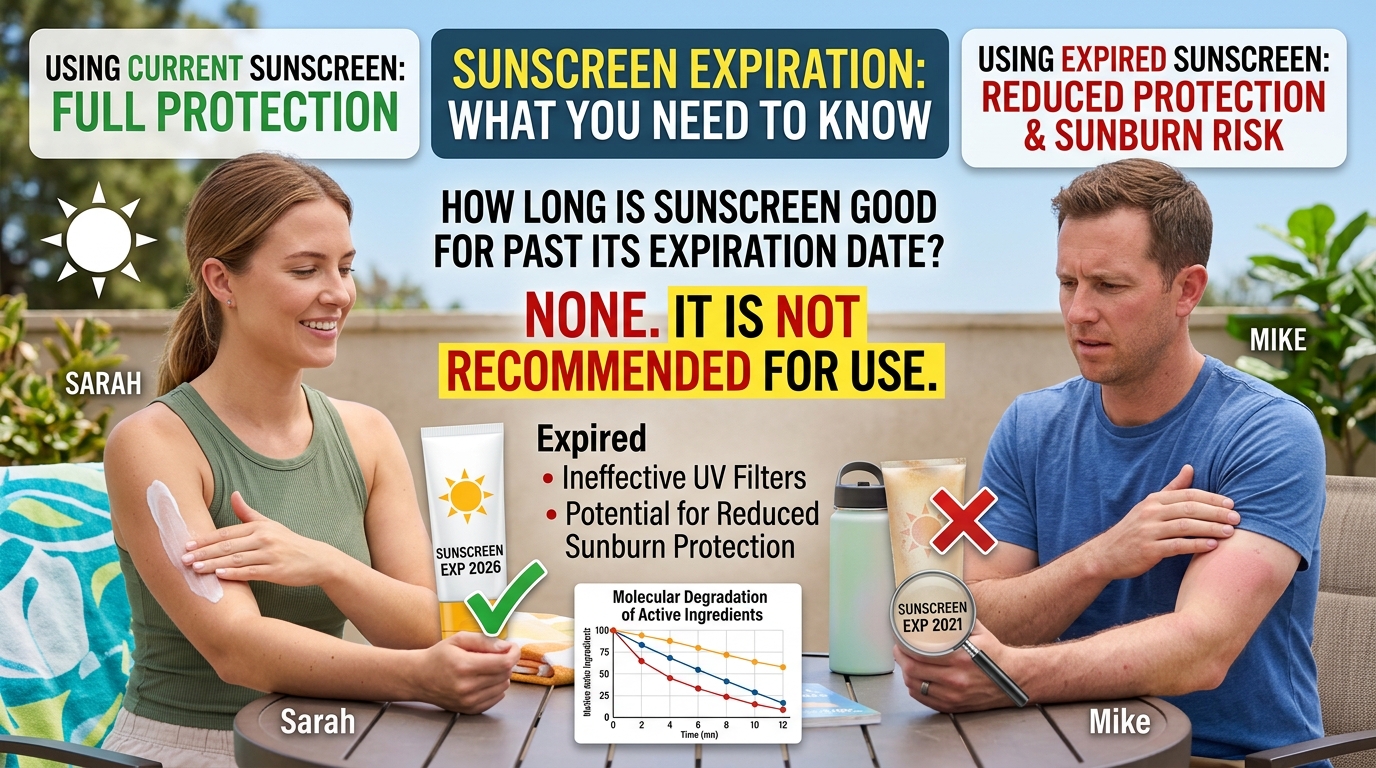
Once your past that printed date, things start going downhill, though not instantly and not dramatically at first, more of a slow fade. Once the active ingredients degrade, the SPF number on the label becomes meaningless, so you could be applying something labeled SPF 50 and actually getting protection closer to SPF 15 or even less, with no visible way to tell until you’re already sunburned.
That’s the scary part honestly, there’s no smell test or color check that reliably warns you in advance for chemical degradation specifically. Though there ARE some physical signs worth checking, listed out below because bullet points make this easier to scan when your standing in a bathroom trying to decide fast:
- Texture turning watery, gritty, or separating into weird layers
- Color shifting, especially going yellowish or brownish
- Smell changing to something sour, rancid, or just “off”
- Consistency feeling thinner or thicker than you remember
If any of those show up, chuck it, doesn’t matter what the date says. Mayo Clinic backs this up too, noting plainly that you should throw out sunscreen whenever its color or texture changes noticeably, regardless of the printed expiration date.
Storage Matters Way More Than People Realize
I think this is honestly the most underrated part of this whole topic. People obsess over the printed date but ignore how they actually treat the bottle day to day, which matters arguably even more.
| Storage Condition | Effect on Shelf Life |
|---|---|
| Cool, dry cabinet indoors | Full 3-year lifespan generally holds up |
| Beach bag in direct sun for hours | Can degrade noticeably within one season |
| Hot car glove compartment, summer | Severe degradation possible, sometimes within weeks |
| Refrigerated storage | May extend usable life slightly beyond 3 years for some formulas |
Researchers looking specifically at sunscreen stability found that formulations kept below roughly 30°C, about 86°F, held onto their protective compounds much better than those exposed to higher heat, and a bottle left in a car reaching 122°F could lose effectiveness well before its printed date ever arrives. Basically your glovebox is a sunscreen graveyard, don’t do it.
What If There’s No Date On the Bottle At All
This happens more then you’d expect, especially with smaller or imported brands, or just bottles where the ink wore off from being tossed in a bag for months. Since the FDA doesn’t actually mandate a printed bottling or expiration date, manufacturers sometimes skip it entirely, and when there is a date it can appear in formats people aren’t used to, like the year digits listed before the month.
If you genuinely cannot find any date and don’t remember the purchase month, the safest move according to nearly every dermatology source is simple: don’t risk it, buy new. The FDA advises against using sunscreen with no expiration date that wasn’t purchased within the last three years, recommending it just be discarded. A ten dollar bottle of sunscreen is cheap insurance compared to a nasty sunburn or worse, cumulative skin damage you won’t notice for years.
Reading the Cryptic Batch Codes
Sometimes there’s no clear “EXP” label but there IS a little code stamped somewhere, on the crimp of a tube or the bottom of a bottle. These codes usually encode the manufacture date and lot number, even if they look like gibberish at first glance. Some websites let you punch in the brand and code to decode the actual bottling date, which honestly feels like unnecessary detective work for a beach day but hey, it works if your desperate to know.
Quick Answers People Usually Search For
Can I use sunscreen a few months past the expiration date? Probably fine if it looks and smells normal and was stored well, but its a gamble, not a guarantee. The safer move is always replacing it.
Does opened sunscreen expire faster than unopened? Not really according to the research, opening doesn’t meaningfully speed up degradation on its own, heat and light exposure are the actual culprits.
Is expired sunscreen dangerous to use, or just less effective? Mostly just less effective, though there is a real risk of skin irritation, and in older bottles, potential bacterial growth if preservatives have broken down.
How much sunscreen should I even be using? The FDA recommends about one ounce for a full adult body application, roughly the amount that fills a shot glass, applied 15 minutes before sun exposure and reapplied every two hours or sooner if swimming or sweating.
The Bottom Line
Sunscreen expiration isn’t some made up marketing gimmick meant to squeeze more money out of you, its a real regulatory standard backed by actual stability testing, and it exists because the active ingredients genuinely do break down over time, faster if you leave the bottle baking in a hot car or sitting in direct sun for hours on end. Generally you’re looking at about three years from manufacture, whether the bottle’s been opened or not, but that number shrinks fast under bad storage conditions.
Next time you find that mystery bottle in the back of a drawer, do the quick checks, look at the date if there is one, check the texture and smell, and when in doubt just replace it. Your skin will thank you later, probably in about twenty years when you’re not dealing with sun damage you could’ve easily avoided for the price of a new bottle.