
When to apply sunscreen before or after moisturizer kinda sneaks into your head right when you’re already standing in front of the mirror with two bottles in your hands, wondering if swapping the order will somehow ruin everything. Maybe you’ve tried both ways already and your skin still felt a bit weird. Yeah, that happens more often then people admit. The good news is that the answer isn’t actually confusing once you understand why skincare products behave the way they do.
The order you apply skincare products matters because each one has a different job. Moisturizers are designed to hydrate and strengthen your skin barrier, while sunscreen forms a protective layer that shields your skin from ultraviolet (UV) radiation. If you mix up the order, you may reduce the effectiveness of one or both products without even noticing it.
So let’s clear up the confusion once and for all.
Should You Apply Sunscreen Before or After Moisturizer?
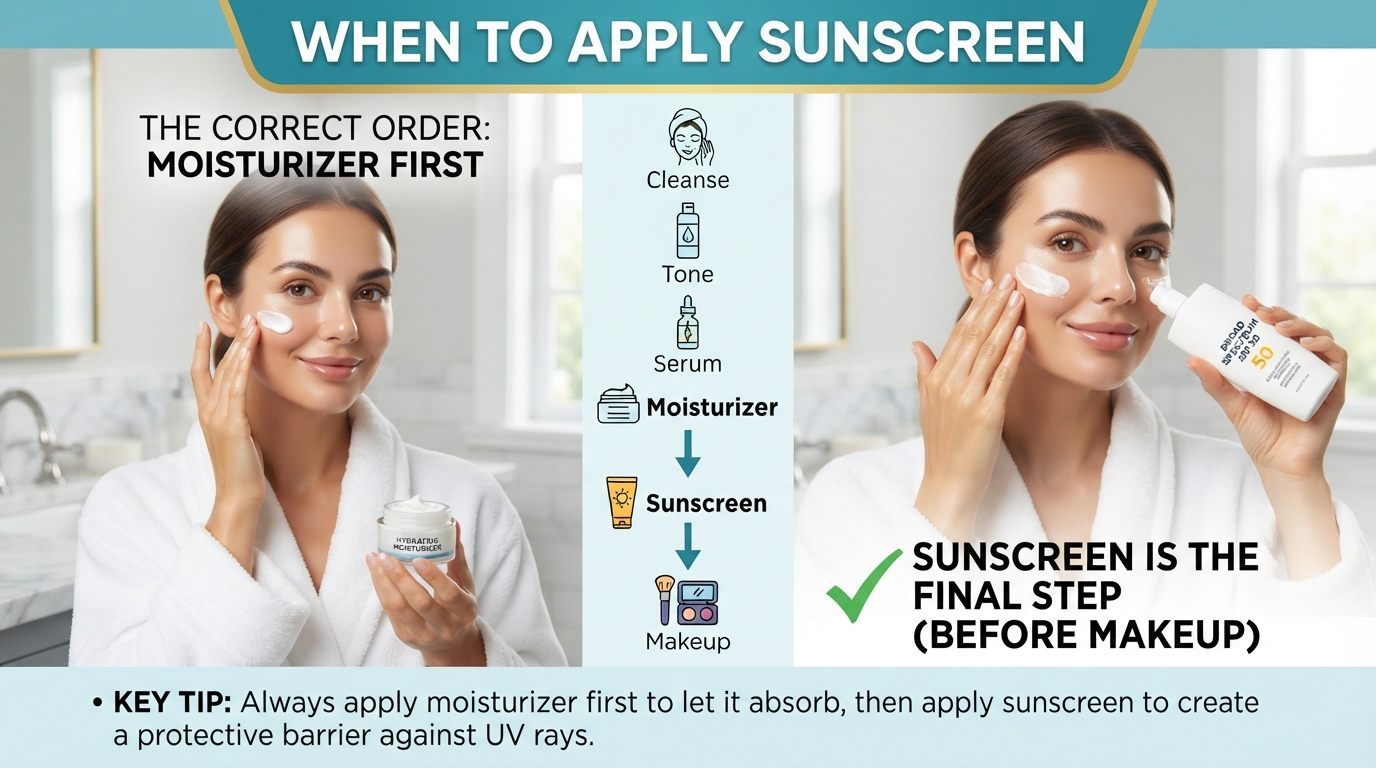
For almost everyone, sunscreen should be applied after moisturizer as the final step of your skincare routine and before makeup.
Think about it this way. Your moisturizer feeds your skin with hydration, while sunscreen sits on top like an invisible shield. If you apply moisturizer over sunscreen, you can disturb that protective film and reduce its ability to block UV rays.
Dermatologists, including guidance from organizations like the American Academy of Dermatology and the Skin Cancer Foundation, consistently recommend applying sunscreen as the last skincare step before cosmetics.
Here’s the basic morning order:
| Step | Product |
|---|---|
| 1 | Cleanser |
| 2 | Toner (optional) |
| 3 | Serum |
| 4 | Moisturizer |
| 5 | Sunscreen |
| 6 | Makeup (optional) |
It looks simple, but there’s a tiny catch depending on the kind of sunscreen you’re using.
Does the Type of Sunscreen Change the Order?
A little bit, yeah.
There are two major sunscreen categories:
- Chemical sunscreen
- Mineral sunscreen (also called physical sunscreen)
Both protect against UV damage, but they work a little differently.
Chemical Sunscreen
Chemical sunscreens contain ingredients that absorb UV radiation before it damages skin. Common filters include:
- Avobenzone
- Octinoxate
- Octisalate
- Homosalate
These formulas generally work best when applied after moisturizer has fully absorbed.
Years ago, many people believed chemical sunscreen had to touch bare skin directly. Modern dermatology guidance says that’s largely unnecessary. As long as your moisturizer has absorbed completely, applying sunscreen afterward provides excellent protection.
Give your moisturizer about one or two minutes to settle. Doesn’t need forever, honestly.
Mineral Sunscreen
Mineral sunscreens contain zinc oxide, titanium dioxide, or both.
These ingredients create a protective barrier across the skin’s surface. Since they work on top of your skin, applying moisturizer afterward would interfere with that layer.
That means mineral sunscreen should definitely be your final skincare step.
Why Moisturizer Comes Before Sunscreen
Imagine painting a wall.
First you smooth the wall.
Then you apply the protective coating.
Nobody paints the protective coating first and then scrubs lotion over it. Bit of an odd image, but somehow it sticks in your brain.
Moisturizer helps by:
- Preventing dryness
- Supporting the skin barrier
- Reducing moisture loss
- Improving comfort throughout the day
Sunscreen helps by:
- Blocking UVA rays
- Blocking UVB rays
- Lowering sunburn risk
- Reducing premature aging
- Helping prevent skin cancer
Each product performs its own job better when applied in the correct sequence.
How Long Should You Wait Between Moisturizer and Sunscreen?
This is one of those questions that gets overcomplicated online.
You don’t usually need to wait ten or fifteen minutes.
Instead:
- Apply moisturizer.
- Wait until it no longer feels slippery.
- Apply sunscreen.
For most people that’s around one to three minutes.
If your moisturizer feels sticky, give it another minute. If it feels dry already, you’re good to go.
Honestly, skin isn’t running on a stopwatch.
What Happens If You Apply Sunscreen Before Moisturizer?
Nothing dramatic happens instantly, but you may reduce your sunscreen’s effectiveness.
When moisturizer is rubbed over sunscreen:
- The sunscreen layer may become uneven.
- Coverage can thin out.
- Protective filters may shift.
- Some spots may receive less UV protection.
It’s kinda like wiping away fresh paint before it dries.
You probably won’t notice with your eyes, but sunlight certainly will.
Can You Mix Moisturizer and Sunscreen Together?
People still try this because it saves time.
Unfortunately, it isn’t recommended.
Mixing products can:
- Dilute sunscreen protection
- Create uneven application
- Change product stability
- Lower the advertised SPF
Researchers have shown that sunscreen must be applied at the tested amount to deliver its labeled SPF.
Using half moisturizer and half sunscreen doesn’t magically become both.
It usually becomes less effective at each job.
What If Your Moisturizer Already Contains SPF?
This changes things a little.
A moisturizer with SPF combines hydration and sun protection into one product.
However, many dermatologists still recommend using a dedicated sunscreen because people rarely apply enough moisturizer to achieve the labeled SPF.
For example:
If your moisturizer says SPF 30, you’ll only receive SPF 30 if you apply the tested amount—roughly a quarter teaspoon just for your face.
Most people use far less than that.
So if you’ll spend meaningful time outdoors, applying a separate broad-spectrum sunscreen remains the safer choice.
Morning Skincare Routine Using Moisturizer and Sunscreen
A practical morning routine might look like this.
- Wash your face with a gentle cleanser.
- Apply antioxidant serum if you use one.
- Moisturize your skin.
- Wait one or two minutes.
- Apply sunscreen generously.
- Let sunscreen settle before makeup.
Simple routines usually stay consistent longer.
And consistency beats complicated routines almost every time.
How Much Sunscreen Should You Apply?
One of the biggest mistakes isn’t the order.
It’s using too little.
Experts commonly recommend:
| Area | Recommended Amount |
|---|---|
| Face | About 1/4 teaspoon |
| Face and neck | Around 1/2 teaspoon |
| Entire body | About one ounce (a shot-glass amount) |
Applying less sunscreen significantly lowers the protection you receive.
A sunscreen labeled SPF 50 won’t behave like SPF 50 if only half the necessary amount reaches your skin.
Do You Need Moisturizer Under Sunscreen?
Not always.
Some modern sunscreens already contain moisturizing ingredients such as:
- Glycerin
- Hyaluronic acid
- Ceramides
- Squalane
If your sunscreen leaves your skin feeling comfortable and hydrated, you may not need an additional moisturizer.
People with oily skin often find this works pretty well.
Dry skin, though, usually benefits from moisturizer underneath.
Your skin kinda decides that one for you.
What About Oily Skin?
Many people skip moisturizer because they think oily skin doesn’t need it.
Actually, oily skin still needs hydration.
Skipping moisturizer may even encourage your skin to produce more oil.
Choose lightweight products like:
- Gel moisturizers
- Oil-free lotions
- Non-comedogenic sunscreen
- Fluid sunscreen formulas
These absorb quickly without feeling heavy.
What About Dry Skin?
Dry skin usually benefits from richer moisturizers before sunscreen.
Look for ingredients like:
- Ceramides
- Glycerin
- Hyaluronic acid
- Shea butter
- Squalane
Apply moisturizer first, allow it to absorb, then finish with sunscreen.
This combination helps reduce tightness throughout the day.
Does Makeup Change Anything?
Not really.
The order remains:
Cleanser → Moisturizer → Sunscreen → Makeup.
Foundation should never replace sunscreen.
Even products labeled SPF foundation rarely provide enough protection because people don’t apply nearly enough makeup to reach the advertised SPF level.
Reapplying Sunscreen During the Day
Morning sunscreen isn’t an all-day pass.
The American Academy of Dermatology recommends reapplying sunscreen every two hours while outdoors and immediately after swimming or heavy sweating.
If you’re wearing makeup, you can use:
- Sunscreen sprays
- Powder sunscreen
- Cushion sunscreen
- Sunscreen sticks
These options make reapplication easier without completely redoing your makeup.
Common Mistakes People Make
These mistakes are surprisingly common.
- Applying moisturizer after sunscreen.
- Using too little sunscreen.
- Forgetting the ears and neck.
- Skipping sunscreen on cloudy days.
- Mixing moisturizer with sunscreen.
- Not reapplying outdoors.
- Assuming SPF makeup is enough.
None of these mistakes are impossible to fix. Tiny changes can improve your daily protection a lot more then buying expensive skincare.
What Research Says
Research consistently supports daily sunscreen use.
A landmark Australian randomized trial found that participants who used sunscreen daily experienced significantly fewer signs of skin aging than those who used it occasionally.
According to the World Health Organization, ultraviolet radiation contributes to most non-melanoma skin cancers and plays a major role in premature aging.
The Skin Cancer Foundation also states that daily broad-spectrum sunscreen with SPF 30 or higher helps reduce cumulative UV damage.
As dermatologist Dr. Elizabeth Hale has said:
“The best sunscreen is the one you’ll use every day.”
That advice sounds almost too simple, but it’s probly the most useful skincare tip you’ll hear.
Final Thoughts
Knowing when to apply sunscreen before or after moisturizer really comes down to understanding each product’s purpose. Moisturizer prepares and hydrates your skin, while sunscreen creates the protective layer that stands between your skin and ultraviolet damage. Reversing that order can reduce the protection you’re counting on without making your routine any faster.
The easiest routine is usually the one you’ll actually keep doing. Cleanse your face, apply moisturizer if your skin needs it, let it settle for a minute or two, then finish with a generous layer of broad-spectrum sunscreen. Keep reapplying when you’re outdoors, don’t skimp on the amount, and remember that daily consistency matters far more than chasing the perfect product. Your future skin will quietly thank you, even if it never says a word.
When should I apply sunscreen after moisturizer?
Wait until your moisturizer has mostly absorbed, usually one to three minutes, then apply sunscreen evenly as the final skincare step before putting on makeup.
Can I skip moisturizer and only use sunscreen?
Yes, if your sunscreen provides enough hydration for your skin. Many modern formulas include moisturizing ingredients that comfortably replace a separate moisturizer for some people.
Does sunscreen go before or after serum?
Apply serum first, then moisturizer, and finish with sunscreen. Sunscreen should remain the last skincare product before applying makeup or cosmetic products.
Should I reapply sunscreen if moisturizer is underneath?
Yes. Moisturizer underneath doesn’t affect reapplication. Add a fresh sunscreen layer every two hours during outdoor exposure or after sweating and swimming heavily.
Can makeup replace sunscreen in my routine?
No. Most people apply too little SPF makeup to achieve full protection. Dedicated sunscreen should always be applied underneath makeup for reliable daily UV defense.