
So you’re standing in the CVS aisle, sunscreen bottle in one hand, your FSA card in the other, wondering is sunscreen fsa eligible or if you’re about to get that awkward “card declined” moment while a line forms behind you. Been there. It’s a weirdly stressful little moment for something that should be so simple, and honestly most people never get a straight answer until they’ve already swiped and prayed.
Here’s the short version before we get into all the nitty gritty stuff: yes, sunscreen is FSA eligible, and it has been pretty reliably eligible for a good while now, but there’s some fine print that trips people up more than you’d think. Not every SPF product qualifies, and the rules aren’t always as obvious as “SPF good, therefore FSA good.” So lets actually dig into this properly.
Quick Answer: Is Sunscreen FSA Eligible in 2026
Yes. Sunscreen with an SPF of 15 or higher that offers broad spectrum protection is FSA eligible, and this has been true without needing a doctor’s prescription since the CARES Act passed back in March 2020. Before that law changed things, you actually needed a Letter of Medical Necessity for a lot of over the counter health items, sunscreen included, which honestly sounds kind of ridiculous in hindsight.
The current rule boils down to two conditions that a product has to meet:
- SPF of 15 or above (SPF 30+ is what dermatologists recommend but 15 is the FSA floor)
- Labeled as broad spectrum, meaning it protects against both UVA and UVB rays
If a product ticks both of those boxes it generally qualifies, whether its a spray, a stick, a lotion, or one of those gel formulas that never seem to fully rub in no matter how hard you try.
Why Sunscreen Counts as a “Medical” Expense at All
This confuses people a lot honestly, because sunscreen feels more like a beauty aisle item than a medical one. But under IRS Code Section 213(d), items get FSA eligibility if they’re used to prevent or treat a medical condition, and skin cancer prevention falls squarely into that bucket. Sunscreen isn’t classified as cosmetic in the eyes of the IRS, its classified as preventive care, same general category as things like blood pressure monitors or allergy medicine.
Skin cancer stats back this up pretty hard. Roughly one in five Americans will develop some form of skin cancer over the course of their lifetime, according to figures cited by the American Academy of Dermatology, and UV exposure is the single biggest controllable risk factor involved. So from the government’s perspective, sunscreen isn’t a lifestyle purchase, its a preventive health tool, which is exactly why it gets pretax treatment.
What Sunscreen Products Actually Qualify
Not everything with “SPF” printed on the label is automatically eligible, and this is where a lot of the confusion actually lives. Here’s a breakdown of what typically passes and what typically doesnt.
| Product Type | FSA Eligible? | Notes |
|---|---|---|
| Traditional lotion sunscreen | Yes | Must be SPF 15+ and broad spectrum |
| Spray sunscreen | Yes | Same SPF/broad spectrum rule applies |
| Mineral sunscreen (zinc oxide, titanium dioxide) | Yes | Often preferred for sensitive skin |
| SPF lip balm | Usually yes | Must clearly list SPF value on packaging |
| Tinted sunscreen (marketed primarily as sun protection) | Usually yes | Think EltaMD-type products |
| Foundation or powder with SPF | Usually no | Primary purpose is cosmetic, not sun protection |
| Tanning oil | No | Not designed for sun protection |
| After-sun aloe gel with no active ingredients | No | Considered general skincare, not medical |
| Sunscreen under SPF 15 | No | Doesn’t meet the minimum threshold |
One thing that trips a lot of people up specifically is the “product line” issue. A brand that’s built entirely around sun care, where basically their whole catalog is sunscreen and sun-adjacent items, tends to get its SPF lip balms and tinted products approved more consistently. Meanwhile a general beauty or cosmetics brand that just happens to sell one SPF-30 tinted moisturizer among fifty other non-SPF cosmetics can sometimes get flagged as ineligible, even at the identical SPF level, because the IRS looks at whether sun protection is the actual primary purpose or just a side feature.
Does Kids’ Sunscreen Count Too
Yes, and this one’s actually pretty straightforward, kids sunscreen qualifies under the same SPF 15+ and broad spectrum rule as adult products. You can also use your FSA dollars for your spouse’s sunscreen or any dependent’s, so if you’ve got a family beach trip coming up, that whole cart of SPF 50 spray bottles for the kids is fair game.
How to Actually Buy It With Your FSA
There’s genuinely more than one way to do this and some are smoother than others.
- Swipe your FSA card directly. Most major pharmacies (CVS, Walgreens, Rite Aid, Target) have their sunscreen inventory pre-coded for FSA eligibility, so an eligible product should just go through at checkout without any hassle.
- Buy through Amazon’s FSA/HSA store. You can add your FSA card as a payment method and Amazon will only apply it toward items flagged as eligible in that specific storefront, which takes a lot of the guesswork out.
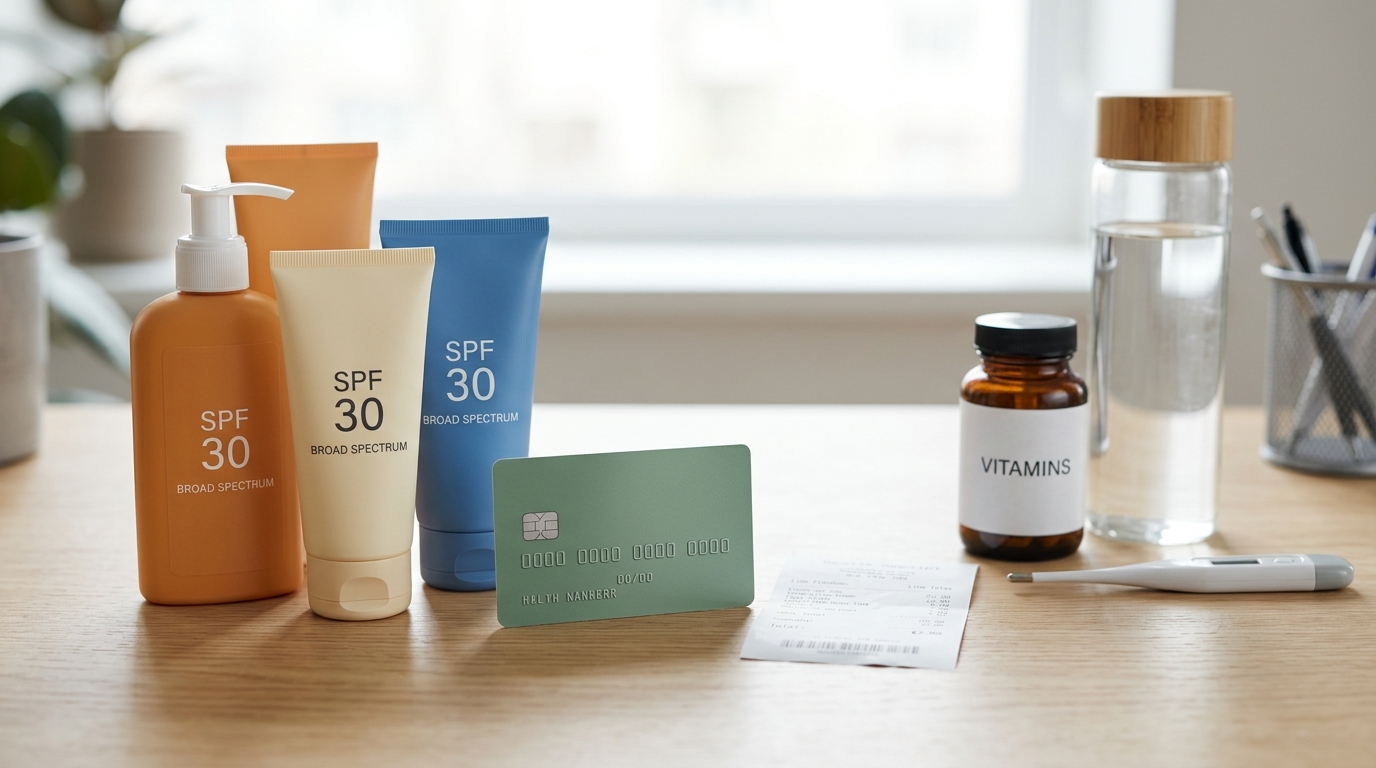
- Pay out of pocket and file for reimbursement. This one works basically anywhere, any store, any sunscreen brand, as long as it meets the SPF and broad spectrum requirement. Just keep your itemized receipt because your plan administrator can request it, and a credit card slip alone usually won’t cut it.
If your card gets declined on something you’re pretty sure qualifies, its often just a coding issue on the retailer’s end rather than an actual eligibility problem. Ask the pharmacist, or fall back on option three above.
FSA vs HSA vs HRA, Does It Matter for Sunscreen
Not really, at least not for eligibility purposes. Sunscreen that meets the SPF and broad spectrum requirement is reimbursable across Flexible Spending Accounts, Health Savings Accounts, and Health Reimbursement Arrangements. The one place it doesn’t fly is Dependent Care FSAs and Limited Purpose FSAs, since those are structured around totally different expense categories (childcare costs and vision/dental respectively).
Where FSA and HSA genuinely diverge isn’t the eligible-items list, its the account mechanics themselves:
- FSAs are usually employer sponsored and typically operate on a “use it or lose it” basis, sometimes with a small carryover allowed (for 2026 that carryover cap sits at $660)
- HSAs are tied to high deductible health plans, and unused funds roll over year to year indefinitely, no forfeiture deadline hanging over your head
So if you’re the type who forgets to spend down your FSA balance every December, stocking up on a few extra bottles of broad spectrum SPF 30 or 50 before the deadline is honestly one of the easiest, least wasteful ways to burn through leftover funds, because unlike, say, a fancy blood pressure cuff you’ll never use again, sunscreen is something most people are going to buy anyway.
Common Mistakes People Make With Sunscreen FSA Claims
A few patterns show up again and again when people get denied or confused:
- Assuming any SPF product automatically qualifies, when cosmetics with incidental SPF often don’t
- Not checking the broad spectrum label, since SPF alone without broad spectrum wording technically doesn’t meet the bar
- Tossing the receipt, then getting asked for documentation months later and having nothing to show
- Buying tanning oils or accelerators expecting them to count, they never do, sun protection and tanning are treated as opposite purposes entirely
- Assuming aloe vera gel counts as sun care, when in reality plain aloe without active medicinal ingredients like lidocaine is treated as general skincare, not FSA eligible
A Word From the Experts
The American Academy of Dermatology has been consistent in recommending broad spectrum protection with an SPF of 30 or higher, water resistance for anyone who’ll be swimming or sweating, and reapplication roughly every two hours regardless of how “long lasting” the label claims to be. A sunscreen might legally qualify at SPF 15, but most dermatology guidance nudges people well above that minimum for actual sun protection purposes, the FSA threshold and the medically ideal threshold aren’t quite the same number, worth keeping in mind.
Bottom Line
Sunscreen is FSA eligible, has been since the CARES Act removed the prescription requirement in 2020, and the rule really just comes down to two things, SPF 15 or higher and broad spectrum labeling. Most everyday sunscreens clear that bar without any issue, whether you’re grabbing a spray for the kids or a mineral stick for your face. The exceptions worth remembering are cosmetics with incidental SPF, tanning products, and after-sun items with no active ingredients, those tend to get flagged. When in doubt about a specific product, your plan administrator can confirm it in about thirty seconds, and honestly that’s a lot less stressful than finding out at the register.