

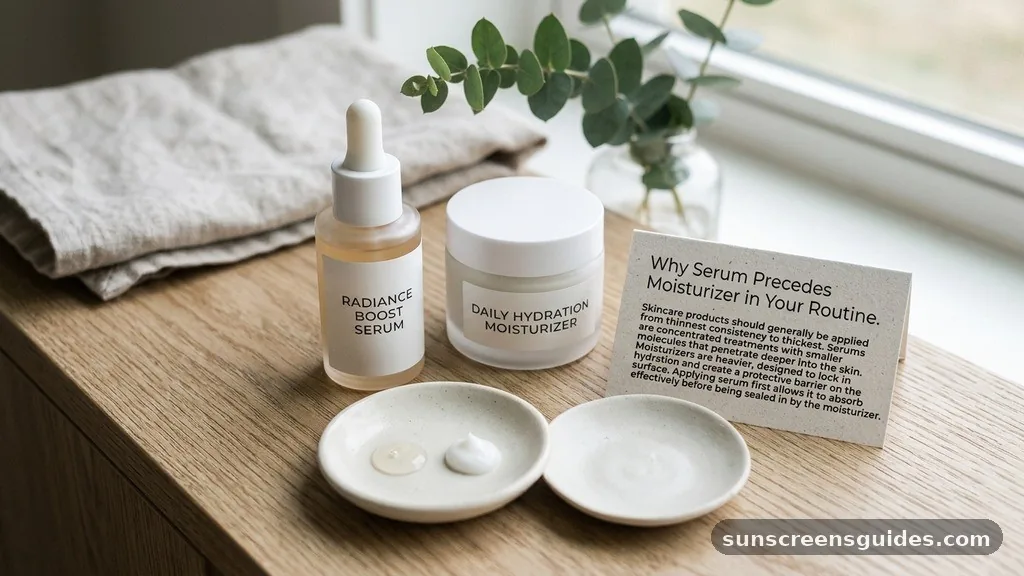
Determining whether you should apply a serum or a moisturizer first is the most common point of confusion in any daily skincare routine order. If you have ever stared at a lineup of bottles wondering about the sequence, you aren’t alone. The rule of thumb in dermatology is to apply products from the thinnest consistency to the thickest, which almost always means the serum goes on your skin before the heavier cream.
Understanding how these products interact with your skin barrier ensures that you get the most out of your investment in high-quality skincare. By following this simple layering principle, you allow your skin to drink up the potent actives before sealing them in.
Why Serum Precedes Moisturizer in Your Routine

You should always apply your serum before your moisturizer because serums are designed to penetrate deeply while moisturizers are formulated to lock everything in. A serum typically features a lower molecular weight, allowing it to sink into the dermis rapidly without leaving a thick residue on the surface. If you were to apply a heavy cream first, its thicker texture and occlusives would create a physical barrier that blocks the serum from ever reaching your pores.
Think of your skin like a sponge that needs to be hydrated before it can be protected. By applying water-based serums first, you provide your skin with a concentrated dose of active ingredients like antioxidants or peptides. Once these are absorbed, the moisturizer acts as an effective seal.
This simple sequence prevents trans-epidermal water loss, ensuring that your skin stays hydrated throughout the day rather than just sitting under a layer of grease. If you get the order wrong, you are essentially wasting expensive products because they simply cannot perform their intended function.
The Science of Molecular Weight and Absorption
The primary reason we prioritize specific product sequences involves the absorption rate of different chemical formulations. Most high-quality serums are engineered to be lightweight, often using humectants like hyaluronic acid to draw moisture into the deeper layers of the epidermis.
Because these molecules are tiny, they move past the surface barrier with ease. If you apply a thicker, oil-rich cream beforehand, the larger molecules in that cream clog the path, preventing the lighter serum molecules from traveling inward.
This hierarchy is essential for maintaining a healthy skin barrier. When you use products in the correct order, you optimize the delivery system of your skincare. For instance, a vitamin C serum needs direct contact with the skin to function as an effective antioxidant.
If you apply a thick moisturizer or a facial oil before the vitamin C, the serum will sit on top of the cream and likely oxidize before it can be absorbed. Always look at the viscosity of your products; if it is runny and translucent, it belongs early in your routine. If it is opaque and creamy, it belongs toward the end.
Balancing Active Ingredients and Skin Health

Integrating potent treatments like retinol or brightening acids requires careful attention to the sequence of application. Because these ingredients are often highly concentrated, they can be irritating if applied to damp or unprepared skin.
However, you still need to follow the thin-to-thick rule to ensure these actives reach the cellular level where they can actually trigger skin turnover or collagen production. Once these potent treatments have dried for a minute or two, applying a non-comedogenic moisturizer helps buffer the skin against potential irritation.
If you are using multiple serums, the order becomes even more important. You should layer them from the most liquid to the slightly more viscous, usually starting with your most targeted treatment.
A pH-balanced toner can be used before these steps to prep the surface, but the serum remains the heavy hitter in terms of active delivery. Using a moisturizer as the final step is non-negotiable because it provides the necessary lipids to repair the skin’s surface after the active ingredients have done their work.
| Product Type | Typical Consistency | Primary Function |
|---|---|---|
| Serum | Thin/Watery | Targeted treatment delivery |
| Moisturizer | Thick/Creamy | Barrier protection and sealing |
| Facial Oil | Viscous/Oily | Locking in moisture/Sealing |
Addressing Common Misconceptions About Layering
Many people believe that applying more products at once leads to better results, but this is a major topical gap in most routines. Over-layering serums can lead to “pilling,” where the product balls up on the skin instead of absorbing. This usually happens when you don’t wait for the first layer to dry completely.
You must allow each layer to settle for thirty to sixty seconds before moving to the next. If your skin feels tacky or greasy after you finish your morning routine, you have likely used too much product or chosen a moisturizer that is too heavy for your skin type.
Another common myth is that you can skip a moisturizer if your serum is hydrating enough. Even if your serum contains high concentrations of humectants, it lacks the occlusive properties required to prevent the environment from pulling moisture out of your skin.
Without an occlusive layer, your skin can actually become more dehydrated as the humectants evaporate. Always view the serum as the “treatment” and the moisturizer as the “protection.”
- Cleanse your face to remove debris and oils.
- Apply a toner if your skin requires pH balancing.
- Massage in your lightest serum (e.g., Vitamin C or Hyaluronic Acid).
- Wait for the serum to absorb completely until the skin is no longer tacky.
- Apply your moisturizer to lock in the hydration.
- Finish with SPF during the day to protect your skin barrier.
Frequently Asked Questions
Does the order change if I use a facial oil?
Yes, facial oils should almost always be the final step because their density prevents anything else from absorbing.
Can I mix my serum into my moisturizer?
While convenient, this can dilute the potency of active ingredients and prevent them from reaching deeper skin layers.
Should I wait between applying serum and moisturizer?
Waiting about one minute allows the serum to absorb, which prevents pilling and ensures maximum product efficacy.
What if my serum feels thicker than my moisturizer?
This is rare; if it happens, apply the product with the thinner, more watery consistency first regardless.
Is it necessary to use both a serum and a moisturizer?
For optimal skin health, yes, as serums treat specific concerns while moisturizers support the overall skin barrier.
Does night-time layering differ from the morning?
The logic remains the same, though your evening products may be richer or contain stronger active ingredients like retinol.
Can I apply serum on dry skin?
Most serums, especially those with hyaluronic acid, perform best when applied to slightly damp, clean skin for absorption.
Applying your products in the correct order is a small change that yields significant improvements in your skin’s health and appearance. By prioritizing the thin-to-thick sequence, you ensure that your active ingredients actually reach their destination rather than sitting uselessly on the surface. Remember that your skin barrier thrives on consistency and proper nourishment, so take the extra minute to let each layer soak in.
If you have been struggling with products that seem ineffective or cause pilling, try adjusting your sequence today. Your skin will thank you for the extra attention to detail. Feel free to reach out if you have questions about specific product combinations or need help refining your personal routine.



